The answer
“A182 F53 bolts” turns up regularly on super duplex datasheets and bolting lists. On its own, it does not define the acceptance requirements for finished studs and nuts. ASTM A182 covers forged piping components: flanges, fittings, valves and parts. F53 tells you the alloy (UNS S32750, 2507), but not how a stud or nut should be made, tested or marked.
For duplex and super duplex bolting there are two workable routes:
- ASTM A1082/A1082M, a bolting specification for precipitation-hardening and duplex stainless steels used in pressure equipment and other special-purpose service. It brings in the common bolting requirements of ASTM A962 and sets per-grade minimum properties and maximum hardness.
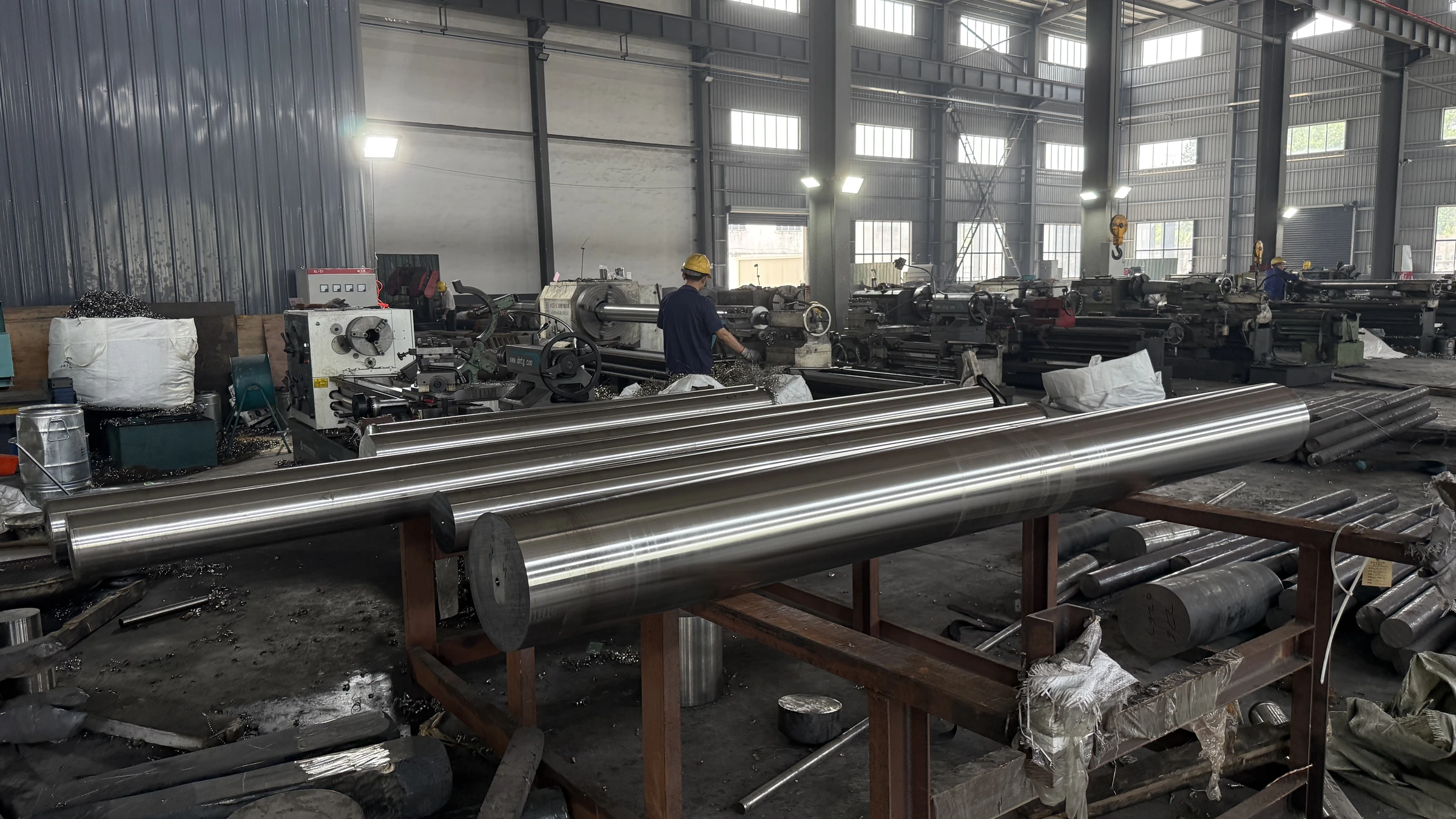
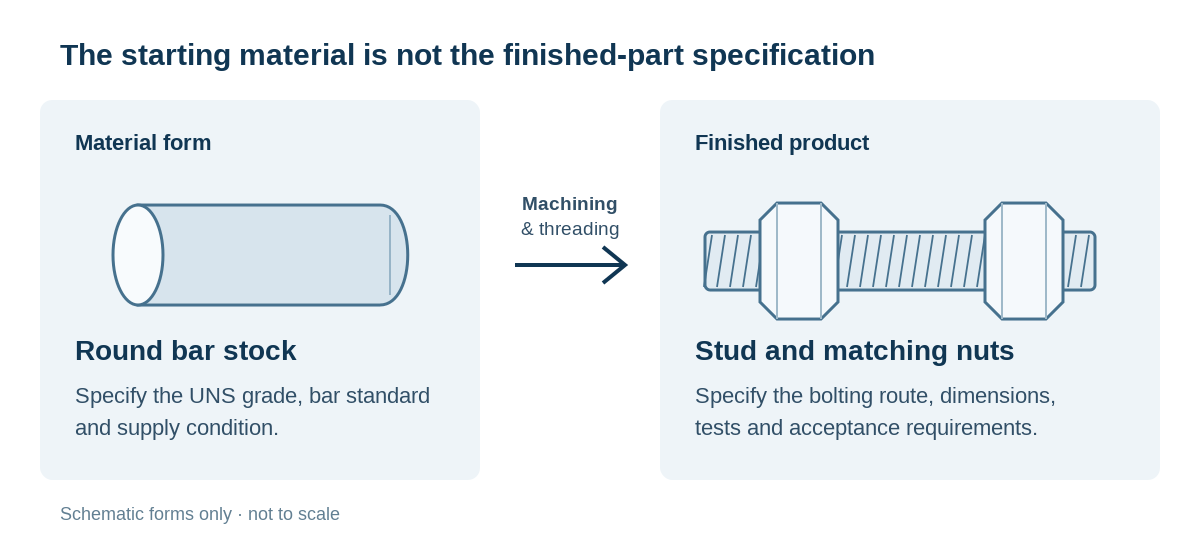
- A bar specification plus a dimensional standard, typically ASTM A479 (bar for boiler and pressure-vessel service) with ASME B18.31.2 studs and ASME B18.2.2 heavy hex nuts, and the project’s own test requirements.
A1082 is the cleaner choice when the buyer wants one specification to govern the finished bolting. The bar route is common where the project specification already sets ferrite, hardness and impact requirements.
For sour service, ISO 15156-3 sets environmental limits for solution-annealed duplex but no hardness limit. A 28 HRC cap, if your project has one, must be written on the PO.
Why “A182 F53” alone is not enough on a bolting line
The F-numbers are convenient shorthand: F51 = S31803, F60 = S32205, F53 = S32750, F55 = S32760. On a flange or valve body, A182 is the right specification. On a stud, it leaves questions that surface at inspection:
- A182 points most bar products elsewhere. Its scope refers bars and products machined directly from bar to A479, A739 or A511, except those the specification itself addresses (its section 6.4). Most studs are made from bar, so unless that exception applies, a stud certified only “A182 F53” is certified to a product form it was not made from.
- No bolting requirements. A182 is written for forgings. It does not carry the bolting-specific requirements that A1082 brings in through A962.
- The inspector cannot close it out. The certificate shows either a forging specification for a bar product, or a bar specification the PO never asked for. Either way it becomes a query.
Writing “A1082 S32750”, or “A479 S32750 bar, studs to ASME B18.31.2”, removes the ambiguity before the order is placed.
The routes compared
ASTM A1082 | A479 bar + dimensional standard | A276 bar + dimensional standard | A182 forging | |
|---|---|---|---|---|
Written for | Bolting (duplex and PH stainless) | Bars and shapes for boiler and pressure-vessel service | General-purpose stainless bars | Forged flanges, fittings, valves and parts |
Common bolting requirements (A962) | Yes | No | No | No |
Properties specified for | Bolting, per grade, with maximum hardness | Bar | Bar | Forgings |
Optional tests | S1 Charpy, S4 NDE, S5 proof load, S6 nut hardness | Per project specification | Per project specification | Per project specification |
Fit for a bolting PO | Yes | Yes, with project requirements | Only where pressure-vessel rules do not call for A479 | Not on its own |
Two routes to a complete bolting order
The finished parts can look the same. The purchasing documents define how they are accepted.
Where does A182 F53 fit?
A182 covers specified forged piping components, with scope exceptions. “A182 F53” alone does not define the complete finished-stud or nut acceptance requirements. Resolve the purchasing route before placing the order.
A1082 duplex grades: minimum properties
UNS | Common name | Solution treatment | Min. tensile | Min. yield | Min. elongation | Max. hardness |
|---|---|---|---|---|---|---|
S31803 | 2205 (F51) | 1900 °F (1040 °C) | 90 ksi (620 MPa) | 65 ksi (450 MPa) | 25% | 30 HRC / 290 HBW |
S32205 | 2205 (F60) | 1900 °F (1040 °C) | 95 ksi (655 MPa) | 65 ksi (450 MPa) | 25% | 30 HRC / 290 HBW |
S32750, up to 2 in | 2507 (F53) | 1880–2060 °F (1025–1125 °C) | 116 ksi (800 MPa) | 80 ksi (550 MPa) | 15% | 33 HRC / 310 HBW |
S32750, over 2 in | 2507 (F53) | 1880–2060 °F | 110 ksi (760 MPa) | 75 ksi (515 MPa) | 15% | 33 HRC / 310 HBW |
S32760 | Zeron 100 type (F55) | 2010 °F (1100 °C) | 109 ksi (750 MPa) | 80 ksi (550 MPa) | 25% | 30 HRC / 290 HBW |
S32550 | 255 type (F61) | 1900 °F (1040 °C) | 110 ksi (760 MPa) | 80 ksi (550 MPa) | 15% | 31 HRC / 297 HBW |
Values from ASTM A1082/A1082M-16(2021); material is water quenched after solution treatment. Check them against A1082/A1082M-26 before ordering.
Large 2507 studs are weaker. Above 2 in, S32750 drops to 75 ksi minimum yield, so a bolt-load calculation that assumed 80 ksi needs rechecking for those sizes.
“2507” is not always S32750. S32760 is often described loosely as a 2507-class super duplex, but it contains tungsten and copper, carries its own PREN requirement in A1082 (Cr + 3.3Mo + 16N ≥ 40) and has different minimums. Order by UNS number.
S31803 and S32205 are not identical either: S32205 has the higher minimum tensile strength. Dual-certified material meets both; see 2205 S31803 vs S32205 dual certification.
Strength compared with B7
Duplex studs often replace carbon or low-alloy steel bolting that has corroded, but they are not a like-for-like strength swap. ASTM A193 B7 has a 105 ksi (725 MPa) minimum yield in sizes up to 2-1/2 in. S32750 at 80 ksi gives about 76% of that, and 2205 at 65 ksi about 62%. Check the bolt load against the duplex yield before approving the substitution, and calculate new tightening values for the new material.
Duplex grades also have an upper temperature limit in the design codes. Check the maximum temperature your code allows for the grade before using it in hot service.
Phase balance, intermetallics and impact toughness
Duplex properties depend on holding the ferrite–austenite balance and avoiding sigma and other intermetallic phases during heat treatment and hot working. On a bolting PO that means settling three things:
- Ferrite content. ISO 15156-3 requires 35–65% ferrite for wrought solution-annealed duplex in sour service. Outside sour service, agree a range, a measurement method and the sample location.
- Detrimental phases. ASTM A923 gives three methods: A (etch examination), B (Charpy impact) and C (ferric chloride corrosion test). Acceptance criteria are not given for every grade, so check that the edition you cite covers yours.
- Impact toughness. A1082’s supplementary requirement S1 adds Charpy testing at a temperature the purchaser sets. On NORSOK projects, the test temperature and acceptance values come from the NORSOK M-630 material data sheet (MDS) for the grade, product form and size, so quote the MDS and its revision on the PO rather than a generic value. NORSOK also requires manufacturers of super duplex and other special materials to be qualified under M-650 for the relevant manufacturing route, within the range of their qualification test record (QTR). Ask for that status at the RFQ stage if your project invokes it.
Our duplex and super duplex heat treatment and inspection guide covers how to read these results and where specimens should come from.
Sour service: what ISO 15156-3 limits
For oil and gas production equipment exposed to H₂S, NACE MR0175/ISO 15156-3 covers duplex stainless steels in Table A.24. The values below are from the 2003 text. The current edition is ISO 15156-3:2020, and the table and limits in the edition your project invokes, with its technical circulars, are what govern.
- Metallurgical condition: solution annealed and liquid quenched, 35–65% ferrite, no aging heat treatment.
- Super duplex (40 < FPREN ≤ 45): maximum 232 °C (450 °F) and 20 kPa (3 psi) H₂S partial pressure. Within those limits, any combination of chloride concentration and in-situ pH found in production is acceptable. ISO 15156-3 calculates FPREN with its own formula, which is not the same as the A1082 PREN quoted above.
- 22Cr duplex (30 ≤ FPREN ≤ 40, Mo ≥ 1.5%): maximum 232 °C and 10 kPa (1.5 psi) H₂S partial pressure.
- Elemental sulfur: the table notes that no data were submitted for service with elemental sulfur present.
- Hardness: no limit for solution-annealed material. The earlier 28 HRC maximum was removed in the 2003 edition of MR0175. Cold-worked material is treated differently.
Many company and end-user specifications still carry 28 HRC for 2507. That is a project cap, not an ISO 15156 requirement. It is tighter than A1082’s 33 HRC, so it has to appear on the PO, with hardness reported against it on the certificate.
Refinery equipment falls under a different standard, NACE MR0103/ISO 17945. Langley Alloys reports a 32 HRC maximum for wrought super duplex under MR0103-2015.
For nickel-alloy alternatives in sour service, see nickel alloy fasteners for sour service.
Subsea bolting under cathodic protection
Duplex and super duplex components installed subsea and exposed to cathodic protection can fail by hydrogen-induced stress cracking (HISC). The design practice for this is DNV-RP-F112 (edition 2019-09, amended 2021-09). It addresses design stresses and strains, not material purchasing, but if your bolting will sit under CP, the project’s HISC assessment should cover it before duplex is chosen.
Nuts and galling
- Same grade for nuts. A 316 nut on a 2507 stud is weaker, and it puts the least corrosion-resistant part where seawater crevice attack starts. Order nuts in the same UNS grade. A1082 includes supplementary requirement S6 for cross-sectional hardness testing of nuts, so the specification anticipates nuts made to it; check the nut requirements in the edition you cite.
- Galling. Duplex on duplex galls under high preload, as nickel alloys do. Thread fit, lubricant and a controlled tightening speed are what prevent it; see nickel alloy fastener galling.
PO wording
- UNS number, not “2507” or “F53” alone.
- Bolting specification and edition (A1082/A1082M-26), or bar specification (A479) plus dimensional standard.
- Size, thread series and class, and length per ASME B18.31.2 (studs) and ASME B18.2.2 (heavy hex nuts).
- Supplementary requirements: S1 Charpy with test temperature and acceptance values; S6 for nuts if wanted.
- Ferrite range and method, if your project requires it.
- Any hardness cap tighter than the specification, such as 28 HRC.
- Sour-service declaration (NACE MR0175/ISO 15156-3) if the bolting will be exposed to H₂S.
- Certification: EN 10204 3.1 with heat number, solution-treatment record, tensile and hardness results.
Example line item, A1082 route:
Stud bolts, 1”-8 UNC-2A × 7”, ASTM A1082/A1082M-26, UNS S32750, solution annealed and water quenched, dimensions per ASME B18.31.2, each with 2 heavy hex nuts ASTM A1082 UNS S32750 per ASME B18.2.2. Supplementary requirement S1, Charpy test temperature and acceptance per project MDS/specification. Hardness 28 HRC max (project requirement). EN 10204 3.1 certificate.
Example line item, bar route:
Stud bolts, 1”-8 UNC-2A × 7”, made from ASTM A479 UNS S32750 bar, solution annealed, threads cut or rolled, dimensions per ASME B18.31.2. Each with 2 heavy hex nuts machined from ASTM A479 UNS S32750 bar, solution annealed, dimensions per ASME B18.2.2. For studs and nuts: tensile and hardness results for each bar heat, hardness on finished parts per project sampling plan, ferrite 35–65% by ASTM E562 on bar from each heat. EN 10204 3.1 certificate.
FAQ
Is ASTM A1082 the same as A182 F53? No. A1082 is a bolting specification. A182 is a forging specification for flanges, fittings and valve parts; F53 identifies the alloy, UNS S32750.
What is the maximum hardness for super duplex bolts? Under A1082, 33 HRC (310 HBW) for S32750 and 30 HRC (290 HBW) for S32760. ISO 15156-3 sets no hardness limit for solution-annealed duplex, so a 28 HRC limit, where it appears, is a project requirement.
Can 2507 studs replace B7 on the same flange? Only after the bolt load is rechecked. S32750’s minimum yield is about three-quarters of B7’s.
Related products and materials
- Super duplex 2507: material page · stud bolts · heavy hex nuts · stud and nut sets
- Super duplex S32760: material page · stud bolts · heavy hex nuts
- Duplex 2205: material page · stud bolts · heavy hex nuts
- Industry: offshore and marine
Quote duplex and super duplex bolting
Paste the bolting line from your datasheet or PO, even if it says “A182 F53”. We will suggest the bolting or bar specification it should cite and send that as a technical query for your written approval before we quote on it. Include any project hardness cap, Charpy temperature and ferrite requirement. Tests beyond the tensile and hardness results on the certificate are quoted separately. Certificates are EN 10204 3.1, and bolting is supplied uncoated. PMI is done on a sampling basis as standard; 100% PMI or third-party inspection can be arranged on request. Lead time is confirmed on the quote. Minimum order is 100 pieces per item.
References
- ASTM A1082/A1082M-26, High strength precipitation hardening and duplex stainless steel bolting for special purpose applications: https://store.astm.org/a1082_a1082m-26.html
- ASTM A962/A962M-26, Common requirements for bolting: https://store.astm.org/a0962_a0962m-26.html
- ASTM A182/A182M (scope, incl. §1.2 on bar products), 2011 sample: https://cdn.standards.iteh.ai/samples/77253/189bbfbdf42c46599ba5365d6ae0ae55/ASTM-A182-A182M-11.pdf
- ASTM A193/A193M, Alloy-steel and stainless steel bolting for high temperature or high pressure service: https://webstore.ansi.org/standards/astm/astma193a193m08a
- NACE MR0175/ISO 15156-3 (2003 text, Table A.24 and A.7): https://www.octalsteel.com/wp-content/uploads/2017/10/NACE-MR0175-ISO15156-specification.pdf
- ISO 15156-3:2020 (current edition): https://standards.iteh.ai/catalog/standards/iso/0e72f9c7-95e8-45d3-bdbb-53d66f52a5a2/iso-15156-3-2020
- Swagelok, NACE MR0175/ISO 15156 environmental limits (2507, Table A.24): https://www.swagelok.com/downloads/webcatalogs/en/ms-06-124.pdf
- Rolled Alloys, The selection of super duplex stainless steel (MR0175 hardness history, NORSOK Charpy and M-650): https://www.rolledalloys.ca/wp-content/uploads/The-Selection-Of-Super-Duplex-Stainless-Steel-rolled-alloys.pdf
- Langley Alloys, A479 grades and F-numbers: https://www.langleyalloys.com/?p=238
- Langley Alloys, Hardness of S32750 (A479 and MR0103 limits): https://www.langleyalloys.com/technical-resources/what-is-the-hardness-of-s32750/
- DNV-RP-F112, Duplex stainless steel – design against hydrogen induced stress cracking: https://www.dnv.com/oilgas/download/dnv-rp-f112-duplex-stainless-steel-design-against-hydrogen-induced-stress-cracking.html