The short version
ASTM A453 Grade 660 is A286 (UNS S66286). The class records how the material was heat-treated, and so what kind of joint it was made for.
660A, 660B, 660C and 660D are shorthand for ASTM A453 Grade 660 Classes A, B, C and D. For example, 660B corresponds to “A453 Gr 660 Cl B”. State the full grade and class on the purchase order.
- Class A: solution treated at 1650 °F (900 °C), liquid quenched, aged at 1325 °F (720 °C). Minimum 130 ksi (895 MPa) tensile and 85 ksi (585 MPa) yield, the same as B and C. The lower solution temperature favors room-temperature strength and ductility.
- Class B: solution treated at 1800 °F (980 °C), liquid quenched, aged at 1325 °F. The higher solution temperature gives the best creep-rupture strength.
- Class C: solution treated at 1800 °F with an oil quench, then double aged at 1425 °F and 1200 °F. It is a variant of the 1800 °F route.
- Class D: either solution route, aged at 1325 °F, with a second age at 1200 °F if needed to reach a higher minimum: 105 ksi (725 MPa) yield up to 2-1/2 in (63.5 mm), with a lower hardness ceiling. Class D is not stress-rupture tested and is stamped “NR”.
Classes A, B and C must meet a stress-rupture requirement at 1200 °F (650 °C) for design temperatures above 800 °F (427 °C). Any material that has not been stress-rupture tested is stamped NR.
In practice, Class D suits joints below about 800 °F where clamp load is the main concern, and Class B (or C, where the end user’s specification calls for it) suits joints where creep governs. If a drawing just says “A453 660”, get the class confirmed before the RFQ goes out rather than leaving the supplier to choose. Name the edition on the PO; the current one is ASTM A453/A453M-26.
The four classes side by side: 660A, 660B, 660C and 660D
Class A (660A) | Class B (660B) | Class C (660C) | Class D (660D) | |
|---|---|---|---|---|
Solution treatment | 1650 ± 25 °F (900 ± 14 °C), 2 h min, liquid quench | 1800 ± 25 °F (980 ± 14 °C), 1 h min, liquid quench | 1800 ± 25 °F, 1 h min, oil quench | 1650 °F / 2 h or 1800 °F / 1 h, liquid quench |
Aging | 1325 ± 25 °F (720 ± 14 °C), 16 h, air cool | 1325 °F, 16 h, air cool | 1425 °F (775 °C), 16 h, air cool, then 1200 °F (650 °C), 16 h, air cool | 1325 °F, 16 h; second age at 1200 °F, 16 h, if needed to meet properties |
Min. tensile | 130 ksi (895 MPa) | 130 ksi | 130 ksi | 130 ksi up to 2-1/2 in; 120 ksi (825 MPa) over 2-1/2 in |
Min. yield (0.2%) | 85 ksi (585 MPa) | 85 ksi | 85 ksi | 105 ksi (725 MPa) up to 2-1/2 in; 95 ksi (655 MPa) over 2-1/2 in |
Elongation / RA, min | 15% / 18% | 15% / 18% | 15% / 18% | 15% / 18% |
Hardness | 248–341 HBW (approx. 24–37 HRC) | 248–341 HBW | 248–341 HBW | 248–321 HBW (approx. 24–35 HRC) |
Stress-rupture test | Required for design temperatures above 800 °F; untested material stamped NR | Same | Same | Not required; stamped NR |
Compare the Grade 660 routes
Choose a class to see its heat-treatment sequence and what the strength result does—and does not—show.
Sequence schematic using the earlier-edition values cited in the article. It shows process order, not heating rates or a complete furnace cycle.
Values from earlier editions of ASTM A453/A453M (2004 text; Class D size split from the 2017 edition). Check them against A453/A453M-26 before ordering. Stress-rupture requirement for Classes A, B and C: 1200 °F (650 °C), 56 ksi (385 MPa), at least 100 hours to rupture, at least 5% elongation.
Buyers holding aerospace drawings will see AMS numbers instead. AMS 5737 uses the 1650 °F route with higher minimums (140 ksi tensile, 95 ksi yield). AMS 5732 uses the 1800 °F route with the same 130/85 ksi minimums as Class B. Neither is interchangeable with an A453 class without checking the test requirements.
What the solution temperature changes
Within Classes A to C, the main variable is the solution temperature, which sets the microstructure before aging. Supplier literature sums up the effect: the 1800 °F treatment gives the highest creep-rupture strength after aging, and the 1650 °F treatment gives better ductility and room-temperature strength.
NASA’s A-286 data compilation shows the size of the gap in typical properties: about 157 ksi tensile and 102 ksi yield after 1650 °F plus aging, against about 145 ksi and 95 ksi after 1800 °F plus aging. These are typical results, not specification minimums. A453 holds Classes A, B and C to the same 130/85 ksi floor, so on a test certificate the three can look alike while behaving differently at temperature.
That is why the class has to be specified rather than inferred from a certificate. Our A286 fastener heat treatment guide covers the metallurgy, including why a matching hardness result does not prove the same heat-treatment route.
Class D: more preload, no rupture evidence
Class D is aimed at joints where clamp load matters more than long-term creep. Its 105 ksi minimum yield is about 24% higher than the 85 ksi of Classes A to C. At the same ratio of bolt stress to yield, that means more preload from the same stud, or the same preload from a smaller one.
That 105 ksi figure comes with three conditions:
- It applies only up to 2-1/2 in. Above that, Class D drops to 95 ksi yield and 120 ksi tensile. Its yield is still above the 85 ksi of Classes A to C, but its tensile minimum is now below their 130 ksi, and a large-stud design that assumed 105 ksi will come up short on preload.
- The hardness ceiling is lower: 321 HBW against 341 HBW for the other classes.
- There is no stress-rupture test. Using Class D above 800 °F is a decision for the designer to make and document. A supplier should not offer Class D as a substitute on a hot-service order.
How A286 strength holds up with temperature is covered in A286 yield strength vs temperature.
Choosing a class
Joint condition | Class to specify | Add to the PO |
|---|---|---|
Design temperature at or below 800 °F (427 °C), clamp load governs (compressor, pump and valve bolting) | D | Bolt size, so the right Class D minimums apply |
Design temperature above 800 °F, long holds, creep or relaxation governs (turbine casings, hot flanges) | B, or C where the end user’s specification calls for it | Design temperature and the stress-rupture test |
Room-temperature strength governs, or the project specification calls for the 1650 °F route | A | Stress-rupture test if the design temperature is above 800 °F |
Bolting exposed to H₂S | Any class, within the ISO 15156-3 limits below | 35 HRC maximum, by Rockwell C test |
Replacement for existing bolting | Same class as the original record | Treat any class change as a deviation for approval |
For pressure-boundary bolting, also check that the class you choose has allowable stresses in the design code you are working to (ASME Section II Part D, or B31.3 for piping). This matters most for Class D.
Sour service
Table A.26 of the 2003 text of NACE MR0175/ISO 15156-3 listed A286 (UNS S66286) in the solution-annealed and aged, or solution-annealed and double-aged, condition at 35 HRC maximum, with environmental limits of 65 °C (150 °F) and 100 kPa (15 psi) H₂S partial pressure, any chloride and in-situ pH combination within those limits, and no rating for elemental sulfur. The current edition is ISO 15156-3:2020. The table and limits in the edition your project invokes, with its technical circulars, are what govern.
Two consequences for the PO:
- The Table A.26 limits cited above do not cover service above 65 °C. Using A286 outside that envelope needs qualification and acceptance by the equipment user under the standard the project invokes, so do not assume hot sour bolting is covered.
- Classes A, B and C allow hardness up to about 37 HRC, so a sour-service order needs “35 HRC max” written on the PO and tested by Rockwell C. Class D’s table maximum corresponds to about 35 HRC, but the HRC values in A453 are approximate conversions, so specify the Rockwell test as well.
For nickel alloys in sour service, see nickel alloy fasteners for sour service.
Temperature ceiling
The same NASA compilation gives A286 a useful service range up to about 1300 °F (704 °C). Where a joint needs more strength at temperature than A286 can give, compare it with Alloy 718 in A286 vs 718 fasteners.
For long-term loaded service, the temperature range is lower: Rolled Alloys describes high-strength service to about 1000 °F (540 °C) for long durations. Treat the higher temperature figures as short-time context; assess the actual load and duration. See A286 turbine-bolt temperature and class requirements.
Thread types R1, R2, M1 and M2
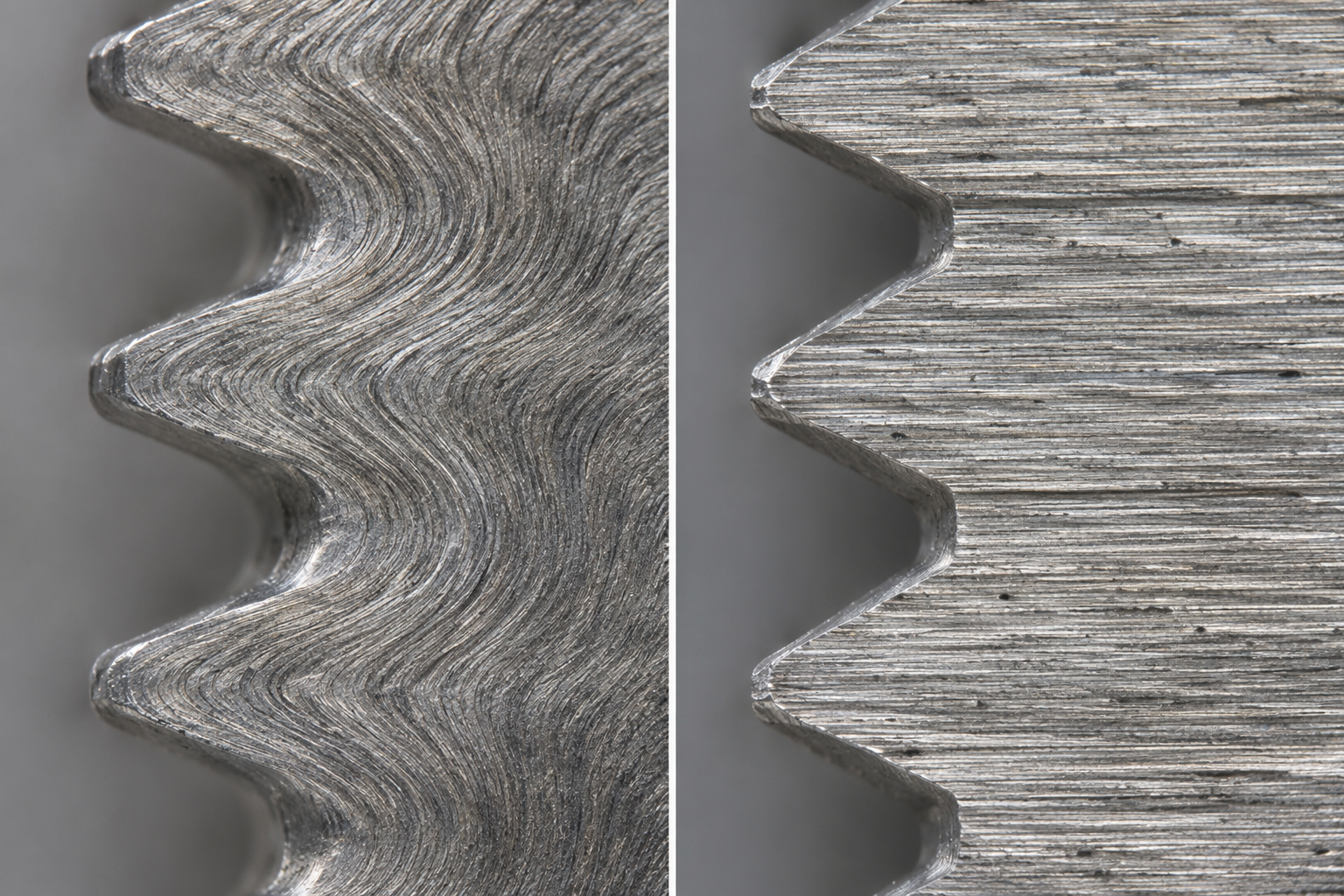
A453 also asks the purchaser to state how and when the threads are made:
- R = rolled threads; M = machined (cut) threads.
- Type 1 (R1, M1): threaded after the precipitation (aging) treatment.
- Type 2 (R2, M2): threaded after solution treatment but before aging.
A 2001 Lockheed Martin report by A. R. Kephart found that threads rolled after the strengthening heat treatment had better resistance to stress-corrosion crack initiation, notes that the fatigue benefit of rolling depends on that same sequence, and describes it as the basis of aerospace fastener process controls. Which type to order should still come from the drawing and from a manufacturing process qualified for it, not from a blanket rule. If the PO is silent, the manufacturer chooses, and the type must be marked on the product. Rolling after aging (R1) also raises the hardness of the threads, which matters for Class D and for sour-service hardness limits; see rolled vs cut threads.
Nuts and washers
A453 covers nuts and washers as well as bolts, studs and bar. In most A286 joints the nuts are made in the same grade and class as the studs, so their properties come from the same heat-treatment route. Bar for machined nuts is often supplied to ASTM A638 Grade 660, whose Type 2 corresponds to the 1800 °F solution-and-age route used for Class B.
A286 nuts on A286 studs can gall under high preload. The controls are the same as for nickel alloys; see nickel alloy fastener galling.
Ordering A453 Grade 660 bolting
A complete line for A286 bolting states:
- Quantity and product: studs, bolts, nuts, washers or bar.
- Grade 660 and the class: A, B, C or D.
- Specification edition, for example A453/A453M-26.
- Design temperature, which decides whether stress-rupture testing applies.
- Thread type: R1, R2, M1 or M2.
- Stress-rupture testing for Classes A to C where the design temperature is above 800 °F (not applicable to Class D).
- Dimensional standard, size, thread series and class, for example ASME B18.31.2 studs with ASME B18.2.2 heavy hex nuts.
- Hardness limit and test method if the bolting is for H₂S service.
- Certification: EN 10204 3.1 showing heat number, class, tensile and hardness results, and the stress-rupture result where tested. See material certificates and PMI.
Example line item:
Stud bolts, 3/4”-10 UNC-2A × 5”, ASTM A453/A453M-26 Grade 660 Class B, Type R1, stress-rupture tested, dimensions per ASME B18.31.2, each with 2 heavy hex nuts ASTM A453 Grade 660 Class B per ASME B18.2.2. Design temperature 1000 °F. EN 10204 3.1 certificate.
Common questions
Is A453 Grade 660 the same as A286? Yes. Grade 660 is UNS S66286, the alloy sold as A286. A453 adds the heat-treatment class, test requirements and marking.
What do 660A, 660B, 660C and 660D mean? They are shorthand for ASTM A453 Grade 660 Classes A, B, C and D. The class identifies the specified heat treatment and associated mechanical-property and test requirements; it is not a simple strength ranking.
Can Class D replace Class B? Only where the design temperature does not call for rupture properties and the engineer of record accepts it. Class D has higher yield but no stress-rupture test.
What does “NR” stamped on an A286 bolt mean? It means the material was not stress-rupture tested. All Class D bolting carries it. Classes A to C carry it whenever the test was not performed, for example because the design temperature did not call for it or the order did not require it.
Related products and materials
- A286 stud bolts · double-end studs · hex bolts · 12-point flange bolts · heavy hex nuts · washers
- Application: A286 12-point flange bolts for turbines
- Hot joints: high-temperature fastener preload and creep
- Industry: power and turbines
Quote A453 Grade 660 bolting
Send the drawing or the bolting line from your datasheet, with the design temperature. If the class is not stated, we will ask before quoting rather than pick one for you. Tell us at the RFQ stage whether stress-rupture testing is required. Lead time, including any testing, is confirmed on the quote. Bolting is supplied uncoated with an EN 10204 3.1 certificate. PMI is done on a sampling basis as standard; 100% PMI or third-party inspection can be arranged on request. Minimum order is 100 pieces per item.
References
- ASTM A453/A453M-26, High-temperature bolting with expansion coefficients comparable to austenitic stainless steels: https://store.astm.org/a0453_a0453m-26.html
- ASTM A962/A962M-26, Common requirements for bolting: https://store.astm.org/a0962_a0962m-26.html
- NACE MR0175/ISO 15156-3 (2003 text, Table A.26 for UNS S66286): https://www.octalsteel.com/wp-content/uploads/2017/10/NACE-MR0175-ISO15156-specification.pdf
- ISO 15156-3:2020 (current edition): https://standards.iteh.ai/catalog/standards/iso/0e72f9c7-95e8-45d3-bdbb-53d66f52a5a2/iso-15156-3-2020
- NASA, A-286 data compilation (typical properties, service temperature): https://ntrs.nasa.gov/api/citations/19720022813/downloads/19720022813.pdf
- A. R. Kephart, Optimum thread rolling process that improves SCC resistance, Lockheed Martin, 2001: https://digital.library.unt.edu/ark:/67531/metadc781924/m2/1/high_res_d/821687.pdf
- Wieland Diversified, A-286 (1650 °F vs 1800 °F solution treatment; AMS 5737 and AMS 5732): https://www.wieland-diversified.com/stainless-steel-extra/a-286-alloys/