
This guide compares Inconel 625 and super duplex 2507 for the same job: a seawater flange stud set that must seal, survive crevices, and come apart again at the next turnaround without a shutdown caused by a seized or pitted set.
The choice is not a grade ranking. It is a match between four joint facts, crevice severity, stud temperature, cathodic protection, and the load the joint must seat, and the strength and corrosion limits of each alloy.
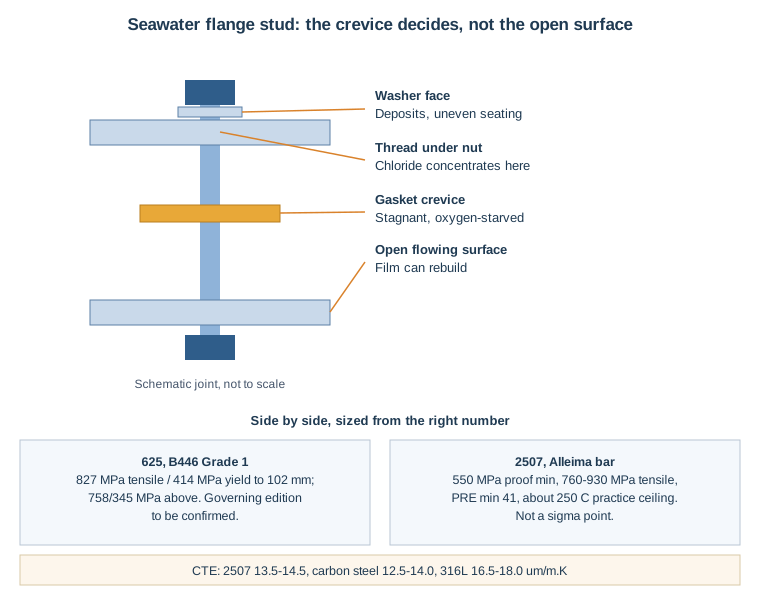
Figure: Seawater flange stud — the crevice decides the grade; 625 and 2507 compared on the numbers the joint is sized from.
01 Why the crevice, not the open surface, decides the grade
Pitting starts where chloride can concentrate. On an open, flowing surface, seawater washes the surface and a passive film can rebuild. In a tight crevice, under a nut, under a washer, at a gasket face, or under a deposit, the fluid is stagnant and oxygen-starved. The chemistry inside that crevice turns aggressive, and attack concentrates there while the open surface still looks fine. That is why a grade that passes a flowing seawater test can still pit in a real flange: the test did not include the crevice the flange creates.
Crevice attack also starts below the pitting temperature. A temperature that looks safe for open-surface pitting can already be unsafe inside a gasket crevice, especially where biofouling, deposits, or chlorination add to the local chemistry. State the temperature at the stud, the chloride level, whether the seawater is chlorinated, and whether the joint sees flowing, stagnant, or de-aerated seawater. Each of those changes the answer, and "seawater" alone does not describe them all.
De-aerated seawater deserves a separate line on the order. Neither grade should be assumed to cover de-aerated service on its flowing-seawater record: confirm the de-aerated chemistry and temperature against the project specification, and treat 625 as the escalation to check, not as a proved answer for every de-aerated condition.
02 The two alloys, side by side
Inconel 625, UNS N06625, is a solid-solution nickel-chromium-molybdenum-niobium alloy, to ASTM B446 as a bar and material specification. Special Metals' INCONEL alloy 625 bulletin lists nickel at 58% minimum, chromium at 20–23%, molybdenum at 8–10%, and niobium plus tantalum at 3.15–4.15%. The same bulletin gives annealed rod, bar, and plate composites of 120–150 ksi tensile and 60–95 ksi yield, and states that those composites are not suitable for specification purposes. The order therefore uses the ASTM B446 Grade 1 standard figures, to be confirmed against the governing edition: 827 MPa tensile / 414 MPa yield to 102 mm, and 758 MPa tensile / 345 MPa yield above. Its high molybdenum content helps it resist pitting and crevice attack, and its high nickel content helps it resist chloride stress corrosion cracking. Annealed 625 is a corrosion-first grade, not a high-strength grade. A joint must be sized for that strength, not swapped like-for-like with a stronger stud.
Super duplex 2507, UNS S32750, is a ferritic-austenitic stainless steel, to ASTM A479 as a bar specification and ASTM A182 F53 as a forging specification. Alleima's SAF 2507 bar datasheet lists a solution-annealed and quenched bar with a 0.2% proof strength minimum of 550 MPa, a tensile range of 760–930 MPa, elongation of at least 25%, a hardness maximum of 28 HRC, and a ferrite content of 35–55%. The same datasheet defines the pitting resistance equivalent as PRE = %Cr + 3.3 × %Mo + 16 × %N, and gives a minimum PRE value of 41 for SAF 2507. PRE is a chemistry screen, not a specification: it says nothing on its own about crevices, temperature, or aeration.
Temperature is where 2507 needs a hard boundary. The Alleima bar datasheet states that prolonged exposure above 250°C changes the microstructure and reduces impact strength. Treat about 250°C continuous as a conservative long-term practice limit for chloride service. Above that band, low-temperature 475°C embrittlement, where ferrite decomposes and loses toughness across roughly 250–550°C, is the mechanism to watch, while sigma-phase embrittlement is a higher-temperature, roughly 600–1,000°C, fabrication and excursion risk, not the mechanism that suddenly appears at 250°C. That practice ceiling matters for a process flange that is not just a cold seawater line. State the stud temperature, not just the fluid temperature, and check it against that ceiling and the project code limit before choosing 2507.
Thermal expansion is the second quantified contrast. The Alleima bar datasheet gives mean linear expansion for SAF 2507 of about 13.5 µm/m·K over 30–100°C, rising to about 14.5 over 30–400°C, against about 12.5–14.0 for carbon steel over the same bands, and about 16.5–18.0 for 316L. A 2507 stud set on a carbon steel flange therefore grows at nearly the same rate as the flange, while a 316L set grows measurably more, a real seating and preload consideration at temperature.
A third candidate frames the replacement decision. A 316L set, UNS S31603, bolting to ASTM A193 B8M or ISO 3506 A4, is often the set being replaced, not a peer in this comparison. Do not size a replacement set from the old 316L dimensions alone: state the chloride level, temperature, and crevice condition that pitted the old set, and check whether the new grade, size, and preload actually change that outcome.
| Property | Inconel 625, UNS N06625 | Super duplex 2507, UNS S32750 |
|---|---|---|
| Strengthening | Solid solution, no ageing step to get wrong | Ferritic-austenitic, 35–55% ferrite in the solution-annealed and quenched condition |
| Strength, standard or mill-bar condition | ASTM B446 Grade 1: 827 MPa tensile / 414 MPa yield to 102 mm, 758 MPa tensile / 345 MPa yield above, to be confirmed against the governing edition | Alleima bar: 0.2% proof strength minimum 550 MPa, tensile 760–930 MPa, elongation at least 25%, hardness maximum 28 HRC |
| PRE, chemistry screen only | No PRE number is stated for 625 in this guide; the mill bulletin composition, 20–23% Cr and 8–10% Mo, is the number the order can check | Minimum PRE 41, defined as %Cr + 3.3 × %Mo + 16 × %N |
| Crevice behaviour | Strong crevice resistance in seawater in many cases, but not immune: crevice risk rises with temperature, so still state the actual stud temperature | Crevice attack starts below the pitting temperature; gasket and washer crevices are the risk |
| Temperature ceiling in chloride service | No equivalent 250°C-type practice ceiling applies in this comparison | About 250°C continuous as a conservative practice limit; prolonged exposure above 250°C changes the microstructure and reduces impact strength |
| Thermal expansion | Size the joint from the flange pairing and the stud temperature, not from a generic nickel-alloy value | About 13.5–14.5 µm/m·K, close to carbon steel at about 12.5–14.0, well below 316L at about 16.5–18.0 |
| Cathodic protection risk | Lower ferrite-related hydrogen-cracking risk, but state the CP system for confirmation | Hydrogen-induced stress cracking risk in ferrite under CP, especially coarse grain, high stress, and potentials near -1.0 V, as described in TWI's cathodic protection FAQ for duplex steels |
| De-aerated seawater | The escalation to check against the actual de-aerated chemistry and temperature, not a standing answer for every de-aerated condition | Confirm the aeration condition on the order; do not assume the flowing-seawater record covers de-aerated service |
03 Set cost is not kilograms times price
A cheaper kilogram price does not always make a cheaper set. Set cost is material, machining, inspection, and the cost of the next intervention added together. A 2507 set can use a smaller diameter for the same tensile load, since the number the stud is sized from is 550 MPa proof strength against 414 MPa yield for 625 to 102 mm, which can narrow the material gap, subject to stiffness, seating, and thread-engagement checks. A 625 set can cost more per kilogram, yet last longer in a severe crevice, need fewer replacements, and avoid a shutdown caused by a seized set.
Use price only as a screening range, not as a quote. No kilogram-price ratio is stated in this guide: pipe-mill ratios do not predict stud-set prices, where machining, threading, testing, and small-batch handling dominate. Order the set that fits the crevice, temperature, CP, and load case, then compare quoted set prices for that exact set, not for a kilogram of bar.
04 Choose by the joint, in this order
| Check | Pick 625 when | Pick 2507 when |
|---|---|---|
| Main driver | H₂S outside the qualified 2507 envelope governs, to be confirmed against NACE MR0175 / ISO 15156 | Load and cost govern, and the crevice and temperature limits are met |
| Temperature | Stud temperature is above the 2507 ceiling, or the margin is thin | Stud temperature is well below about 250°C, with margin for a hot excursion |
| Crevice and chlorination | Gasket, washer, or under-deposit crevices are severe, or chlorination is continuous | Crevices are controlled, chlorination is limited, and the joint can be inspected |
| Cathodic protection | CP potential or qualification for 2507 is uncertain | CP system, potential with its reference electrode, austenite spacing, and a current DNV-RP-F112 assessment have been checked for 2507 |
| Load and size | The joint can be sized for 414 MPa yield to 102 mm, or a larger diameter is acceptable | A smaller, stronger stud is needed to seat the gasket within the existing bolt circle |
| Set cost | A longer life in a severe crevice outweighs a higher kilogram price | The quoted set price, for the exact set, is lower and the life in that crevice is acceptable |
At turnaround, inspect the removed set by location, not as a mixed pile. Note pitting under each nut and washer separately, measure thread condition, and record whether the set came off by hand, with a normal tool, or only after cutting. That location record is what turns the next order from a grade swap into a targeted fix: a set that pitted only under the washer needs a washer, crevice, or lubricant change, while a set that pitted everywhere needs a different alloy or a different seawater condition.
A bar specification alone does not define a finished stud. State the finished-stud dimensions per ASME B16.5, the thread form and class, using a rounded-root form such as UNR or UNJ, the nut pairing, and the finished-part testing on the project stud specification. For a 2507 set under CP, add the austenite-spacing requirement and the strain assessment under DNV-RP-F112 (now DNVGL-RP-F112), current edition at the project date. Thread seizure is a separate assembly risk: Bossard's galling technical note describes how a broken oxide layer lets stainless thread surfaces lock together, which is why lubricant and thread finish belong in the same enquiry. That note covers stainless threads only.
Send the flange material, the seawater condition, the stud temperature, and the CP details to the BYBOLT engineering team for a check before ordering. That check is where a 2507 set is caught above its temperature ceiling, a 625 set is caught undersized for the load, or a nut pairing is caught that changes the crevice or galvanic picture at the joint.
At receipt, the BYBOLT documentation package should tie each stud set to its heat, its heat-treatment or microstructure record where specified, and its hardness report. Ask for EN 10204 3.1 certificates, a dimensional report for the actual studs, and a PMI report where the project requires it. A bar certificate alone does not prove the finished stud meets the temperature, CP, or crevice assumptions the joint was sized on.
| What to lock before ordering | Why it changes the joint | Document to ask for |
|---|---|---|
| Seawater condition per location | Flowing, stagnant, chlorinated and de-aerated seawater are different services | Joint exposure datasheet, per location |
| Stud temperature and crevice type | Decides 625 versus 2507, and whether the 2507 ceiling is met | Process datasheet, stud temperature stated separately |
| CP system, potential and reference electrode | Decides hydrogen risk for 2507, and whether qualification is needed | CP design datasheet, potential range and electrode stated |
| Load, stud size and nut match | A weaker grade swapped at the same size can under-seat the gasket | Joint load calculation, nut standard and condition |
| Thread form, engagement and lubricant | Galling or short engagement can ruin a sound alloy choice | Drawing with both ends dimensioned, approved lubricant |
| Set list and records | Mixed sets on deck cannot be audited after a leak | Set list by flange position, EN 10204 3.1 certificates, PMI where specified |
05 Ask for a quote with the seawater condition, not just the grade
If a seawater flange is being re-specified, or if a 2507 set is being considered to replace a pitted stainless set, send the seawater condition with the size. A note like "M24 seawater flange stud set, gasket crevice and splash zone, 60°C stud temperature, aluminium-anode CP to be confirmed, 8-bolt set" gives the BYBOLT engineering team enough to check crevice, temperature, CP, and load before quoting. Even a photo of a removed stud, showing pitting under the nut or washer, helps show whether the last failure started in a crevice, at the washer face, or at the gasket edge.
Send that note with the drawing if you have it, and the team will work through the missing details with you before quoting a small batch or a full set with EN 10204 3.1 traceability.