
The order says UNS S32205. The quotation says “2205, dual certified”. The attached mill certificate says UNS S31803. Before deciding whether the offer is acceptable, put those three statements beside one another: they do not yet describe the same documented product.
Do not release an S32205 order against an S31803-only certificate merely because both grades are sold as 2205. Ask for certification that establishes the ordered designation and its applicable product requirements. A missing designation can be a documentation gap; a result outside the required limits is a different problem.
At the quotation desk: one order, three descriptions
In this hypothetical stud-and-nut enquiry, the order, quotation and mill certificate describe the proposed supply differently.
| Document | What it says | What remains unresolved |
|---|---|---|
| Purchase order | Stud material: UNS S32205. | Which product specification, condition and finished-stud requirements apply? |
| Supplier quotation | “2205, dual-certified S31803/S32205.” | Will the release documents actually certify both designations? |
| Attached mill certificate | UNS S31803; round bar. | Does the mill support S32205 certification for this heat, form and size? |
| Assembly line item | Studs supplied with nuts. | Which material and acceptance requirements apply to the nuts? |
The immediate decision is hold for clarification, not “equivalent” and not yet “failed material”. The quotation is a promise about the offer; the mill certificate describes the material it certifies. The buyer needs the two to agree before acceptance.
A useful first reply is short and specific:
Our order requires UNS S32205. Please provide the supporting certification for that designation, identify the applicable product specification and edition, and link it to the heat and stock proposed for these studs. Please also confirm the mating-nut material and acceptance basis.
The nitrogen result changes the decision
Outokumpu’s published comparison shows why the two designations cannot simply be interchanged. S32205 narrows the chromium, molybdenum and nitrogen ranges within those shown for S31803: Cr 22.0–23.0% rather than 21.0–23.0%; Mo 3.0–3.5% rather than 2.5–3.5%; N 0.14–0.20% rather than 0.08–0.20%, all by mass. [1] ATI also distinguishes the nitrogen ranges. [2]
Now suppose the proposed heat reports 22.4% Cr, 3.2% Mo and 0.11% N. These are hypothetical results. Chromium and molybdenum fall inside the displayed S32205 ranges; nitrogen does not.
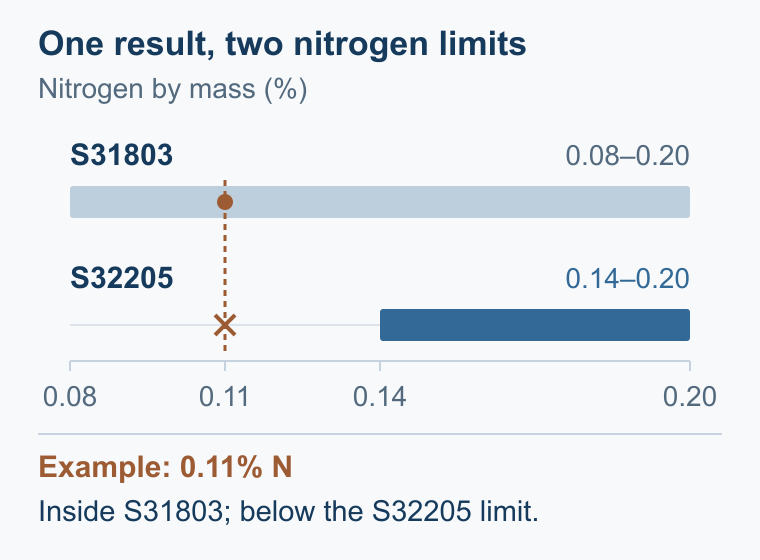
This is no longer just an omitted UNS label. The reported nitrogen result does not meet the displayed S32205 limit. A revised description on the quotation cannot change that result. Resolve the discrepancy against the ordered specification and its analysis provisions; do not accept the heat on the strength of the family name.
The reverse reasoning also has a limit: even if the reported nitrogen were 0.16%, that would only close this particular chemistry check. It would not establish complete chemistry, mechanical compliance or dual certification. The producer comparison is a reference; the ordered product specification and edition control acceptance.
Missing evidence and conflicting evidence need different replies
If nitrogen is missing
Request the supporting analysis for the identified heat. Missing data does not by itself prove a failed heat, but it prevents a supported acceptance decision. A generic datasheet cannot fill in a result for the material being delivered.
If the analysis appears compatible but only S31803 is certified
Ask the certifying producer to establish whether the complete S32205 requirements for that product are met and to provide the appropriate certification. Do not add a second designation to someone else’s certificate. Agreement on selected chemistry limits is not authority to recertify the product.
If the required designation is documented
Connect that document to the actual delivery. Check the heat or lot, product form, size, condition and applicable test evidence. A correctly worded certificate for unrelated stock does not resolve the order. The MTC, PMI and inspection-report guide explains why these documents provide different kinds of evidence.
Follow the certificate from the bar to the assembly
In the example, the mill document covers round bar while the buyer orders a finished stud-and-nut assembly. Keep that distinction visible. ASTM A479/A479M-26 covers stainless bars and shapes for boiler and pressure-vessel construction; it does not, by itself, define the completed assembly. [3]
The bar-stock enquiry concerns the material form and its delivery requirements. A finished-stud enquiry also needs the drawing revision, length, thread designation and class, and the agreed finished-product acceptance route. ASTM A1082/A1082M-26 has a separate high-strength stainless bolting scope and invokes A962/A962M general requirements; confirm its grade, condition and size coverage before selecting it for an order. [4]
For a fully threaded stud and nut set, the nuts remain separately specified components. A traceable stud-bar certificate does not certify them. The purchase can be one line item while its component evidence remains distinct.
Check any additional requirements for detrimental intermetallic phases
Suppose the producer supplies the required dual certification and the delivery is traceable. If the project also specifies a check for detrimental intermetallic phases, that requirement still needs its own evidence. ASTM A923-25 explains that chemical and mechanical compliance alone does not necessarily establish the absence of such phases. [5]
Specify the applicable method, grade provisions, specimen location, sampling and acceptance basis. A report saying only “A923 passed” is not enough to explain which requirement was evaluated. Conversely, do not turn a project-specific additional test into an unsupported claim that every 2205 order requires the same package.
Close the enquiry with a clear acceptance decision
The quotation review should end with one of three outcomes: the ordered material is supported by matching evidence; acceptance remains on hold for specified missing records; or a departure from the order requires a formal technical disposition. “Both are 2205” is not a fourth outcome.
Keep the clarification attached to the order:
Stud material: UNS S32205. Dual S31803/S32205 certification is acceptable when both designations are supported under the agreed product specification. Confirm feedstock form and delivery condition, finished-stud requirements, drawing revision and mating-nut requirements separately. Resolve substitutions and additional test requirements before acceptance.
BYBOLT deliveries include MTC/EN 10204 3.1, heat-number traceability and mechanical testing; threaded products receive sampled GO/NO-GO checks. Include any project-specific additions, the drawing and the unresolved certificate questions in your request for quote. The Duplex 2205 material reference provides further grade context.