
An SWRO pump cover is a pressure joint in seawater, and it fails in one of two ways: the joint wasn't designed for the real pressure and temperature, or the set that arrived didn't match the one that was specified. Both are caught on paper before the studs are made, if the order carries the right information.
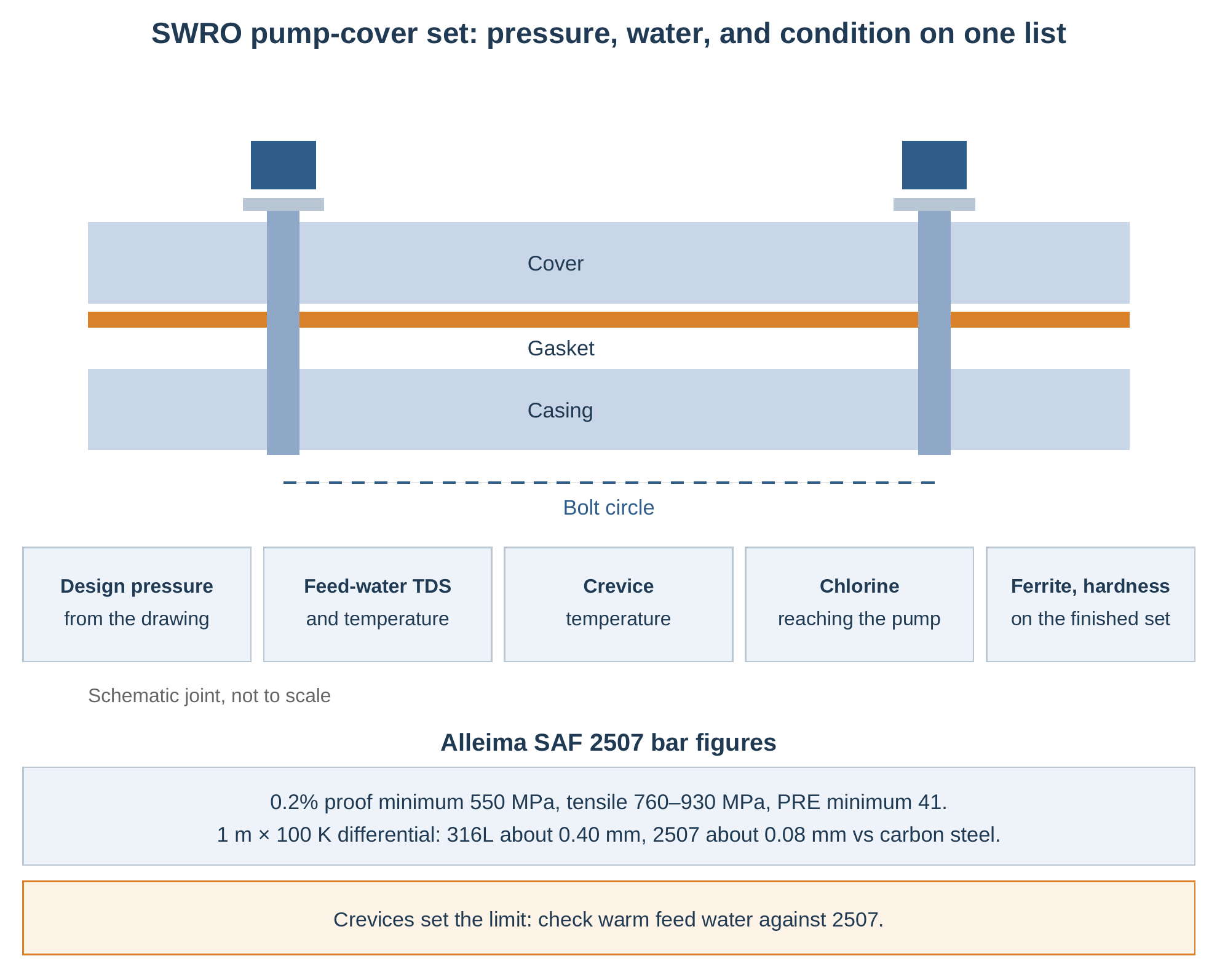
Pressure and the pump drawing
The applied pressure in seawater RO is set by the feed salinity and temperature. A review of high-pressure RO in Environmental Science: Water Research & Technology puts conventional SWRO at 800–1,000 psi, and the pressure rises with feed salinity and recovery, so the same pump may run harder with colder feed water or at higher recovery than at commissioning.
From the pump's pressure connection drawing, give the design pressure, the operating range and the hydrotest pressure, the bolt circle diameter, the number of studs, the stud size and thread, and the gasket type. A stud set ordered without the bolt circle can't be checked against the cover, and a set sized for operating pressure may yield at hydrotest.
Feed water, crevices and temperature
Super duplex 2507 has a nominal 25% chromium, 7% nickel, 4% molybdenum and 0.3% nitrogen, with a ferritic-austenitic structure of 35–55% ferrite. Alleima's SAF 2507 bar datasheet gives a 0.2% proof strength of at least 550 MPa, tensile 760–930 MPa, elongation of at least 25% and a PRE of at least 41.
PRE is a chemistry screen. It ranks alloys against pitting but says nothing about a specific crevice, temperature or chlorination level. TWI notes that super duplex shouldn't pit in seawater up to about 40°C but that crevice corrosion can start lower, and that NORSOK M-001, a conservative offshore piping standard, sets 20°C as the maximum for natural and chlorinated seawater. Pump makers routinely use 2507 above that in dechlorinated SWRO feed, but warm water, chlorine and stagnant pockets all narrow the margin.
Feed water is normally dechlorinated before the membranes, and therefore before the HP pump, but intake shock-chlorination or a dosing upset can still reach it. The order should therefore give the feed-water temperature range, its chloride, whether chlorine can reach the pump, and whether any part of the cover joint holds stagnant water, for example during shutdowns. Where those go beyond 2507's crevice margin, Inconel 625 gives more crevice margin at lower strength; our 625 vs 2507 comparison goes through the trade-off.
Expansion is rarely the problem with 2507. Its coefficient is close to that of carbon steel and duplex pump casings, while an austenitic 316L stud expands noticeably more, which is one reason duplex studs suit duplex casings.
The stud, the nut and the condition
| Candidate | UNS and specification | Where it fits an SWRO pump cover | What to watch |
|---|---|---|---|
| Super duplex 2507 | S32750, ASTM A479 bar, A182 F53 forgings | Standard choice for HP pump covers | Warm feed water erodes crevice margin; project hardness cap in sour service |
| Super duplex S32760 | S32760 | Alternative where the pump maker specifies it | Similar limits to 2507 |
| Inconel 625 | N06625, ASTM B446 Grade 1 | Warm feed water or tight crevices | 414 MPa minimum yield to 102 mm; check stud size |
| 316L | S31603 | Not suitable for HP seawater covers | Too weak, poor crevice resistance in seawater |
For the specification, see how A1082 and A479-bar orders are written for 2507.
Related references: Super duplex S32760
2507 is supplied solution annealed and quenched, and its properties depend on that treatment. Slow cooling or a later exposure in the wrong temperature range lets brittle phases form, and Alleima notes that prolonged exposure above 250°C lowers impact strength. Neither happens in an SWRO pump, but both can happen during manufacture, which is why the certificate matters. Our note on duplex heat treatment and inspection explains what to check.
Nuts should be 2507 or another grade the pump maker approves. Super duplex threads gall when run together dry, so name a lubricant suitable for potable-water and seawater service.
Whole-set acceptance
Ask for:
- studs from one heat and nuts from one heat per set, listed on a heat list by part
- solution-annealed condition stated on the certificate
- ferrite content in the 35–55% range, measured on the finished parts or a representative sample
- hardness on the finished parts, against the project limit (commonly 28 HRC)
- PMI per the project requirement, and a dimensional report
| Lock before ordering | Why it matters | Document to ask for |
|---|---|---|
| Design, operating and test pressure; bolt circle | Sets the load per stud | Pump pressure connection drawing |
| Feed-water temperature, chloride, chlorine reaching the pump | Decides whether 2507 has enough crevice margin | Feed-water data sheet |
| Stagnant zones and shutdown conditions | Crevices corrode where water stands | Operating description |
| Solution-annealed condition, ferrite, hardness | Wrong heat treatment leaves brittle phases | EN 10204 3.1 certificates, ferrite and hardness reports |
| Nut grade and lubricant | Dry super duplex threads gall | Nut specification, lubricant |
Related references: EN 10204 3.1 certificates
Requesting a quote
Start with the drawing. A note such as "M24 super duplex 2507 stud and nut sets for SWRO HP pump covers, design pressure 8.3 MPa, feed water 18–32°C (please check 2507's crevice margin at 32°C), 22,000 ppm chlorides, dechlorinated feed, 16 studs per cover, 6 pumps, one set per pump plus spares" gives the team enough to check load and crevice margin before quoting.
The engineering team will confirm grade, size and acceptance tests with you, then quote 2507 stud and nut sets or 2507 stud bolts with 2507 heavy hex nuts, packed per pump with EN 10204 3.1 certificates. For the rest of the RO train, see water treatment and desalination.