
A quotation that says “Inconel 718, NACE compliant” leaves a crucial question unanswered: compliant for which material condition and which service environment? For a fastener exposed to wet hydrogen sulfide, the alloy name is only the beginning of the selection.
Specify sour-service nickel-alloy fasteners by connecting the local exposure, the applicable ISO 15156 / NACE MR0175 requirements, the supplied material condition and the finished-part evidence. A hardness result alone cannot complete that chain. Neither can a certificate that names the standard without identifying the basis of conformity.
First establish what the standard covers
ISO 15156-3 addresses cracking-resistant corrosion-resistant alloys and other alloys in H2S-containing oil and gas production and associated natural-gas treatment. It supplements other equipment requirements; it does not replace the design code. Its scope includes several environmental cracking mechanisms but excludes general metal loss and localized corrosion. [1]
That distinction changes the purchasing question. “Does this material meet the relevant cracking-resistance requirements?” and “Will this connection resist the actual corrosion and mechanical duty?” are separate questions. Both need answers.
Confirm that ISO 15156 is the applicable project basis before putting it on an order. Its scope is not automatically transferable to every refinery or downstream chemical process. As checked on 20 October 2026, ISO lists Part 3:2020 as published, with a revision in development. State the contractual edition and applicable amendments or technical circulars explicitly. [1] [3]
Describe the exposure at the fastener
Start with a marked-up assembly drawing. A stud exposed to the process fluid and external bolting outside a pressure boundary do not automatically have the same exposure. Identify credible wetting during operation, shutdown, leakage or maintenance instead of assigning a fluid label to every part on the equipment.
ISO 15156-1 treats service-condition definition as part of material selection. Its terminology distinguishes sulfide stress cracking involving water and H2S from broader stress-corrosion mechanisms. Applied and residual stresses both matter. The practical consequence is that a gas analysis without the aqueous environment, temperature and component condition is incomplete. [2]
| Input | Record for the actual connection |
|---|---|
| Exposure location | Wetted component surfaces, pressure boundary, external bolting and credible trapped-fluid locations. |
| Fluid and pressure | Available H2S analysis, pressure basis and the aqueous phase; identify uncertainty rather than supplying only “sour gas.” |
| Chemistry | Relevant pH, chlorides, sulfur and treatment or cleaning conditions for the selected assessment route. |
| Operating envelope | Temperatures and pressures during normal service and relevant start-up, shutdown and upset conditions. |
| Mechanical state | Required preload, external loading, manufacturing condition and any relevant residual-stress-producing operations. |
This is a way to organize the information for review, not a substitute for the governing standard’s environmental limits. Where a listed route has several limits, evaluate them together. AMPP’s published interpretations explicitly caution against treating one favorable variable as permission to exceed another limit. [3]
825 and 925 need different condition checks
For Incoloy 825, UNS N08825, the producer describes mill heat treatment that balances stabilization, corrosion resistance, mechanical properties and formability. A buyer should identify the supplied product form and condition, including any later thermal processing. An 825 bar certificate should not be treated as evidence for a different form or manufacturing history. [6]
Incoloy 925, UNS N09925, is precipitation hardenable: its titanium and aluminium additions allow aging to increase strength and hardness. A 925 designation alone does not identify the delivered thermal condition. Establish that condition before reviewing both the mechanical requirements and the applicable sour-service acceptance criteria. Do not transfer a hardness or strength value between solution-annealed and aged material without checking its basis. [7]
If either alloy is proposed for the connection, request its applicable ISO 15156-3 material category and qualification route against the stated service envelope. Then check the proposed form, condition and any hardness restrictions together. A producer’s mention of sour-gas applications is useful background; it does not establish that the delivered fastener meets this project’s requirements.
Why “718” plus a hardness number is incomplete
Inconel 718, UNS N07718, obtains important mechanical properties through precipitation hardening. Special Metals describes different thermal treatments and separately discusses material for oil-tool applications. The bulletin therefore supports asking which condition is supplied; it does not make every product bearing the 718 name interchangeable. [4]
Review chemistry, product form, manufacturing route, thermal condition and any applicable hardness restrictions as a connected description. Do not copy a familiar aerospace strength requirement into an oilfield order and assume that adding “NACE” resolves any conflict.
A useful example appears in AMPP inquiry 2016-08: solution-annealed N07718 is still assessed within the precipitation-hardenable nickel-alloy category identified by that interpretation. Removing an aging treatment does not simply move the alloy into a different category. Do not infer sour-service acceptability from “solution annealed” alone. Identify the applicable category, then verify the supplied condition against its requirements. [3]
Treat a substitute as a new proposal
If a supplier proposes Inconel 625, UNS N06625, in place of a specified 718 condition, reassess both the mechanical requirements and the sour-service basis.
625 is principally solid-solution strengthened; the producer explains that its strengthening mechanism does not require the precipitation-hardening treatment used for 718. That difference is a reason to revisit mechanical requirements and product condition, even before checking the sour-service route. [5]
For this example, request a marked proposal showing exactly what changes: alloy and condition, the applicable environmental qualification basis, finished-fastener requirements and any effect on the specified assembly. Keep the original order in force until the responsible reviewer accepts the change. The 625 and 718 selection guide explains the broader material distinction.
Ask the certificate to answer a specific question
“NACE certificate required” is a weak acceptance instruction because it does not tell the supplier which facts must be traceable to the delivered parts. A more useful document review links each claim to its supporting record.
| Claim to resolve | Evidence to agree before manufacture |
|---|---|
| Correct material | Specified alloy/UNS and material specification, with chemistry linked to the heat. |
| Correct condition | Delivery and heat-treatment condition; process records and hardness results where required by the selected route. |
| Applicable sour-service basis | Named standard edition, relevant material route and environmental limits, or an agreed qualification basis with supporting records. |
| Conforming fastener | Drawing and thread requirements, agreed mechanical acceptance, inspection scope and finished-lot identification. |
A chemical identity check does not establish the heat-treatment history. A hardness result does not establish thread conformity. A list of test reports also needs a reliable connection to the parts in the box. Use the MTC, PMI and inspection-report guide to keep those roles distinct.
Carry the decision through the whole assembly
For a stud connection, identify the stud, mating nuts and any washers individually. Do they have the same exposure? Are the nut requirements stated? Does the proposed condition meet the required load as well as the environmental basis? A label applied to one component should not silently cover the rest.
When ordering studs and nuts together, identify each component’s material, condition and acceptance requirements alongside the assembly drawing, service envelope and project specification. Then use the 718 specification guide or 625 specification guide to complete the product details.
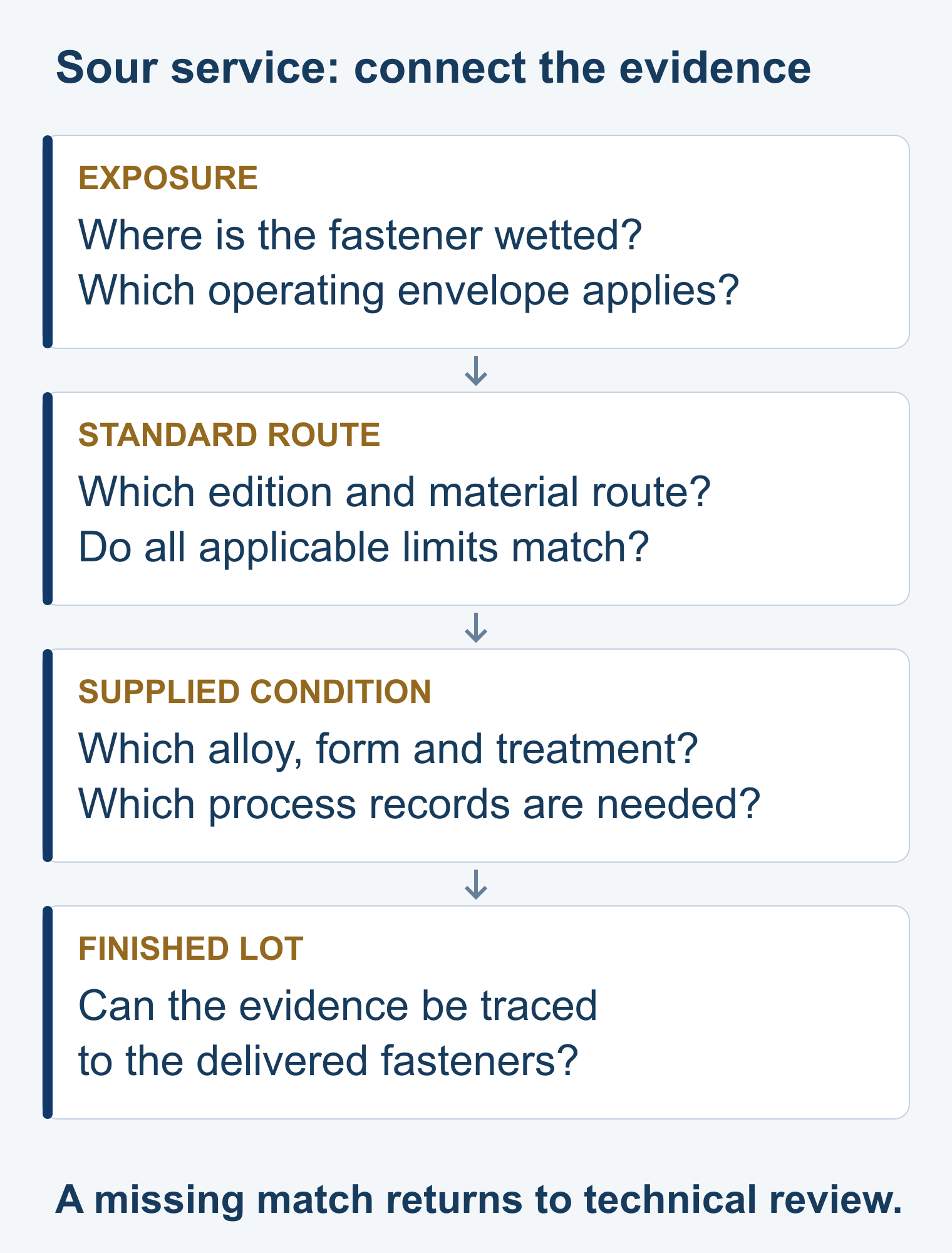
The release decision should be a documented match between the order and the delivered lot. If the exposure or qualification basis is still unresolved, keep that item open for technical review rather than accepting a broader “suitable for sour service” statement. Send the drawing and service requirements for review →
For the remaining drawing, mating-component and purchase details, use the nickel-alloy fastener selection guide alongside the project’s sour-service requirements.