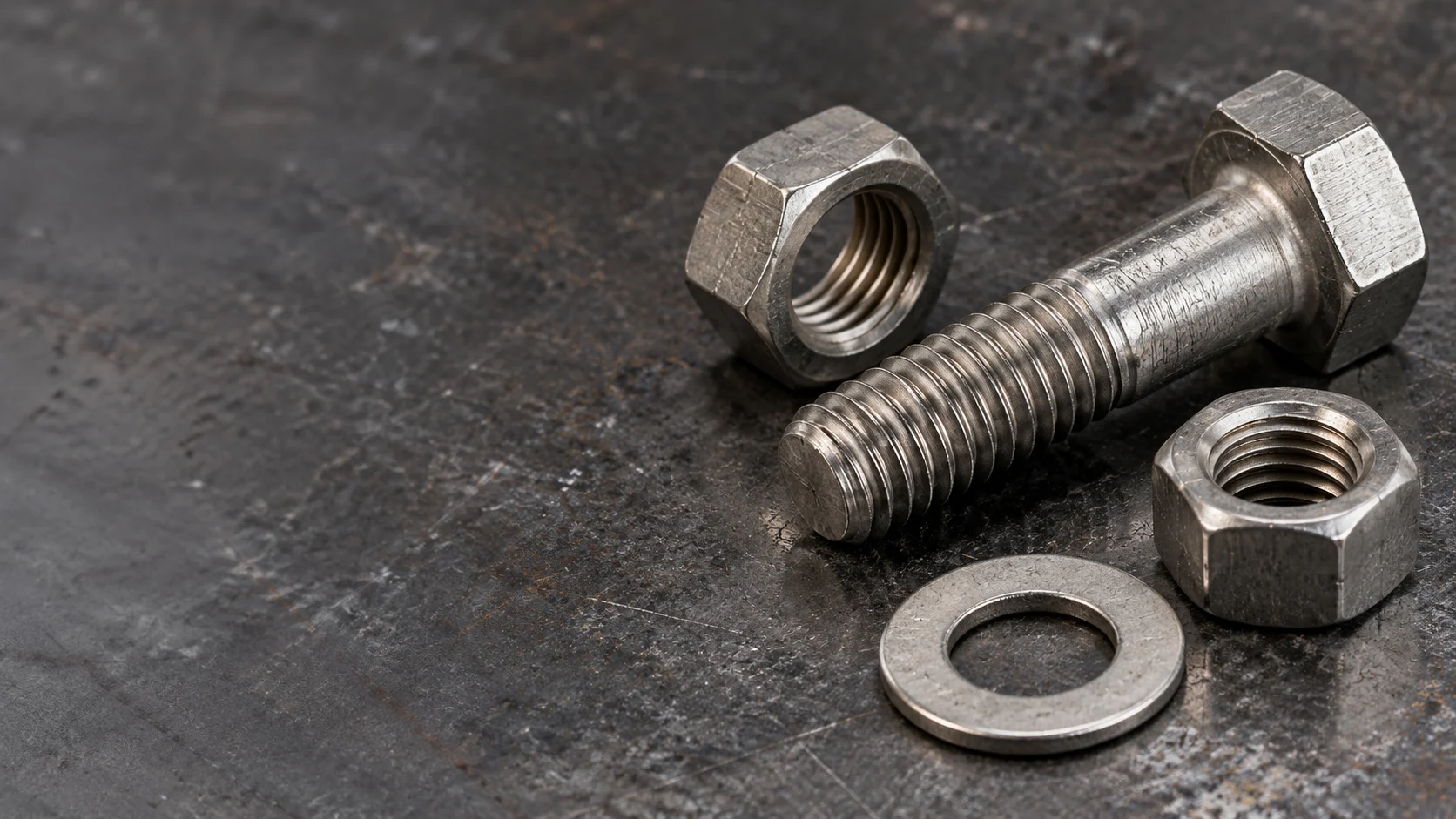
The nut starts normally, becomes difficult to turn and then locks before reaching its seating face. The torque wrench may already show a high reading. That is a reason to stop, not evidence that the joint has reached its intended preload.
Galling is adhesive damage between sliding metal surfaces. Preventing it requires control of the mating threads, surfaces, lubrication and installation method together. Changing the alloy name alone is an unreliable cure.
What happens at the thread contact
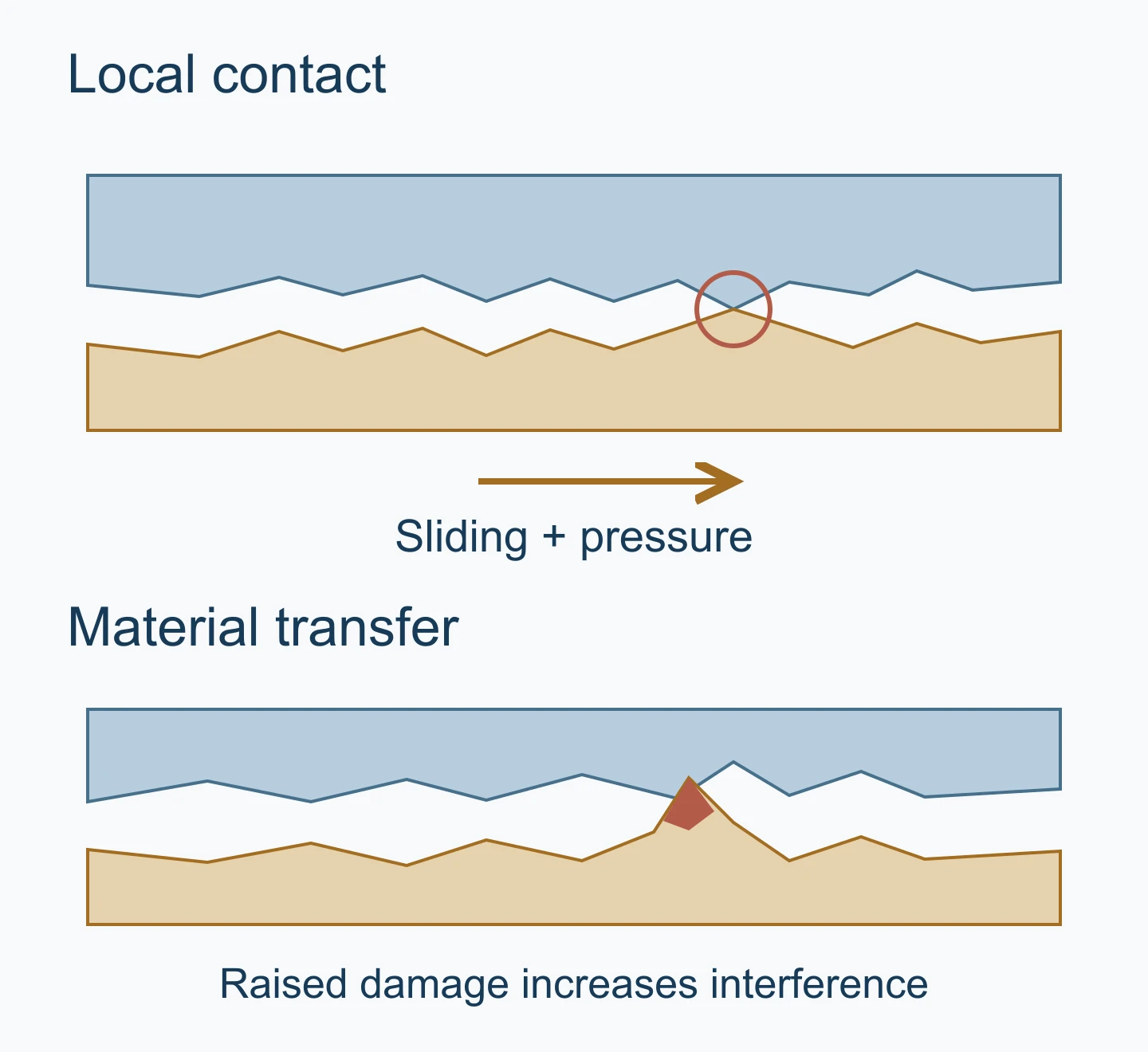
The thread flanks touch at small surface high points. Under sliding contact, local adhesion can tear and transfer material, producing raised damage that increases interference and friction. The connection may eventually seize. Nickel Institute’s wear review describes this adhesive-wear mechanism and reports strong dependence on the tested material pair and condition. [1]
A tight thread is not automatically a galled thread. Wrong pitch, an incompatible thread form, burrs, contamination or misalignment can also obstruct assembly. Check those causes before treating the problem as a material-selection failure.
When resistance rises, preserve the evidence
- Stop tightening and follow the equipment’s safe isolation procedure if the joint is in service. Do not keep applying torque to force seating.
- Record where resistance began, the tool setting, lubricant used and whether the parts were new or reused.
- After safe removal, inspect both threads for transferred metal, torn flanks, burrs and dimensional interference. Set damaged components aside for disposition.
- Compare an unused mating pair under the approved inspection procedure before releasing the remaining lot.
Forcing the seized pair can destroy the features needed to diagnose the cause. A damaged nut should not be used as an informal gauge for otherwise good studs.
Why adding anti-seize also changes the torque question
Applied torque is affected by friction at the threads and bearing face. Lubrication can reduce those losses, so the same torque can produce more bolt tension. Galling can have the opposite effect: torque rises without delivering the intended clamp load. NASA’s fastener manual identifies friction, coatings, lubricants and joint stiffness among the variables in torque control. [2]
If a dry assembly was seizing, applying anti-seize and retaining its old torque setting is not a complete correction. Identify the lubricant product, application method, service compatibility and the assembly procedure used to establish the torque–tension relationship. Reassess that relationship when the nut, finish or lubricant changes.
What an A-286 assembly study shows
NASA’s 2014 torque–tension study tested small A-286 and 300-series stainless fasteners in phosphor-bronze and silver-plated stainless helical-wire inserts, both dry and with Braycote 601EF. In those tests, dry installation produced greater torque-coefficient scatter than lubricated installation; cycling also changed the relationship. [5] The study measured torque and preload together. It did not establish a universal A-286 torque setting or a galling threshold, and its insert results do not qualify a 718 stud-and-nut assembly.
What to record in a 718 or A-286 assembly trial
For a proposed correction, agree the trial configuration and acceptance criteria with the person responsible for the joint design. Record:
- The complete mating set and sample plan: fastener and nut or insert identity, alloy and condition, thread size/form/class, finish and bearing surfaces; planned specimen quantity and the component lots covered.
- The installation sequence: cleaning, lubricant product and application locations, tightening method and rate, and tool identity. State which parts are new or reused, the number of tightening cycles, and when parts are replaced or lubricant is reapplied.
- The result: applied torque together with measured preload where torque–tension behavior is being established, the spread of results, and thread condition after disassembly. Include running or prevailing torque separately where relevant.
- The decision: whether the agreed preload range and damage criteria were met, and which changes to components, finish, lubricant or reuse require another review or trial.
Smooth tightening alone does not prove acceptable preload. If load is not measured, describe the check as a fit or assembly observation rather than torque–tension validation. A material-pair screening result is also a different test: ASTM G98 ranks galling resistance in laboratory contact and explicitly excludes quantitative final-design use; its method is not intended to assess lubricated sliding. [6]
Will a different nut solve the problem?
Replacing only a damaged nut does not remove the cause of galling; inspect the mating stud and review the assembly procedure too. A different material or hardness condition may improve sliding behavior, but the proposed nut must still satisfy strength, thread engagement, temperature and corrosion requirements. The stainless nuts on nickel-alloy bolts guide covers those pairing decisions.
XM-19 / Nitronic 50 is UNS S20910. Do not confuse it with Nitronic 60, UNS S21800. Galling-resistance evidence for the latter cannot be transferred to XM-19 simply because both names contain “Nitronic”. [3] [4]
Similarly, selecting a 316L nut does not establish that it will run freely on a particular 625 or 718 stud. Where seizure has occurred or clamp load is critical, assess the actual pair, condition, thread fit and lubricant in representative assembly trials. A wear-coupon ranking is not a guaranteed torque for a threaded set.
Make the successful assembly repeatable
Before installation, confirm the specified thread form and tolerance, remove contamination, reject damaged threads and check alignment. Apply the approved lubricant consistently and use the specified tool and tightening procedure. Keep the reuse policy explicit: previous tightening can alter the contact surfaces.
Retain component identities and trial conditions for the stud-and-nut set, including the bearing surfaces when washers are supplied. This makes it possible to reproduce a successful installation when another lot arrives.
Send the damaged-part observations and assembly details with an enquiry for replacement nuts or studs. They are more useful for investigating a recurrence than a request for a universally “anti-galling” alloy.
If the investigation leads to a change of alloy or assembly, use the nickel-alloy fastener selection guide to review the wider selection and ordering questions alongside the galling problem.