A duplex bar can have the right chemical analysis and still need further inspection before acceptance. The practical question is whether its processing history and test results support the condition ordered—not simply whether the certificate names 2205 or 2507.
What establishes an acceptable duplex condition?
Check the specified heat-treatment condition, any required phase-balance measurement and the applicable tests for detrimental phases as separate requirements. A ferrite percentage does not replace all of them. ASTM A923-25 explicitly warns that compliance with a product specification’s chemistry and mechanical requirements does not necessarily establish the absence of detrimental phases. [1]
For the grade-identity question, use the S31803/S32205 dual-certification guide. Here, assume the grade has been resolved: the next decision is what evidence must accompany the delivered material.
Read beyond “solution annealed”
Solution annealing and subsequent cooling matter because duplex steels can form harmful intermetallic phases during thermal exposure. The result depends on both composition and processing history. IMOA’s fabrication guidance discusses how cooling through critical temperatures affects the condition of mill products, including their response to later welding. [2]
A quotation that says “heat treated” therefore leaves an important question unanswered. Ask which condition will be supplied under the ordered material specification, and whether subsequent hot working, welding or reheating will occur. Check the heat-treatment records linked to the delivered processing lot for the specified condition and cooling method. Where the contract requires them, obtain the actual temperature, holding-time and cooling records. For finished fasteners, establish whether processing after the mill tests changed the material condition and which records cover the final state.
There is no single furnace setting to copy across 2205, 2507 and S32760. Use the requirements for the actual grade, product form and section size. A producer’s bar treatment is not a procedure qualification for a different component.
Does duplex have to be exactly 50/50?
No. “Approximately equal ferrite and austenite” describes the duplex structure; it is not a universal purchase tolerance. For example, Alleima’s SAF 2507 bar datasheet describes 35–55% ferrite in its solution-annealed and quenched condition. That statement belongs to that producer’s product and condition. It does not authorize the same acceptance range for every duplex grade, weld or finished fastener. [3]
The measurement method also matters. Outokumpu describes manual point counting, image analysis and magnetic measurement, with different sensitivities to preparation, calibration and the sampled volume. A report giving only “ferrite: 48%” leaves the buyer unable to assess how the result was obtained. Request the method, sampling location and agreed criterion alongside the result. [4]
A phase-balance result within the agreed range does not demonstrate compliance with a separately required detrimental-phase test. Keep those results distinct in the inspection plan.
Choose the test for the question
| Check | Question addressed | What still needs attention |
|---|---|---|
| Phase-fraction measurement | What proportion of the examined material is ferrite or austenite? | Method, preparation and location; separate requirements for detrimental phases. |
| ASTM A923, Method A | What etch structure is revealed by the sodium-hydroxide etch examination? | The selected edition’s rules for interpreting the result and any further testing. |
| ASTM A923, Method B | How does the specimen perform in the specified Charpy impact test? | Applicable grade, specimen orientation, temperature and acceptance criterion. |
| ASTM A923, Method C | How does it perform in the specified ferric-chloride corrosion test? | Applicable grade and test conditions; this is not a forecast of service life. |
A923 addresses detrimental intermetallic phases in the grades covered by its tables. It does not cover every cause of reduced toughness or corrosion resistance. Confirm grade coverage and the required method in the governing edition; neither “A923 passed” nor a generic corrosion-test label gives a complete acceptance basis. [1]
Where was the specimen taken?
A result represents the sampled material. A923 calls attention to location and orientation, particularly the region most likely to have formed detrimental phases; under common heat treatment, that can be the slowest-cooled region. A convenient surface sample is not automatically representative of the whole section. [1]
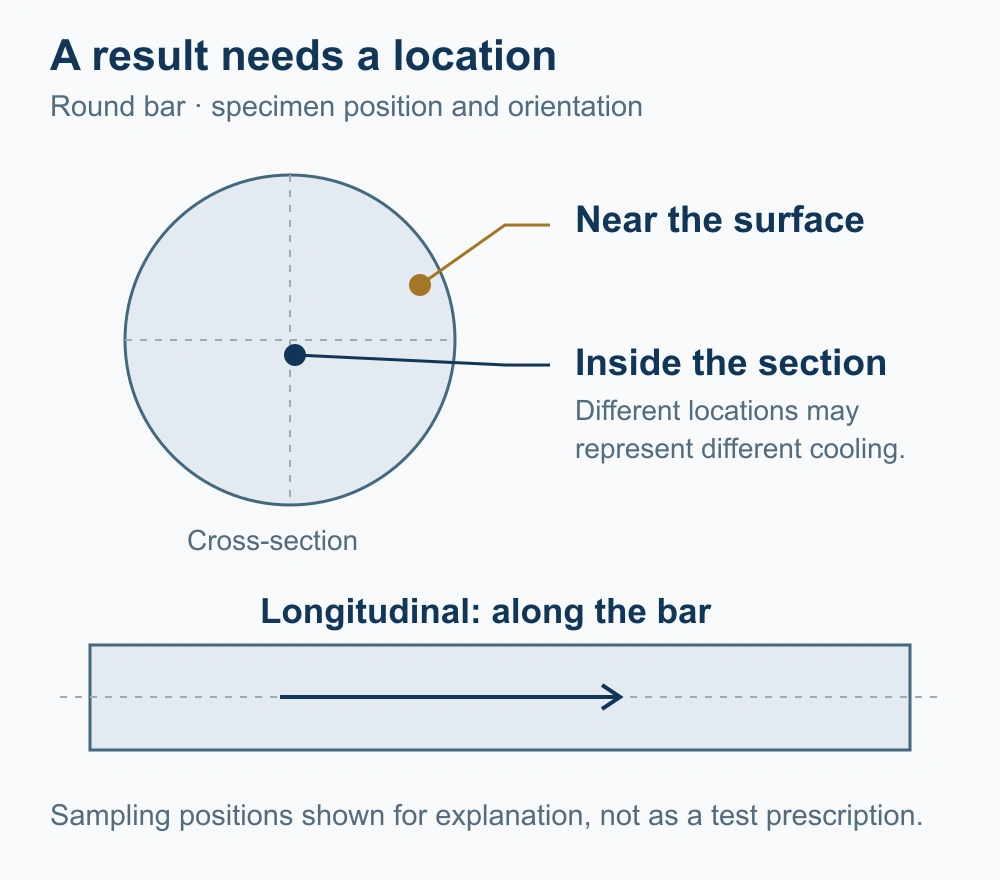
For round bar intended for machining, ask the supplier to identify the tested section and its relationship to the delivered stock. For a finished stud and nut set, retain the connection from feedstock to each component lot. A sound bar test does not establish the nut’s properties or the finished threads.
One heat number, two processing lots
Consider a purchasing example: two bundles carry the same heat number, but only one underwent a later thermal operation. The shared heat analysis is useful for identity. It does not, by itself, show that a condition-sensitive test on the first bundle covers the second.
Before release, reconcile the delivered quantities with the processing lots and the test report’s stated coverage. If coverage is unclear, obtain the missing records or agree an appropriate test with the responsible reviewer. Do not turn an unexplained gap into a blanket retest requirement—or accept it because the chemistry matches.
Before ordering, agree the product form and section size, required condition, test method and edition, specimen location and orientation, test conditions and acceptance criterion. At delivery, request the results and processing-lot records that demonstrate compliance with those agreed requirements. A useful report instruction is: “Identify the delivered heat and processing lot covered by each test, and report the actual test conditions, result and applicable acceptance criterion.”
BYBOLT deliveries include MTC/EN 10204 3.1, heat-number traceability and mechanical testing; threaded products receive sampled GO/NO-GO checks. Additional phase or corrosion tests must be agreed for the order. The MTC, PMI and inspection-report guide explains which records support which claims.