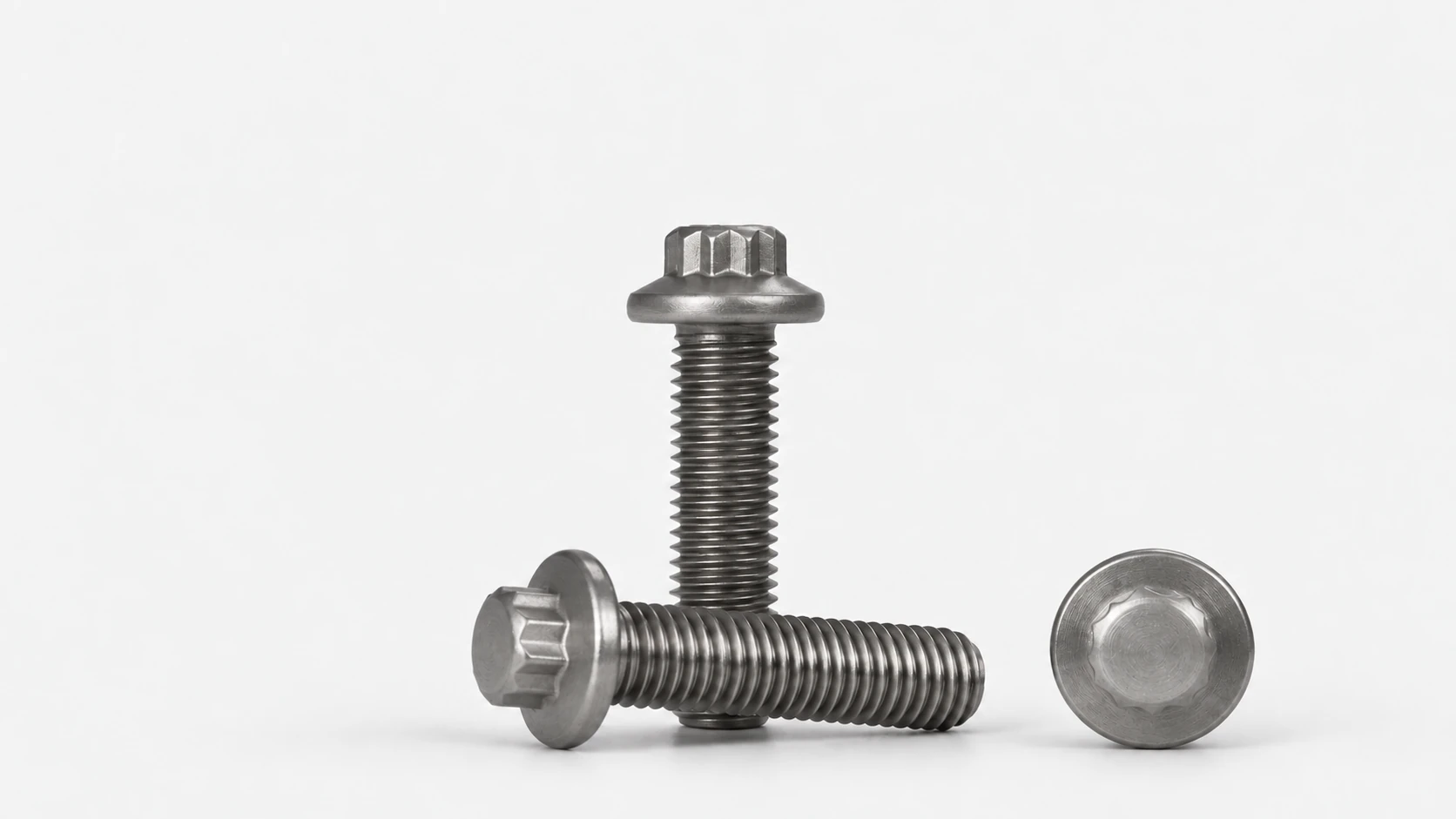
Compare A286 and Inconel 718 fasteners by the approved final condition and the load the full joint must retain, then compare cost on that accepted basis. A286 is an iron-base, age-hardenable alloy; 718 is a nickel-base, age-hardenable alloy. Neither name supplies a universal service-temperature limit, tightening torque or permission to replace the other.
A286’s lower nickel content and comparatively easier machining make it worth investigating when the approved mechanical and joint requirements can be met without a more demanding alloy route. Investigate 718 when its offered condition provides a needed strength advantage within the fixed part geometry. Producer temperature ranges overlap, so a temperature threshold alone does not choose between them. [1] [2] [7]
Start with a comparable material and part definition
| Item | A286 / UNS S66286 | 718 / UNS N07718 |
|---|---|---|
| Alloy basis | Iron-base; producer nickel range 24–27%. | Nickel-base; producer nickel-plus-cobalt range 50–55%. [2] [7] |
| Manufacturing cost question | Carpenter describes the iron-base A286 group as easier to machine than nickel-base precipitation-hardening grades such as 718. | Ask whether a needed property advantage justifies the quoted processing cost; there is no fixed price multiplier. [7] |
| Strength and condition | Identify the required treatment route, bolting class and ductility. | Investigate an approved 718 condition when the part needs more strength within fixed dimensions. Compare final-part requirements, not alloy names. [5] |
| Joint duty | Assess minimum retained load and maximum load over the duty. | Do the same; a higher tensile strength does not remove thermal mismatch. |
Keep dimensions and threads separate from the material and finished-fastener requirements. ASTM A453/A453M-26 is a high-temperature bolting specification whose published scope includes Grade 660 classes; the selected class and edition matter. A material designation alone does not establish a particular class. For 718, ASTM B637 concerns specified material forms, so a feedstock certificate alone does not complete bolt acceptance. [3] [4]
Why a single strength number can mislead
Roach’s fastener-specific paper separates solution-treated-and-aged and cold-worked-and-aged routes for both alloys, and warns that excessive cold work can reduce ductility. [5] The practical question is whether the offered route provides the required strength and ductility in the delivered part.
To look up a number, first choose the kind of number you need. For bolt acceptance, use the drawing’s governing specification, edition, class, size and final condition. For preliminary material screening, use a producer’s table with its product form, treatment and test temperature attached. For retained load, use a joint assessment matching time and temperature. A room-temperature tensile value cannot fill the third role. Roach’s historical comparison is not a set of current purchase minima or a matched hot-joint test.
| Product and reported condition | Material, values and exact lookup |
|---|---|
| A-286: 7/8-inch (22.2 mm) bar Solution treated: 982°C, 1 hour, oil quenched. Aged: 1325°F (about 718°C), 16 hours, air cooled. | A-286 at about 649°C 0.2% yield: 607 MPa. Ultimate tensile: 714 MPa. Typical producer values. Carpenter p.3: Tensile Properties. [7] |
| 718: 5/8-inch (15.9 mm) hot-rolled round Annealed: 982°C, 1 hour. Aged: about 718°C, 8 hours; furnace cooled to 621°C, held there to reach 18 hours total aging time. | 718 at about 649°C Yield: about 1000 MPa. Ultimate tensile: about 1134 MPa. Source values: 145.0 / 164.5 ksi, converted and rounded. Special Metals p.10: Table20, 1200°F row and footnote. [2] |
The test temperature matches, but bar sizes, treatment routes and test populations do not. These examples show why 718 merits investigation for a strength-limited part; their ratio is not an allowable-load ratio or a retained-load prediction. Request each supplier’s order-matching final-part strength and ductility evidence, then assess the joint duty separately.
The A286 and 718 material pages provide grade references. If 718 has already been selected, the 718 specification guide explains treatment records and finished-lot acceptance.
Temperature alone does not decide the hot joint
Carpenter discusses both A286 and 718 for automotive exhaust fasteners in overlapping temperature ranges. That is a screening context, not a safe-temperature assignment for an arbitrary flange. [1] Use fastener metal temperature, dwell time and cycles rather than substituting the gas-stream temperature for the bolt temperature.
NASA’s fastener-design guidance explains that thermal expansion differences between the bolt and clamped members can produce unloading or overload. [6] A stronger bolt can therefore still form an unacceptable connection if a required retained load is lost, or if thermal growth drives another component beyond its permitted load.
Ask for an assembly assessment covering the proposed condition, grip length, members, nut, bearing components, gasket and installation scatter. A short hot-tensile result does not predict long-duration clamp load. The high-temperature preload guide separates thermal movement, relaxation and surface settlement, and explains the limitations of direct historical fastener tests.
Review corrosion separately, including credible leaks and shutdown liquids. A hot-strength comparison does not establish resistance to a particular acid, chloride exposure or H₂S environment. Where H₂S is relevant, use the project’s approved environmental qualification; neither an ordinary A286 nor an aged-718 label is sufficient.
Worked decision: higher retained load can still fail a joint limit
All numbers and assessments below are fictional teaching assumptions. They are not predicted alloy behavior, real supplier reports, a BYBOLT project or an installation procedure.
A design owner is reviewing two alternatives for one drawing. The hypothetical duty is a 550°C fastener temperature, 1,500 hours and 100 cycles. The approved requirement is an actual installation range of 28–34 kN per bolt, including installation scatter, with load remaining between 25 and 40 kN throughout the duty. Assume the two submitted assessments are accepted as representative of the complete joint and each proposed material condition.
| Check | A286 proposal | 718 proposal |
|---|---|---|
| Minimum: ≥25 kN | Minimum 23 kN. Fails by 2 kN. | Minimum 26 kN. Passes this check. |
| Maximum: ≤40 kN | Maximum 38 kN. Passes this check. | Maximum 41 kN. Fails by 1 kN. |
| Disposition | Reject or revise. | Reject or revise. |
The answer is not to accept 718 because it retained more load. Neither proposal meets both limits. The design owner must review the assembly or installation basis and obtain supporting evidence for the revised proposal. If a later proposal passes both load limits, corrosion, drawing and remaining acceptance requirements still need to pass before release.
Price the accepted requirement, not an alloy stereotype
Nickel content can influence raw-material cost, as Carpenter’s selection discussion explains. [1] Compare machining, treatment, inspection, quantity and documents on the same accepted basis. For example, if one quote excludes the required final aging or project tests, obtain the missing scope and revised price before ranking it against an inclusive quote. Do not apply a fixed alloy price multiplier or claim lifetime savings without supporting duty evidence.
Send the drawing revision, quantities, material options, final conditions, actual temperature history, joint details and approved load limits. Ask each supplier to identify the evidence supporting its offer, included work and deviations. For hex-head bolts, use the A-286 hex-bolt or Inconel 718 hex-bolt enquiry page. For a complete stud, nut and washer set, use the stud assembly enquiry route.
BYBOLT deliveries include an EN 10204 3.1 material inspection certificate, heat-number traceability and mechanical testing. Test objects, methods and acceptance requirements follow the agreed order; threaded products include sampled GO / NO-GO gauging. Additional PMI or third-party inspection is agreed in the quotation. Submit the drawing and requirements for review.