The short answer
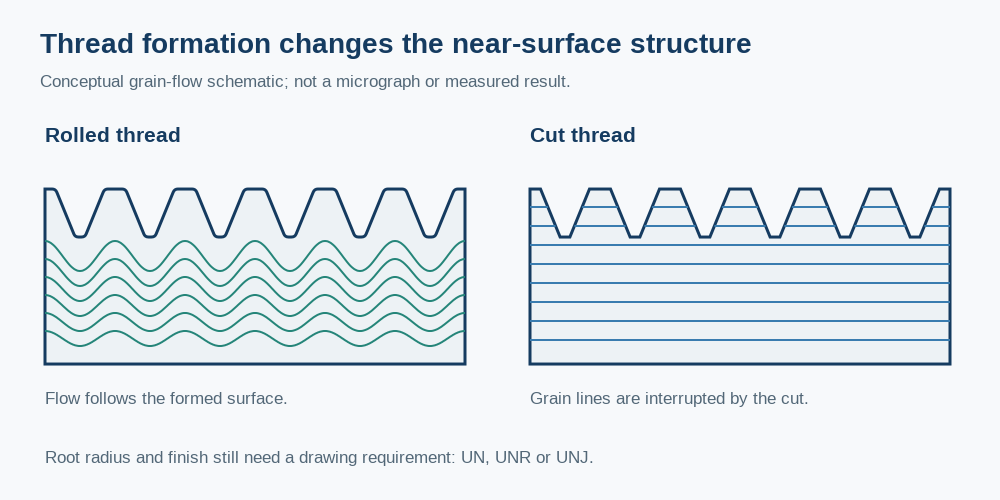
A rolled thread is formed by pressing hardened dies into the blank. A cut thread is machined out with a tool, which removes material.
- Rolling makes the grain flow follow the thread profile. It leaves compressive residual stress and a smooth, rounded root, which is why it is the normal process for fatigue-loaded fasteners.
- Cutting interrupts the grain flow, and the root finish depends on the tool. Cutting is still useful for very large diameters, short runs and forms that cannot be rolled.
On precipitation-hardening alloys such as Inconel 718 and A-286, the bigger decision is when the thread is rolled.
- Rolling after aging keeps the residual stress in the finished part, which helps fatigue and stress-corrosion resistance. It also raises the hardness of the threads and wears the dies faster.
- Rolling before aging gives up some of that benefit, because the aging cycle relieves part of the residual stress. In our experience the hardness result is easier to keep inside a tight window.
On a part with a narrow hardness window, such as ASTM A453 Grade 660 Class D, that trade-off decides the route.
Follow the A453 thread-making sequence
R1 retains the rolling operation after aging. Agree the hardness limit and test location.
Process order only. No heating rate, complete furnace cycle or fatigue-life prediction is implied.
What rolling does to the thread
Rolling is a cold-forming operation. The material flows radially into the die profile instead of being cut away. The Precision Machined Products Association (PMPA) lists four effects:
- Grain flow follows the profile. Grain is not cut through at the flanks and root, so there is no exposed end grain where a fatigue crack would start.
- Cold work hardens the surface. Surface hardness, tensile strength and yield strength rise in the formed layer.
- The root carries compressive residual stress. That stress opposes the tensile stress that opens fatigue cracks.
- The root is smoother and rounded. The stress concentration is lower than at a sharp or torn root.
A cut thread has none of these by default. Its root radius and surface depend on the insert and the cutting conditions. Machining marks at the root act as stress raisers.
UN, UNR and UNJ: the root is specified, not assumed
Rolled threads usually end up with a rounded root, but the thread designation decides whether that roundness is controlled.
| Designation | Root of the external thread | Effect on the mating internal thread |
|---|---|---|
| UN | Flat or rounded, optional | None |
| UNR | Rounded, mandatory; radius 0.108P to 0.144P | None. UNR applies to external threads only, and the nut is plain UN |
| UNJ | Rounded, mandatory; radius 0.15011P to 0.18042P (SAE AS8879) | The internal minor diameter is enlarged to clear the larger root |
UNR: the R stands for a mandatory rounded root. Otherwise it is the ordinary Unified thread. ASME B1.1 says the rounded root improves fatigue strength over a flat root and reduces crest wear on the threading tool. UNR is most often seen on high-volume commercial threads produced by rolling. The same UN ring gauges are used, and the radius is checked optically when it has to be verified.
UNJ is a different profile. Its larger root radius needs a mating internal thread with a bigger minor diameter, so a UNJ bolt should not be put into a standard UN nut. See our UNJ vs UN guide.
In short, a thread rolled with rounded-crest dies may well meet UNR, but writing "UNR" on the drawing makes the radius a requirement that has to be verified.
Rolled before or after heat treatment
For precipitation-hardening alloys, "heat treatment" means solution treatment followed by aging. Most of the strength develops during aging. ASTM A453 defines four thread types for Grade 660 (A-286) bolting. If the purchase order (PO) does not name one, the manufacturer chooses, and the type is marked on the product.
| A453 thread type | How the thread is made | When |
|---|---|---|
| R1 | Rolled | After the precipitation (aging) treatment |
| R2 | Rolled | After solution treatment, before aging |
| M1 | Machined | After aging |
| M2 | Machined | After solution treatment, before aging |
For Inconel 718 bolting, ASTM A1014 requires rolled threads. The 2003 edition requires them rolled in a single pass after oxide removal and does not fix the sequence; supplementary requirement S5 is how a purchaser asks for rolling before the precipitation heat treatment. Without S5, the sequence is left to the manufacturer. Check the edition named on your PO for the current wording.
Why rolling after aging is specified
- Fatigue: Aircraft bolt specifications often require threads to be rolled after heat treatment. A published failure analysis reports better fatigue properties with that sequence than with rolling before heat treatment.
- Stress corrosion: In a 2001 Lockheed Martin report, A. R. Kephart found that threads rolled after strengthening resisted stress-corrosion cracking far better than threads rolled before heat treatment. The benefit was attributed to the retained compressive stress. The tests in that report were on B7 alloy-steel bolting, not on 718 or A-286.
- Aerospace A-286: Procurement specifications such as SAE MA3375 cover A-286 studs that are roll threaded after heat treatment.
The benefit depends on preload
Tests on high-strength steel bolts by Horn and co-workers qualify that fatigue gain. At almost no preload, rolling after heat treatment raised the 10⁷-cycle fatigue strength by roughly 150% over rolling before heat treatment. At high preload, the coarse threads showed little or no gain. The fine threads still gained about 40–50%.
A flange stud tightened to a high fraction of its yield is in the high-preload case, so rolling after aging does not automatically make it last longer. The case is strongest where the joint sees real cyclic load at modest preload, which is typical of aerospace and rotating-equipment hardware.
The hardness trade-off on A-286 and 718
Rolling after aging means cold-working material that is already at full hardness. Two practical things follow.
- The dies work harder. Aged A-286 and 718 resist deformation, so die wear and setup time go up. That is a cost, not a barrier.
- The threads come out harder than the core. Cold work adds hardness to a part that was heat-treated to sit inside a hardness range. Where readings are taken on or near the threads, the result can go over the limit. Rolling before aging is not hardness-neutral either: cold work before aging raises the aged strength and hardness of the worked layer, though the aging cycle relieves part of it.
The second point is what decides orders with tight hardness limits:
- A453 Grade 660 Class D has a hardness range of 248–321 HBW, with a lower ceiling than Classes A, B and C. A purchase specification may add a narrower Rockwell window on top of it. In our production, rolling after aging makes it hard to keep every reading inside that window.
- Sour service. NACE MR0175/ISO 15156-3 lists A-286 and 718 by metallurgical condition as well as maximum hardness; in the 2003 text, A-286 was listed in the solution-annealed and aged condition at 35 HRC maximum. Cold work after aging changes the condition and adds hardness. Confirm with the end user that the edition and listing they apply, or API 6A718 for oilfield 718, accept threads rolled after aging.
Where hardness is measured matters as much as the limit. ASTM F606 allows routine hardness tests on the wrench flats, top of the head, unthreaded shank or end of the bolt. For arbitration, it specifies the mid-radius of a transverse section through the threads, about one diameter from the end. The rolled layer is shallow, so on a large stud the mid-radius reading sits mostly below it; readings on the thread surface, on small diameters or in a hardness survey across the section are where cold work shows. Agree the test location before production, not after a reading fails.
Our A453 Grade 660 class guide covers the class limits, and the A-286 heat treatment guide covers the metallurgy behind them.
When a cut thread still makes sense
- The diameter is beyond the rolling capacity available.
- The thread form cannot be rolled, such as some special or very coarse forms.
- The quantity is a handful of parts, where rolling dies do not pay for themselves.
- The thread is internal. Nut threads are tapped or cut, so the rolled-versus-cut question applies only to the external thread.
If a cut external thread goes onto a fatigue-loaded part, the drawing should control the root radius and surface finish, rather than leaving them to the machinist.
How to specify the thread process
Put these on the drawing or PO:
- Process and sequence: rolled or machined, and before or after aging. For A453 Grade 660, write R1, R2, M1 or M2. For A1014 Inconel 718, state whether supplementary requirement S5 applies.
- Root form: UN, UNR or UNJ, and how the root radius is to be verified if it is controlled.
- Hardness: the limit, the test method (Rockwell or Brinell) and the test location.
- Surface discontinuities: if laps or seams on rolled threads need a defined acceptance, name it, for example ASTM F788.
- Service: if it is H₂S service, the governing sour-service specification, so the sequence and the hardness limit can be checked against it before production.
How BYBOLT rolls threads
- Both sequences on 718 and A-286: We roll threads on Inconel 718 and A-286 either before aging or after aging, to the drawing. Rolling after aging takes more die life and setup, and we price it accordingly.
- Class D and other tight hardness windows: We flag these at contract review. If the drawing calls for R1, we agree the hardness test location and acceptance before production. If the sequence is open, rolling before aging gives a more predictable hardness result.
- Size range: Our thread rolling covers diameters up to 4 in. For rolling after aging, we confirm feasibility for the size at quotation, since aged material needs more rolling force. Above 4 in. we do not offer cut threads on these alloys: large, hard threads are slow to machine and heavy on tooling. Contact us before designing around a larger thread.
- Equipment: Eight thread rolling machines and a tapping line. Our laboratory has Brinell and Rockwell hardness testers, a metallographic microscope for checking grain flow and laps in rolled threads, and an optical image measuring instrument for the root profile.
- Classes: We produce Class 2A/2B and 3A/3B, and UNJ/UNJF threads (see Class 2A vs 3A).
- Inspection: GO/NOT GO gauging on a sampling basis (see our thread gauging guide), routine PMI by sampling, and an EN 10204 3.1 certificate for every lot. 100% PMI or third-party inspection is available on request.
Typical parts include A-286 stud bolts, A-286 12-point flange bolts, Inconel 718 stud bolts and Inconel 718 hex bolts. Material background is on the A-286 and Inconel 718 pages.
Common questions
What does UNR mean on a thread callout? UNR is a Unified external thread with a mandatory rounded root of 0.108P to 0.144P. It mates with an ordinary UN internal thread, because there is no internal UNR.
Are rolled threads always stronger than cut threads? In fatigue, generally yes, because of the grain flow, the residual compressive stress and the smoother root. In static tension, the difference is small. The material and its condition decide the tensile rating.
Should A-286 studs be rolled before or after aging? It depends on what governs the joint, and if you do not state it, A453 leaves the choice to the manufacturer. Rolling after aging (Type R1) gives the best fatigue and stress-corrosion resistance. Rolling before aging (Type R2) makes a tight hardness window, such as Class D or a sour-service cap, easier to meet. The drawing should say which.
Can cold-rolled threads affect a hardness test? Yes, if the reading is taken in the cold-worked layer. Agree the test location, for example the ASTM F606 routine or arbitration location, at the order stage.
Ask for the sequence you need
Send the drawing with the thread designation, the A453 thread type or A1014 requirement, the hardness limit and test location, and the service. We will confirm the rolling sequence and inspection plan in the quotation. MOQ is 100 pcs per size and grade. Request a quote.