In brief
In pure hydrochloric acid with no oxidizing contaminants, Alloy B-3 (UNS N10675) and zirconium 702 (UNS R60702) hold up across the widest range of concentration and temperature. C-276 (UNS N10276) is adequate in dilute, moderately warm acid but corrodes quickly as the acid gets hotter. C-22 (UNS N06022) is not an upgrade in pure HCl: in Haynes’ published test data it corrodes faster than C-276 at 5% concentration and above.
The ranking changes once the acid carries ferric ions, cupric ions or wet chlorine. These usually come from iron or copper corroding somewhere upstream, so treat “pure HCl” on a datasheet as a claim to check with the process engineer. B-3 contains almost no chromium, and producer datasheets advise against it wherever ferric or cupric salts can form. Zirconium pits and stress-cracks once ferric ions are present, and ATI’s data show cracking at weight-loss rates below 1 mpy. A coupon can look clean while a loaded stud cracks. With oxidizers present, C-22 is the better nickel alloy. Titanium Grade 2, which does not resist pure HCl, becomes an option in dilute acid because those same ions inhibit its corrosion.
Process condition | Start with | Avoid |
|---|---|---|
Pure HCl, hot or concentrated, no oxidizers | B-3; Zr 702 (Zr 705 only with data for your concentration and temperature) | C-22; C-276 unless corrosion data for your concentration and temperature support it |
Pure HCl, dilute and moderately warm | C-276, checked against the corrosion data for the actual concentration and temperature | — |
Fe³⁺, Cu²⁺ or chlorine present | C-22; titanium in dilute acid | B-3; zirconium unless tested in that chemistry |
Fluoride present | No default; test in the actual chemistry | Zirconium, titanium |
Strength is the second constraint, covered below: none of these alloys reaches the yield strength of a B7 stud.
Alloy names such as B-3, C-276 and C-22 identify UNS grades. HASTELLOY® is a registered trademark of Haynes International.
Ask what else is in the acid first
In hydrochloric acid the cathodic reaction is hydrogen evolution, so the alloys that resist it rely on molybdenum rather than a chromium-rich passive film. That is why nickel-molybdenum B-3 does so well in clean acid, and why it has no defense when the solution turns oxidizing. Rolled Alloys’ B-3 datasheet is blunt about it: no oxidizing media, no ferric or cupric salts, no wet chlorine, no hypochlorite.
Process acid is rarely reagent grade. Byproduct HCl, pickling liquor and leach solutions can carry dissolved iron or copper, and acid that has passed through carbon steel or copper-alloy equipment can pick up enough of either to matter. Get these answers from the process side before choosing an alloy:
- Concentration range, including start-up and upset conditions, not just the design point.
- Maximum metal temperature at the joint, which may differ from bulk fluid temperature.
- Dissolved iron and copper, even a rough order of magnitude.
- Whether chlorine, air or oxygen can enter the stream.
- Whether fluoride is present at any level.
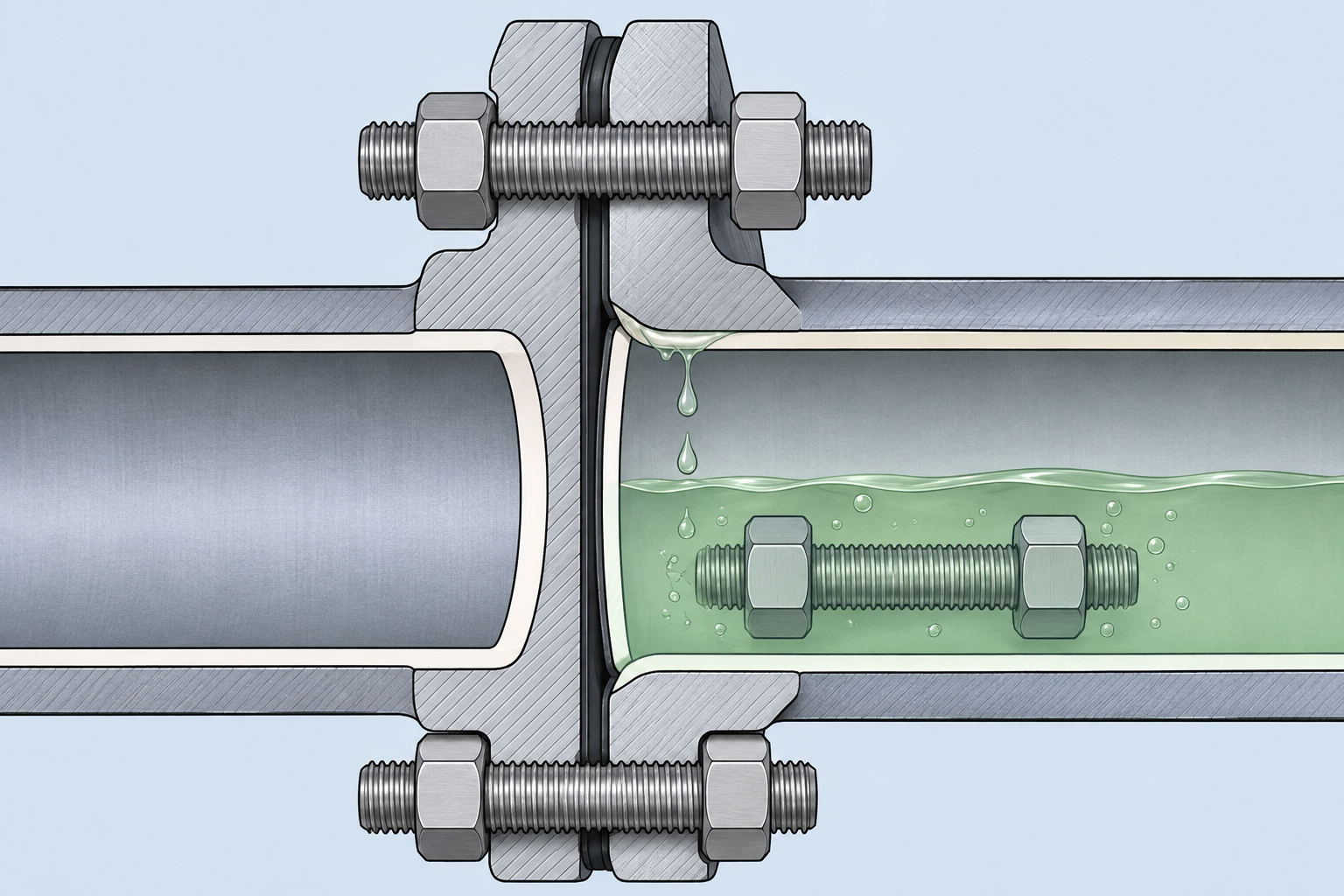
- Whether the fastener is wetted continuously, exposed to vapor, or only sees drips from a weeping gasket.
Don’t skip the last one. A stud outside the gasket that sees occasional drips is in a different environment from an internal fastener immersed in acid, and the two may not need the same alloy.
How far apart the alloys are in pure HCl
The figures below come from Haynes International’s uniform corrosion tables, measured in reagent-grade acid in the laboratory. They show relative behavior, not service life, and Haynes recommends field testing before industrial use.
Corrosion rate in pure hydrochloric acid, mm/y
HCl, wt% | Temperature | B-3 | C-276 | C-22 |
|---|---|---|---|---|
1 | Boiling | 0.01 | 0.33 | 0.06 |
5 | 93 °C (200 °F) | 0.30 | 1.25 | 3.02 |
5 | Boiling | 0.08 | 3.63 | 8.9 |
10 | 66 °C (150 °F) | 0.24 | 0.46 | 0.98 |
10 | 79 °C (175 °F) | 0.28 | 1.18 | 1.99 |
20 | 66 °C (150 °F) | 0.21 | 0.55 | 0.90 |
20 | 79 °C (175 °F) | 0.26 | 1.10 | 1.72 |
Source: Haynes HYBRID-BC1 datasheet, uniform corrosion data (one test series covering all three alloys).
Compare the alloys at one HCl condition

C-22 trails C-276 in clean acid from about 5% upward; at 1% boiling the order reverses. Replacing C-276 studs with C-22 because “C-22 is the better alloy” can make a pure-HCl joint worse.
B-3 is consistent, but it still corrodes. Most of its values fall in the 0.1–0.5 mm/y band that Haynes calls “moderately safe”. That can be acceptable for a vessel wall with a corrosion allowance. A thread flank has almost none, so for continuously wetted fasteners, ask how much flank loss the joint can tolerate between inspections.
C-276 is a dilute-acid material. Its own datasheet shows 0.02 mm/y or less at 2–4% up to 66 °C (150 °F), then a steep climb: 0.42 mm/y at 3% and 79 °C, and 1.18 mm/y at 10% and 79 °C.
Zirconium was not part of that test series. ATI’s corrosion tables report Zr 702 below 1 mpy (about 0.025 mm/y) in 10% and 20% HCl at 100 °C (212 °F), and below 2 mpy in 20% acid at 150 °C (302 °F). Titan Metal Fabricators’ iso-corrosion chart for pure HCl puts the limit above 250 °C at 10% and about 130 °C at 37%. The note does not say which of its curves (0.13, 0.5 or 5 mm/y) those figures belong to, and they are corrosion limits in pure acid, not allowable bolt temperatures: load capacity, localized attack and stress cracking still have to be checked separately. ATI’s entries at 32–37% carry the remark “weld sensitization”, which affects welded equipment more than studs machined from bar.
When oxidizers are present
B-3. Do not use it. Oxidizing salts are the documented failure mode of the nickel-molybdenum alloys. Haynes shows the effect by comparing B-3 with its oxidizer-tolerant HYBRID-BC1 alloy in boiling 2.5% HCl with ferric and cupric additions, but publishes no safe ppm level. Without one, treat any credible source of Fe³⁺ or Cu²⁺ as disqualifying.
Zirconium. Aeration does not affect zirconium in HCl, but ferric and cupric ions do. ATI’s corrosion tables report stress-corrosion cracking with as little as 100 ppm FeCl₃ in 10% HCl at 30 °C, and “Pitting, SCC” in 10–20% HCl with 500 ppm Fe³⁺ from 30 to 100 °C. In every one of those entries the weight-loss rate stays below 1 mpy. Titan’s application note reports oxide-film breakdown from about 50 ppm Fe³⁺, with pitting the main form of attack below 20% HCl and intergranular corrosion above it. For a stressed component such as a bolt, those data leave no ferric level that can be called safe.
C-22. Its higher chromium content gives “much higher resistance to oxidizing media than … C-276”, in Haynes’ words. Our Hastelloy vs Inconel fastener comparison summarizes published coupon data in 20% HCl with ferric-ion additions: C-276’s rate rose sharply while C-22’s stayed low. When the acid is contaminated, start from C-22.
Titanium. It behaves the opposite way. Commercially pure titanium does not resist pure, reducing HCl, but ferric and cupric ions inhibit its corrosion in dilute acid. Where the process reliably carries those ions, titanium Grade 2 can be the economical choice. Where they come and go, it is not, because the joint is protected only while the contaminant is there. Three further limits apply to titanium bolting:
- A bolted joint is a crevice, and commercially pure titanium is prone to crevice attack in hot chloride solutions. Published data put the onset in sharp crevices at around 93 °C (200 °F) in saturated chloride. Grade 7 (palladium-alloyed) and Grade 12 (a titanium–molybdenum–nickel alloy with no palladium) are the usual crevice-resistant grades.
- Acidic fluoride attacks the protective film.
- Titanium ignites in dry chlorine.
Fluoride rules out zirconium in practically any HCl service. ATI lists more than 50 mpy for Zr 702 in 10% HCl at 100 °C with 200 ppm HF.
Strength: can the bolt hold the gasket load?
None of these alloys is precipitation-hardened in the bar grades normally used for bolting, and every one of them falls well short of the 105 ksi (725 MPa) minimum yield a designer may have assumed for B7.
Alloy | UNS | Bar specification | Min. tensile | Min. yield (0.2%) | Min. elongation |
|---|---|---|---|---|---|
B-3 | N10675 | ASTM B335 | 760 MPa (110 ksi) | 350 MPa (51 ksi) | 40% |
B-2 | N10665 | ASTM B335 | 760 MPa (110 ksi) | 350 MPa (51 ksi) | 40% |
C-276 | N10276 | ASTM B574 | 690 MPa (100 ksi) | 283 MPa (41 ksi) | 40% |
C-22 | N06022 | ASTM B574 | 690 MPa (100 ksi) | 310 MPa (45 ksi) | 45% |
Zr 702 | R60702 | ASTM B550 | 379 MPa (55 ksi) | 207 MPa (30 ksi) | 16% |
Zr 705 | R60705 | ASTM B550 | 552 MPa (80 ksi) | 379 MPa (55 ksi) | 16% |
Titanium Gr 2 | R50400 | ASTM B348 | 345 MPa (50 ksi) | 275 MPa (40 ksi) | 20% |
B335 values apply to rod 7.94–88.9 mm (5/16–3-1/2 in), solution annealed.
Before changing the alloy on an existing joint:
- Rerun the flange calculation with the real yield. Lower yield means less usable preload per stud, so bolt diameter, stud count or gasket type may need to change. A torque table written for B7 cannot be reused.
- Prefer Zr 705 for highly loaded zirconium joints. It gives about 80% more minimum yield than Zr 702. ATI’s HCl tables report almost all entries for Zr 702 only, so get Zr 705 data for your concentration and temperature before assuming equal performance.
B-3 has largely replaced B-2. Both meet the same B335 minimums, but B-2 forms embrittling Ni₄Mo rapidly at around 750 °C, while B-3 needs several hours at around 650 °C before harmful phases appear. That margin matters whenever bar is hot-worked or reheated during manufacture. Any substitution of B-3 for a specified B-2 should still go to the end user as a deviation.
Which fastener standard applies? ASTM F468 lists C-276 (N10276) and titanium Grades 2 and 7 (R50400, R52400), so those bolts and studs can be ordered to F468 and nuts to F467; see our F468/F467 vs F2281 guide. Table 1 of ASTM F468-23 does not include C-22, B-3 or zirconium. Those are ordered against the bar specification plus a dimensional standard such as ASME B18.31.2 for studs and ASME B18.2.2 for heavy hex nuts.
Nuts, washers and anti-seize
- Same alloy for nuts and washers. In a conductive acid, a dissimilar nut forms a galvanic couple with the stud right at the crevice under the nut face. Our note on nickel alloy bolts with stainless steel nuts explains why mixed pairs cause trouble.
- Plan for galling. Nickel-molybdenum alloys and zirconium both gall when like runs on like under load. See nickel alloy fastener galling for thread fit and tightening practice.
- Check the anti-seize chemistry. If the lubricant can reach the acid, avoid copper- or iron-bearing compounds: dissolved copper is exactly the contaminant that harms B-3 and zirconium. Use a lubricant the plant has approved for the process fluid.
RFQ and PO checklist
- The process answers from “Ask what else is in the acid first” above.
- Flange or equipment material and gasket type, to check galvanic pairing and preload.
- Alloy by UNS number and bar specification. A trade name alone does not identify a grade.
- Product standard, size, thread and length, for example ASME B18.31.2 studs with ASME B18.2.2 heavy hex nuts.
- Certification and inspection: EN 10204 3.1 with heat-number traceability. State whether sampling PMI is enough or your QA plan needs 100% PMI or third-party inspection. See material certificates and PMI.
Example line item:
Stud bolts, 7/8”-9 UNC-2A × 6-1/2”, UNS N10675, bar to ASTM B335, solution annealed, dimensions per ASME B18.31.2, each with 2 heavy hex nuts machined from ASTM B335 UNS N10675 bar, solution annealed, dimensions per ASME B18.2.2. EN 10204 3.1 certificate, heat-number traceable.
If you already have these answers, send them with your RFQ.
Quick answers
Is C-22 better than C-276 in hydrochloric acid? It depends on the conditions. In Haynes’ tests in pure HCl, C-276 corroded more slowly than C-22 at 5% and above, while C-22 was better at 1% boiling. Where oxidizers are present, the published data favor C-22. Check the data for your own concentration, temperature and contaminants.
Can zirconium bolts be used in hydrochloric acid? Yes, in pure HCl across a wide range of concentration and temperature, subject to the iso-corrosion data for your conditions and a separate check of load capacity and stress cracking. Not where ferric or cupric ions, wet chlorine or fluoride can be present. With ferric ions, ATI reports SCC from 10% HCl upward.
Is B-2 still worth specifying? Rarely, for new work. B-3 meets the same B335 minimums with better thermal stability.
Related products and materials
- Alloy B-3: material page · stud bolts · heavy hex nuts · hex bolts
- Alloy B-2: material page
- C-276: material page · stud and nut sets · specification guide
- C-22: material page · stud bolts · heavy hex nuts
- Zirconium: Zr 702 · Zr 705 · Zr 705 hex bolts
- Titanium Grade 2: hex bolts
- Industry: chemical processing fasteners
Get a quote for HCl-service bolting
Send us the process answers above with your drawing or bolting list. We will propose an alloy and bar specification based on the data in this guide, for your materials engineer to confirm, and price the studs with matching heavy hex nuts. Testing in the actual process fluid is recommended before a new alloy goes into service. Fasteners are supplied uncoated, with an EN 10204 3.1 certificate for every lot. PMI is done on a sampling basis as standard; 100% PMI or third-party inspection can be arranged on request. Minimum order is 100 pieces per item. Lead time is confirmed on the quote.
References
- Haynes International, HASTELLOY HYBRID-BC1 alloy datasheet, uniform corrosion data (B-3, C-276, C-22 in HCl): https://haynesintl.com/wp-content/uploads/2024/08/hybrid-bc1.pdf
- Haynes International, HASTELLOY C-276 alloy, selected corrosion data: https://haynesintl.com/en/datasheet/hastelloy-c-276-alloy/
- Haynes International, HASTELLOY C-22 alloy, principal features: https://haynesintl.com/en/?p=1969
- Haynes International, HASTELLOY B-3 alloy, principal features and Ni₄Mo stability: https://haynesintl.com/en/?p=1965
- Haynes International, Aqueous corrosion background (iso-corrosion bands, oxidizing impurities): https://haynesintl.com/en/?p=18605
- Rolled Alloys, HASTELLOY B-3 datasheet: https://www.rolledalloys.ca/wp-content/uploads/HASTELLOY-B-3_Datasheet-rolled-alloys.pdf
- ATI, Zirconium corrosion data tables: https://atimaterials.com/Products/Documents/datasheets/zirconium/alloy/zirconium-corrosion-data-tables.pdf
- Titan Metal Fabricators, Zirconium in hydrochloric acid applications: https://www.titanmf.com/wp-content/uploads/docs/Zirconium-in-Hydrochloric-Acid-Applications.pdf
- Total Materia, Corrosion of zirconium alloys (aeration, oxidizing ions): https://www.totalmateria.com/articles/corrosion-of-zirconium-alloys-2/
- titanium.com, Titanium corrosion resistance in oxidizing acid environments: https://titanium.com/titanium-corrosion-resistance/
- Chemical Industry Journal, Titanium in chemical service (fluoride, crevice onset temperature): https://www.chemicalindustryjournal.co.uk/?p=15043
- Total Materia, Corrosion of titanium alloys, part two (crevice-resistant grades): https://www.totalmateria.com/articles/corrosion-of-titanium-alloys-2/
- Rolled Alloys, Titanium Grade 2/2H datasheet (dry chlorine, minimum properties): https://rolledalloys.com/wp-content/uploads/TiGrade2_DS_USA-1.pdf
- ASTM B335, Nickel-molybdenum alloy rod: https://store.astm.org/b0335-25.html
- ASTM B574, Low-carbon nickel-chromium-molybdenum alloy rod: https://store.astm.org/b0574-17.html
- ASTM B550/B550M, Zirconium and zirconium alloy bar and wire: https://store.astm.org/b0550_b0550m-07r19.html
- ASTM F468-23, Nonferrous bolts, hex cap screws, socket head cap screws and studs (sample incl. Table 1): https://cdn.standards.iteh.ai/samples/115687/a79dc976e6ea47e7a5f8aac796a2b55e/ASTM-F468-23.pdf