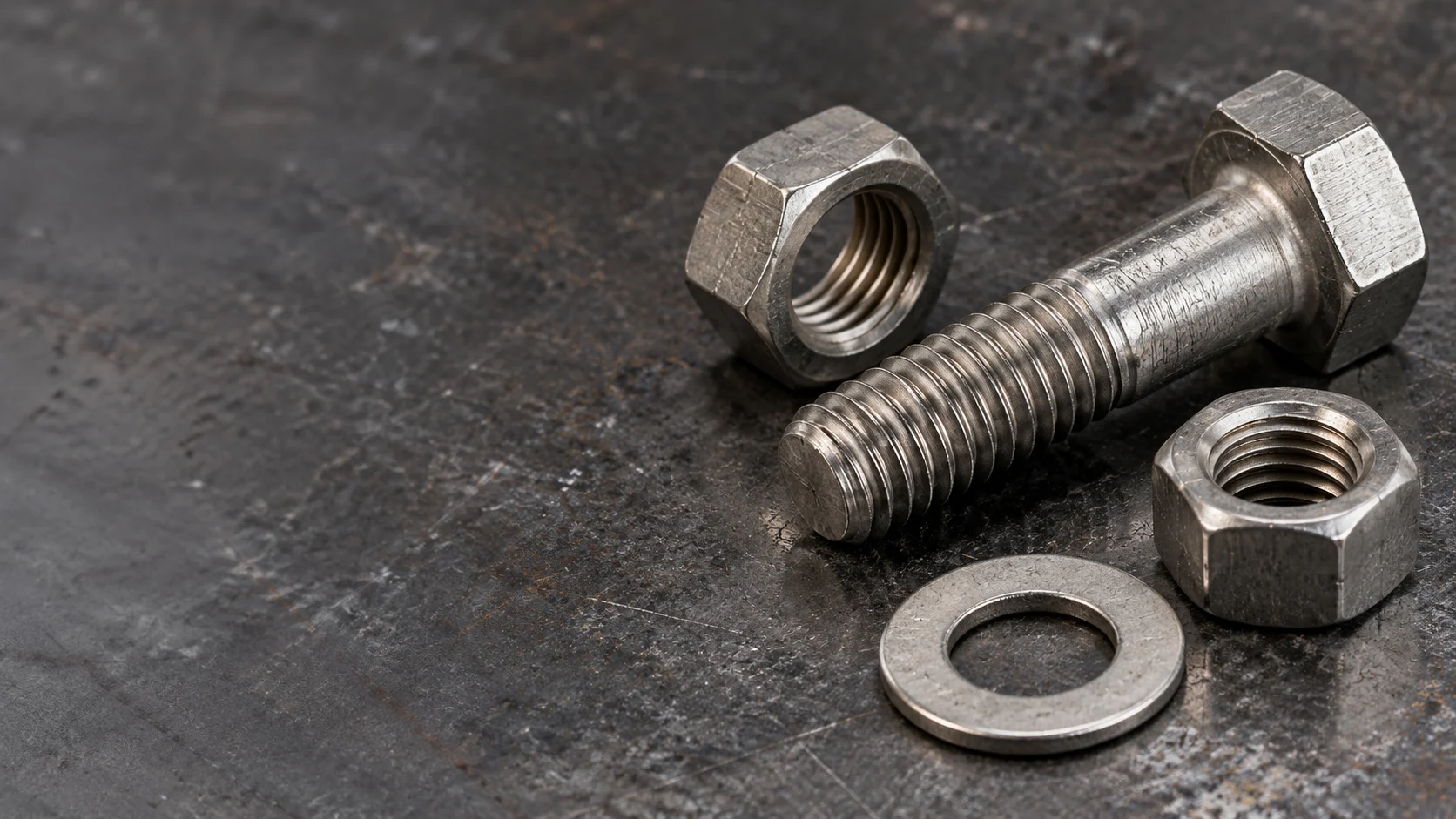
A drawing marked “F468 / F467 / F2281” leaves a supplier to guess which requirement governs each component. These specifications have different product scopes; they are not three interchangeable ways of saying “nickel-alloy fastener”.
Use F468 and F467 as the starting scope checks for applicable general-use nonferrous fasteners and nuts. Consider F2281 for the stainless-steel and nickel-alloy externally threaded fasteners within its heat-resistant and high-temperature scope. Confirm the exact alloy, condition, size and requirements in the selected edition before making a conformity claim. [1] [2] [3]
Which document addresses which part?
| Specification | Product scope | Buying implication |
|---|---|---|
| ASTM F468-23(2026) | Specified nonferrous bolts, hex cap screws, socket-head configurations and studs for general use | Check the configuration and its applicable size range; socket forms do not all share the bolt/stud range |
| ASTM F467-24(2026) | Specified nonferrous nuts for general use | Identify the nut requirement separately from the bolt |
| ASTM F2281-04(2024) | Specified stainless-steel and nickel-alloy bolts, hex cap screws and studs for heat-resistant and high-temperature applications | Check the required type, grade and condition; define the mating nut separately |
F468 names socket head cap, button head, flat countersunk head and low head socket cap configurations within their stated size ranges. Do not extend F2281’s bolt, hex cap screw and stud scope to socket screws by analogy.
The word “nickel” in a standard title does not establish coverage of every nickel alloy or every delivery condition. A catalogue scope is useful for choosing the document to review. The full controlling edition is needed to check the relevant requirements.
Three callouts that need clarification
“M12 bolts to F468”
F468 is an inch-pound specification. Its scope points to a separate metric companion, F468M. Do not convert an inch diameter into millimetres and assume the whole specification has become a metric requirement. Check the metric document’s actual alloy and product coverage; it may differ from the inch edition. The same distinction applies to F467 and F467M. [1] [2]
If the project deliberately adopts selected requirements for a custom metric part, write that acceptance basis explicitly. “Meets selected requirements” and unqualified conformity to the complete standard are different claims. For the dimensional side, see metric and Unified thread classes.
“F2281 stud and nut set”
F2281’s stated product scope does not include nuts. The set therefore needs a separate nut requirement, plus confirmation that the pair meets the joint’s load and temperature requirements. A shared material name cannot fill that gap. [3]
“F2281, therefore suitable at the top of its temperature range”
A broad temperature range in a specification’s scope is not an allowable limit for every included grade, load or duration. Select the fastener condition and evaluate the actual joint, including creep and retained preload. [3] [4]
Keep geometry and material requirements visible
A dimensional standard or drawing establishes the specified shape and tolerances. A raw-material specification applies to its defined material form. A finished-fastener specification establishes requirements within its own scope. Inspection records then demonstrate the particular requirements that were checked.
For a custom order, put each requirement beside the item it controls: bolt drawing and thread callout; material and condition; applicable finished-bolt requirements; nut requirements; tests and documents. This makes conflicting or missing callouts easier to resolve before quotation.
How does this apply to an A-286 or 718 order?
“ASTM A286” is an incomplete requirement: A-286 identifies an alloy, not a complete ASTM document designation. Carpenter identifies A-286 as UNS S66286 and lists ASTM A453 among its applicable specifications. ASTM’s A453/A453M-26 overview distinguishes Grade 660 classes and describes a high-temperature bolting scope. The order must identify the chosen document, grade and class when applicable; the alloy name cannot select those requirements for you. [5] [6]
| Proposed callout | Question to resolve before quotation |
|---|---|
| A-286 bolt; an A453/A453M route is specified | Which edition, grade and class does the drawing require? Define the final condition, component requirements and required evidence; do not accept another class merely because the alloy name or hardness appears similar. |
| Inconel 718 bolt; a feedstock specification is cited | Which requirements govern the finished bolt after manufacture and treatment? State those separately from the raw-material requirement, including the drawing, final condition and required tests. |
Do not replace an explicitly specified A453/A453M or other approved route with F2281 simply because both mention high-temperature service. First check the selected document’s product and material coverage, then reconcile the actual requirements with the design owner. The public scopes establish what to investigate; they do not establish grade-by-grade equivalence.
Use the A-286 condition and heat-treatment guide for the class-and-process questions, or the 718 fastener specification guide for the finished-condition and lot-evidence questions. Once the requirement is resolved, carry it into the A-286 hex-bolt or 718 hex-bolt enquiry with the drawing and mating-part details.
Apply the scope check to the actual product
Confirm the product form and inch or metric series first, then the alloy and condition, and finally the service and contract requirements. A socket screw needs its own scope check; a stud-and-nut set needs requirements for both components. The metric-scope article expands on the separate F468M and F467M documents.
A standard-scope check is one part of the purchase decision. The nickel-alloy fastener selection guide connects it to alloy selection, service conditions and the complete assembly.