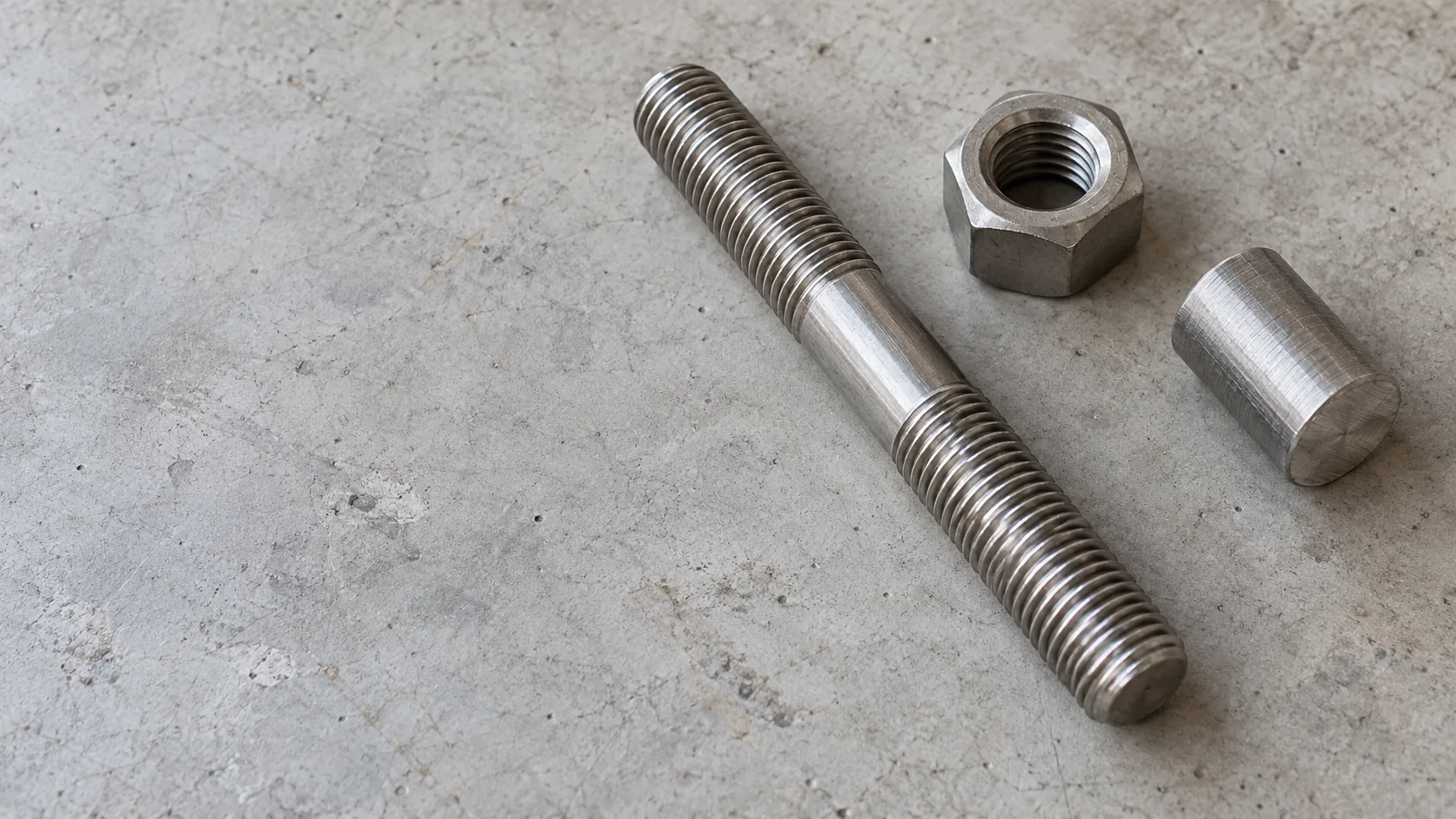
For a fastener exposed to aggressive process liquid, compare C-22, C-276 and 625 using data for that liquid. For a hot joint whose main challenge is retaining load, investigate age-hardened 718 and its time-dependent mechanical evidence. Inconel 625 has an important corrosion-resistant role, so “Hastelloy for chemicals, Inconel for heat” is too crude to specify a bolt or stud.
C-276 and 625 are not interchangeable on a datasheet alone. Match corrosion evidence to the actual stud exposure and mechanical evidence to the final condition. The worked purchasing example shows what that means for an offer.
Choose a reading path
- Chemical attack: identify the actual bolt exposure, then see how impurities and test methods change the comparison.
- Load or heat: compare the final material condition and retained preload.
- A proposed alternative: use the written substitution request.
Hastelloy vs Inconel: C-22, C-276, 625 and 718
On narrow screens, swipe the table sideways to read the source values.
| Grade and selection question | Strength example and original source |
|---|---|
| HASTELLOY C-22 UNS N06022 Investigate oxidizing contaminants. Compare with C-276 using the actual liquid, temperature and localized-attack evidence. [1] | HASTELLOY C-22 solution-annealed plate, 6.4–19.1 mm thick, room temperature YS 372 MPa; UTS 786 MPa. Producer tensile table. |
| Hastelloy C-276 UNS N10276 Investigate reducing-acid service. Identify oxidizing impurities before relying on the grade name. [2] | Hastelloy C-276 solution-annealed plate, 25.4 mm thick, room temperature YS 365 MPa; UTS 785 MPa. Producer tensile table. |
| INCONEL 625 UNS N06625 Include in the corrosion shortlist. Compare same-medium evidence and the offered final condition against the requirements. [3] | INCONEL 625 annealed rod/bar/plate, composite sizes up to 102 mm (4 in.), room temperature YS 414–655 MPa; UTS 827–1034 MPa. Table 5, p.3. |
| INCONEL 718 UNS N07718 For high-strength hot joints. Specify aging and retained-load evidence; assess corrosion separately. [4] | INCONEL 718 15.9 mm hot-rolled round, 982°C anneal plus aging YS ≈1058 MPa; UTS ≈1313 MPa at 27°C. Table 20 and aging cycle, p.10. |
Use the figures to check the stated material condition, not to rank finished bolts. YS (0.2% offset yield strength) relates to resistance to permanent deformation; UTS is the peak tensile stress in the test. These material examples are not finished-fastener acceptance limits. Some ranges combine sizes; 718 is rounded from ksi. The original table gives full conditions; the purchase specification sets acceptance limits.
First establish whether the bolt sees the process liquid
Consider an illustrative process-vessel flange. The wetted vessel wall contacts the process liquid. An external stud may instead remain dry, experience occasional leaks, or trap liquid under insulation. The process chemical alone does not describe the stud’s exposure.
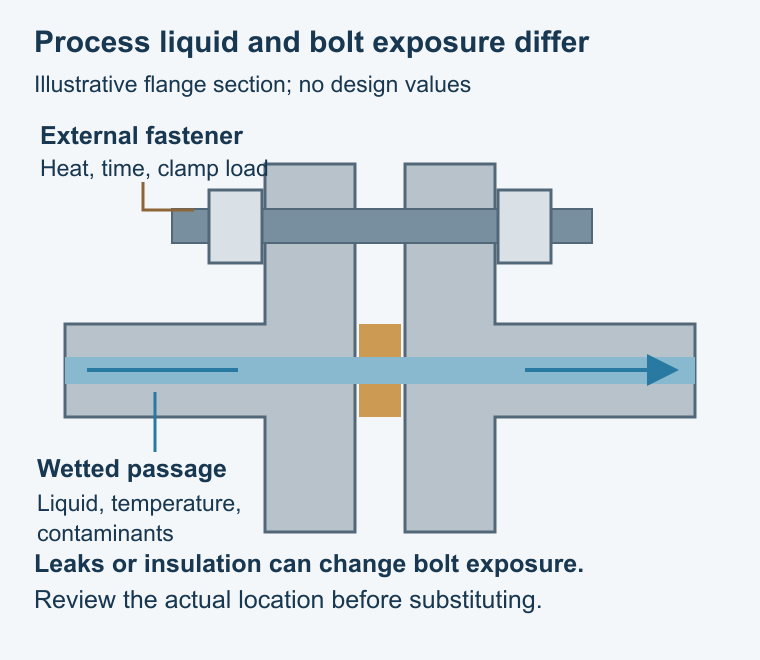
The wetted wall needs process-fluid data. External bolting may instead be governed by credible leaks, thermal cycling or retained preload. Identify that exposure before borrowing the vessel’s material choice for its studs.
What corrosion research adds to the comparison
C-22 vs C-276: an impurity can change the result
In a 2017 journal study conducted at Haynes International, Mishra tested wrought-alloy coupons in hydrochloric acid with controlled ferric-ion additions. The results isolate the effect of an oxidizing impurity. [5]
| Ferric ions added | C-276 | C-22 |
|---|---|---|
| None | 0.29 | 0.32 |
| 1,000 ppm | 3.04 | 0.11 |
Ferric ions are oxidizing species, and the study connects resistance under strongly oxidizing conditions with chromium's contribution to the protective surface film. Ask whether the process liquid contains oxidizing contaminants before choosing between C-22 and C-276. The result does not predict attack at loaded threads or in a washer crevice.
C-276 vs 625: similar in one test, different in another
In the undiluted DBNPA biocide solution tested by Santos and colleagues, neither C-276 nor 625 showed localized attack after 30 days at 25°C and 40°C. [6]
In a different test, Mishra reports critical crevice temperatures (CCT, the laboratory’s crevice-attack threshold) of 35°C for 625 and 55°C for C-276: wrought specimens, 72 hours in 6% ferric chloride plus 1% hydrochloric acid, following ASTM G48 D guidelines. [5] C-276 had the higher threshold there. See the original paper’s Table 3 and test method. These laboratory thresholds are not seawater operating limits.
Choose evidence for the damage that could govern your connection. Uniform corrosion and attack inside a sheltered gap are different questions. Similar results in one biocide do not settle a wet-crevice question in another fluid; an aggressive laboratory test does not automatically reject a grade for every milder service.
Which is stronger: Hastelloy or Inconel?
718 is the high-strength, age-hardenable route in this four-grade comparison. 625 gains strength from elements in its solid-solution matrix. Comparing an annealed C-22 or C-276 value with an aged 718 value describes particular conditions, not a strength ratio between two entire families. [3] [4]
For the order, state the required material tensile properties, test temperature and final condition. Specify any finished-fastener proof-load or other acceptance tests separately from material requirements and dimensions/threads. The UNS number identifies the alloy; it does not complete that specification.
High-temperature resistance must include retained preload
A short hot-tensile test does not show the clamp load remaining after a long hold. Creep is deformation over time under load; relaxation is stress loss while total extension is held.
The whole connection also changes load as its parts expand during heating and cooling. [8]
Direct fastener evidence illustrates the distinction. A NASA-sponsored study tested aged 718 point-drive bolts with Waspaloy twist-off nuts using a fixed distance between their bearing faces. For its 1/4-28 group at about 649°C, the initial stress was about 612 MPa; three 50-hour specimens retained 370–417 MPa, about 60–68% of the initial stress. [7] The threads were rolled after aging. See Table IV.1.1, printed p.407.
This historical result is not a C-276/625 gasketed-flange test. Its three-specimen range is not a design allowable, and 50 hours cannot qualify a 2,000-hour duty. Request evidence for the proposed condition, initial stress and temperature history in the full joint, including its geometry, stiffness and connected parts.
The high-temperature preload guide explains the assembly review; the 625 versus 718 comparison addresses that narrower material choice.
Review a substitution and compare quotations
Neither family is always the cheaper option. Keep the drawing, quantity, required mechanical performance and inspection scope on the same basis; identify each proposed grade and final condition separately. Ask suppliers to identify differences in starting material, machining, treatment and testing. A price premium is meaningful only when you know which requirement or service problem it addresses.
Worked substitution review: C-276 to 625 on a hot flange
All project details and numbers below are hypothetical teaching inputs, not a BYBOLT project, test result or installation recommendation.
A purchase drawing specifies solution-annealed C-276 external studs. The offer proposes solution-treated 625 for the same drawing and quantity. The C-276 callout is a purchase input here, not evidence validating the original joint for this duty. The fictional specification requires:
- At installation: an actual preload range of 40–50 kN per stud, including installation scatter.
- Throughout the duty: at least 30 kN per stud remaining, without exceeding the project’s approved upper-load limit.
- Duty: 2,000 hours at a 600°C stud temperature and 50 thermal cycles.
Credible leakage can wet the external threads during shutdown; the leak-fluid composition has not yet been characterized.
The submitted evidence: the offer includes traceable mechanical results for the proposed solution-treated 625, meeting the drawing’s room-temperature requirements, plus a citation to the DBNPA study above. Those submitted results—not the annealed producer ranges in the first table—support the room-temperature check. It includes no hot-joint retention assessment and no evidence for the unidentified shutdown liquid.
Work the load requirement first. At the lower installation limit, only 10 kN separates 40 kN from the required 30 kN: a 25% reduction from that starting value. This is the example’s load margin, not a prediction of 625 relaxation. The 40 kN lower bound already includes installation scatter. Evaluate thermal movement, time-dependent deformation and any gasket together over the full cycle, including the upper-load limit. Tightening harder is not an automatic remedy.
On the submitted package, keep the alternative pending. The room-temperature results close only that part of the review. The DBNPA test does not qualify the unidentified leak fluid; the project also needs a validated calculation or representative test covering the proposed 625 condition and the full joint duty.
How later evidence would change the decision: suppose, as a further teaching assumption, an accepted joint assessment establishes a minimum of 28 kN over the specified duty. That fails the required 30 kN by 2 kN: reject or revise the proposal, even if corrosion is acceptable. A result meeting 30 kN would close only the lower-load check; upper loads, the actual fluid and the remaining purchase requirements must also pass before approval.
Do not multiply the historical 718 retention percentage by this example’s 40 kN to predict the 625 joint. Record the accepted evidence, final condition, deviations and authorized decision before releasing a revised order.
A useful enquiry can say: “Review a 625 alternative to the attached C-276 drawing and purchase specification. Actual exposure is [fluid, concentration, contaminants and contact pattern]; duty is [stud temperature history, hours and cycles]. State the proposed condition, supporting corrosion and load-retention evidence, and each requirement or deviation needing approval.”
BYBOLT deliveries include an EN 10204 3.1 material inspection certificate, heat-number traceability and mechanical testing. Test objects, methods and acceptance requirements follow the agreed order; threaded products include sampled GO / NO-GO gauging. Additional PMI or third-party inspection is agreed in the quotation. Send the drawing and service details for review.
Comparing a wider set of materials?
For a broader shortlist including 316L, duplex, Monel, A-286 and titanium, use the fastener-material comparison.
If stainless steel or duplex is the starting point, identify the failure mechanism before moving to a nickel alloy; the nickel-alloy guide provides that wider context. For a marine proposal involving Monel, see the Monel versus Inconel comparison.
HASTELLOY and INCONEL are trademarks of their respective owners. Acceptance of ordered fasteners follows the agreed purchase requirements.