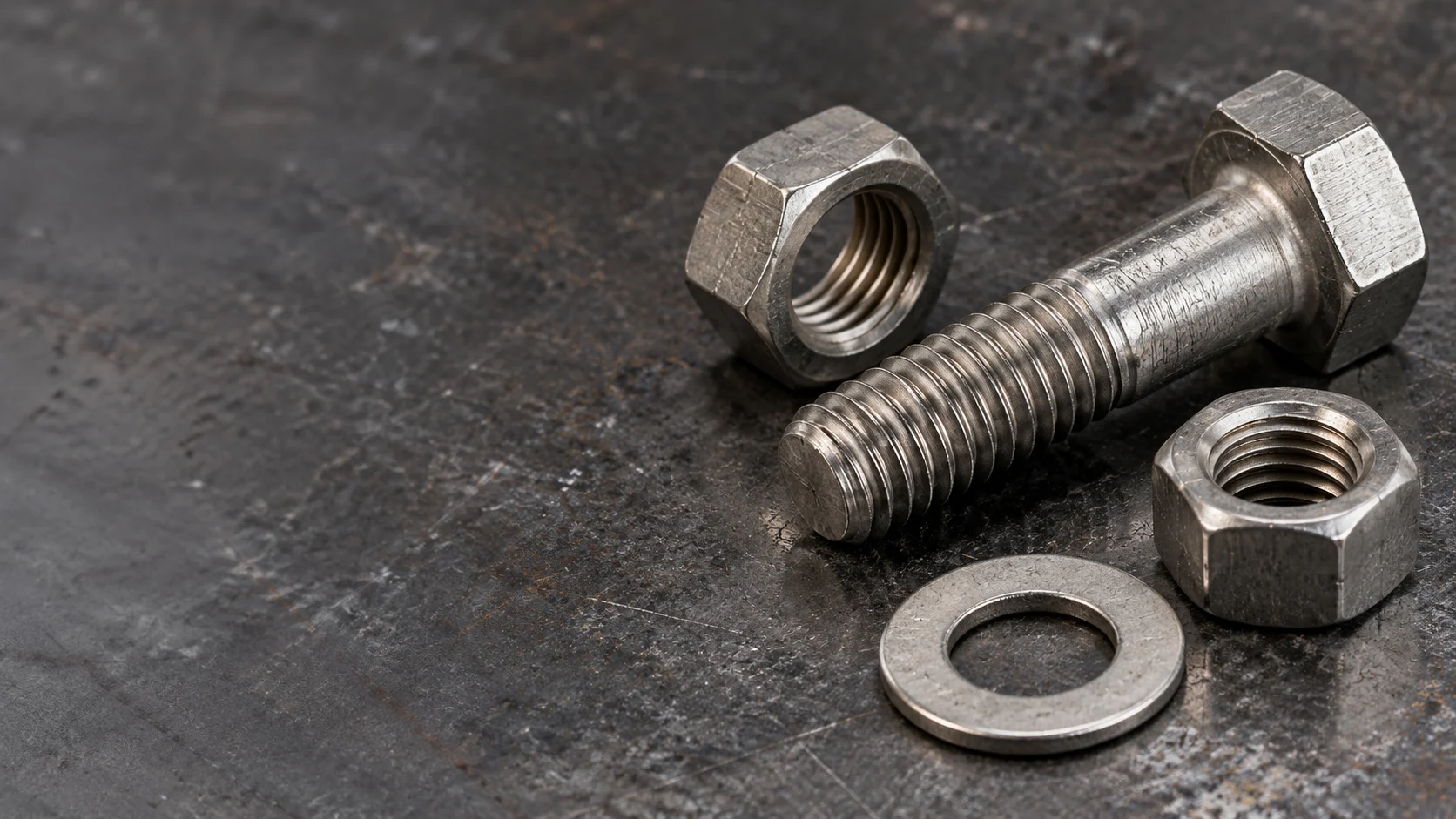
The nickel-alloy bolts have arrived, but the replacement nuts on the shelf are stainless steel. They have the right diameter and pitch, and they run down the threads by hand. Can they be used?
A nickel-alloy bolt and a stainless steel nut can only be accepted as a specified, reviewed combination. A matching thread does not establish adequate load capacity, corrosion resistance or installation behavior. Check the governing specification first: it may already define the mating nut and leave no room for an unapproved substitution.
Read the mating rule before comparing alloys
ASTM F594-24 covers certain stainless steel nuts. Its published scope identifies F593 fasteners of the same alloy group as the default mating bolts, cap screws and studs, unless otherwise specified. It therefore does not provide blanket approval to put a stainless nut on a nickel-alloy bolt. [1]
ASTM F467-24(2026) covers specified wrought nonferrous nuts for general service and points to F468 for applicable mating bolts, cap screws and studs. These are defined product scopes, not interchangeable labels for every nut-and-bolt combination. Both size coverage and unit system must be checked before assigning a standard. [2]
If the drawing specifies a matched material or finished-product requirement, a different nut is a proposed engineering change. Put the alternative in writing with its material, condition, nut style and test basis. Do not hide the change in the phrase “equivalent stainless nut.”
The nut must carry the load, not just fit the thread
The bolt transmits tension through the engaged threads into the nut, and through the nut’s bearing face into the joint. Nut geometry, material strength and effective thread engagement are therefore part of the load path. A free-running fit demonstrates neither thread stripping resistance nor a suitable proof-load basis. NASA’s fastener manual treats internal-thread pullout strength and engagement explicitly, and warns that reduced-height shear nuts are not general substitutes for tension applications. [3]
For an Inconel 718 bolt, specify the thermal condition before discussing strength. The producer’s bulletin shows that mechanical properties depend on processing and heat treatment. The nut needs its own defined properties; “316” on a parts list is not a complete finished-nut specification. [4]
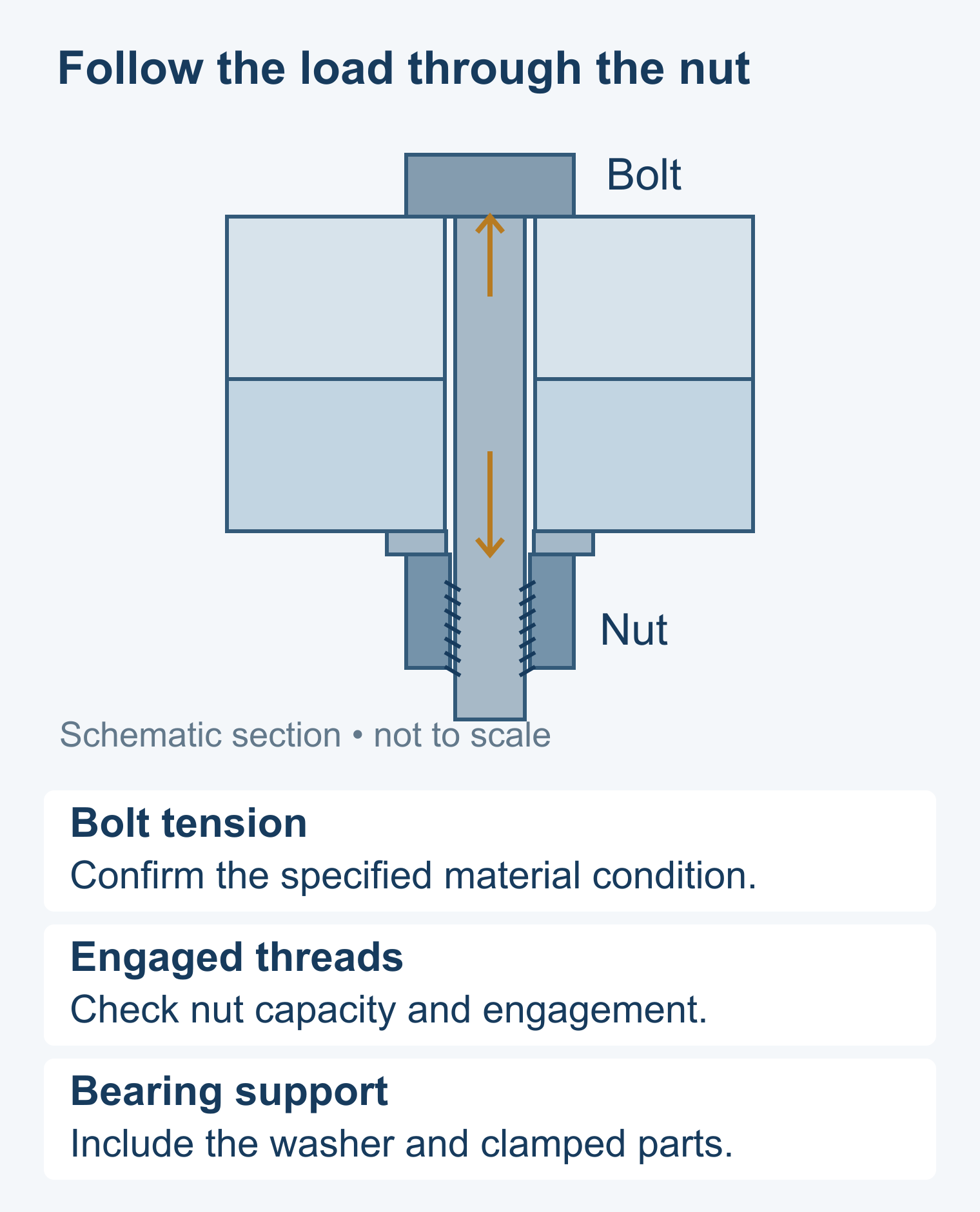
Consider a maintenance proposal to retain a thin stainless nut while changing the stud to a stronger nickel alloy. The stronger stud does not strengthen the nut. Request the specified nut capacity and evaluate the actual engagement and bearing arrangement. Do not try to compensate by tightening harder or by counting the exposed threads above the nut.
Evaluate the environment of both components
Galvanic action requires an electrolyte and an electrical connection between materials with different electrochemical behavior. The relevant comparison concerns the actual surfaces and environment, not simply the words “nickel” and “stainless.” NASA’s discussion also shows why active and passive surface states matter. [3]
A dry indoor joint and a connection repeatedly wetted by seawater need different assessments. Include the washer, flange or plate and any coating in the review. Even if a proposed pair does not create a dominant galvanic problem, the stainless nut still needs sufficient resistance to its own local exposure, including sheltered wetted regions.
If 625 was selected because of a corrosion requirement, replacing its mating hardware with an unspecified stainless part reopens that requirement. The seawater fastener guide follows the wetting, crevice and connected-metal questions in detail. For material identification, use the Inconel 625 reference.
A new nut can require a new tightening procedure
Torque is consumed by friction in the mating threads and beneath the rotating bearing surface as well as by producing bolt tension. Changing the nut material, coating, lubricant or bearing arrangement can change that relationship. NASA lists these variables among the reasons that a torque table must match the assembly being installed. [3]
Consequently, an old torque value is not automatically valid after changing the nut. Nor is a mixed-material pair an automatic cure for galling. Agree the actual surface condition, lubrication and installation method, then use appropriate assembly evidence where the joint demands it. The separate galling guide covers the detailed prevention measures.
For maintenance work, record whether the nut and bolt are new or reused and how the threads will be inspected. A nut that ran freely before installation can still encounter a damaged region or a different friction condition under load. Stop an abnormal assembly process and investigate its cause; do not use additional torque as a diagnosis.
Check the hot joint, not only room-temperature strength
At elevated temperature, check the bolt, nut and clamped stack together. Differential thermal expansion can either increase or reduce fastener load depending on the materials and joint geometry. Room-temperature fit and material strength therefore do not settle the operating condition. [3]
A nickel-alloy bolt chosen for hot service does not extend the temperature capability of an unspecified stainless nut, washer or locking feature. Identify the relevant temperature, duration and retained-clamp requirement for each component. Continue to the high-temperature preload and relaxation guide when time at temperature is part of the duty.
Make the replacement decision explicit
| What you know | Decision still needed |
|---|---|
| The nut fits by hand | Confirm thread designation and inspection, nut geometry and mechanical capacity for the actual load. |
| Both materials are corrosion resistant | Assess each component and their connection in the actual fluid, wetting and temperature conditions. |
| The original torque is available | Check whether it was established for the proposed nut, surface treatment, lubricant and bearing face. |
| The bolt is rated for the temperature | Check the nut, washer and clamped parts, including time-dependent behavior and thermal load changes. |
| The supplier offers an alternative | Obtain a defined deviation and the responsible technical acceptance before substituting it. |
Order the pair as an assembly decision
For a replacement enquiry, send the original drawing or bill of materials and identify what is being retained. Add the proposed nut specification, thread system, nut height/style, service conditions, assembly procedure and available inspection records. The useful question is “Can this defined alternative meet this joint’s requirements?”
Use the Hex Nuts page for the nut itself, or request a fully threaded stud and nut set when the mating pair is purchased together. Where bearing hardware is also part of the scope, use stud, nut and washer sets. The hex bolt catalogue provides the headed-bolt route.
Specifying a set keeps the components visible in one enquiry; it does not remove the need to define their individual requirements. A properly reviewed mixed-material pair may be appropriate, while an unidentified “matching nut” leaves the most important decisions unfinished. Send the proposed assembly for review →
If the proposal changes the bolt as well as the nut, use the nickel-alloy fastener selection guide to review the complete connection before defining the replacement order.