
A double-end stud has no head. One end screws into the valve body and stays there for the life of the valve; the other passes through the bonnet flange, takes the nut and comes off at every overhaul. That split life is why a bonnet stud that matches the original in length can still fail where the original never did.
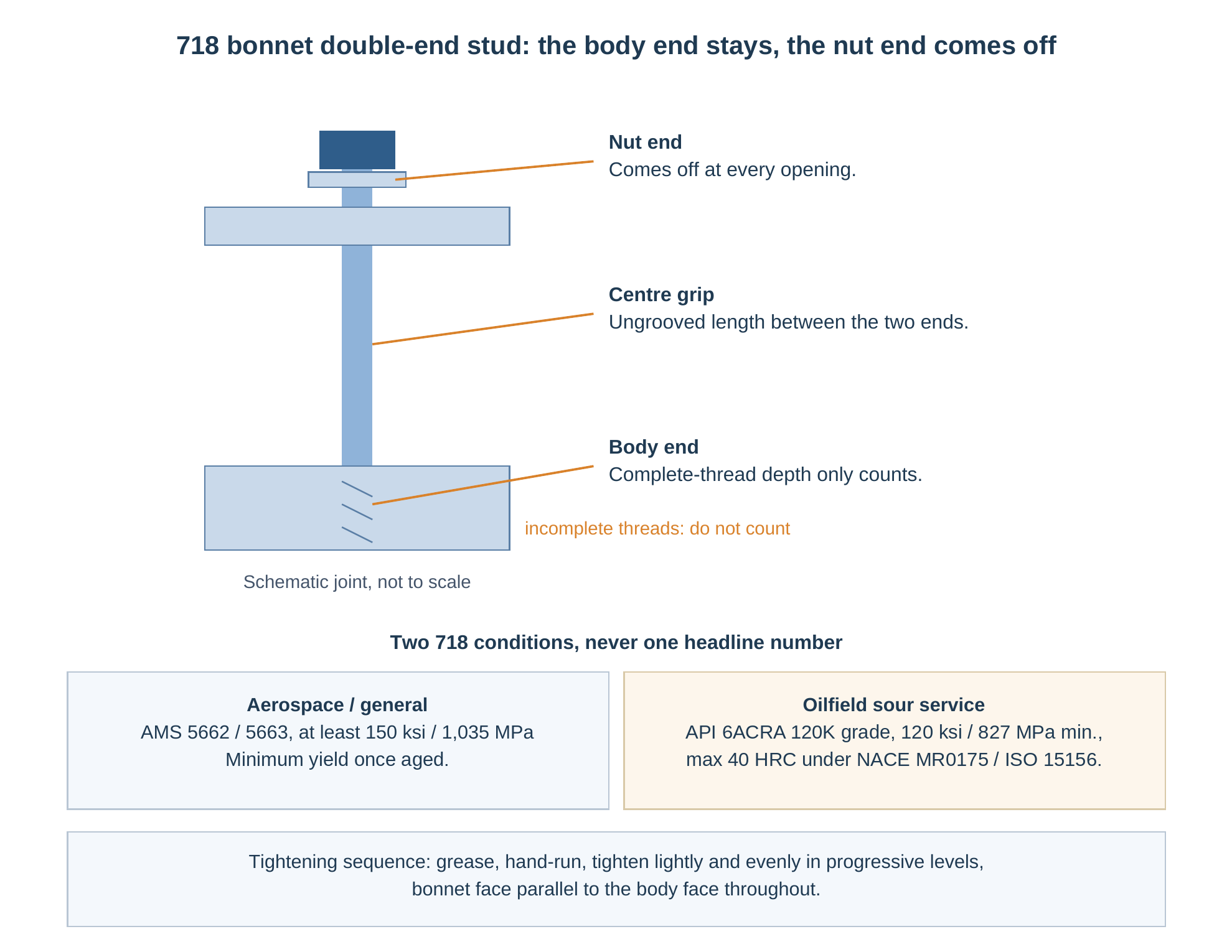
The body end: engagement in a weaker metal
The body end carries the full stud load into the valve body through the tapped thread. How much engagement it needs depends on the two materials. When stud and body have similar strength, an engagement of about one diameter is usually enough for the stud to break before the thread strips. Aged 718 is far stronger than a cast or forged Cr-Mo valve body, so with the same engagement the body thread strips first. That is why 718 body ends often need more engagement than the steel studs they replace, and why the body-end length should come from the valve maker's tapped-hole depth, not from the B16 stud it replaces.
Only complete threads count. A tap can't cut full thread to the bottom of a blind hole, so the last few turns are incomplete and carry little load. The drawing should give the tapped-hole depth and the depth of complete thread as separate numbers, along with the body-end thread length on the stud. A body end that is one or two threads shorter than the original pulls out under the load the original held, and afterwards the failure looks like a material problem.
The body-end fit matters too. Some valves use a standard fit, often with the stud bottomed on its thread runout or locked; others use an interference-fit tap end, to ASME B1.12 Class 5 for inch threads or as defined on the valve drawing for metric ones, which stops the stud turning when the nut is removed. The fit has to be stated on the order: an interference end and a standard end are not interchangeable in the same hole.
Grip, nut end and the dimensions a replacement must match
Double-end studs are dimensioned to the valve drawing or to ASME B18.31.2 (inch) and B18.31.1M (metric), but a replacement for an existing valve should match the original stud, not just the standard. The numbers that have to agree are:
- overall length, body-end thread length and nut-end thread length, each stated separately
- grip length and diameter, plain or reduced shank, because the grip decides how far the nut threads on and where the thread runs out
- thread size, pitch and class at each end, which may differ
- nut standard and condition, since a nut with a different thread depth changes the nut-end engagement even when the stud is right
A stud with the right overall length but a longer grip runs out of thread before the nut is fully engaged. One with a shorter grip puts thread inside the bonnet flange bore, where it weakens the stud at the joint face and can't be inspected. Our note on grip length and thread runout covers how to measure an old stud for these numbers.
Hot load and the tightening sequence
Steam pressure pushes the bonnet off the body while the bonnet, body and studs heat at different rates. During warm-up the body and bonnet flange usually lead the studs, which raises preload; on cool-down the order reverses. Once everything is hot, studs that expand more than the joint lose preload and studs that expand less gain it. 718 sits close to Cr-Mo and 9Cr valve steels in expansion, so the swing is small; an austenitic stud such as A286 in a ferritic body loses a good part of its preload on heat-up alone. On top of that, preload fades slowly with time at temperature through relaxation.
The sequence is where most bonnet leaks start. Lubricate the threads and nut faces, run the nuts down by hand, then tighten in a cross pattern in several even passes, keeping the bonnet face parallel to the body face throughout. A bonnet pulled fully down on one stud before the others seats crooked, and the gasket then seals unevenly. Replace any stud or nut with damaged threads before the final pass. The enquiry should state the torque or tension per pass, the lubricant and how parallelism is checked. 718 threads in 718 or other nickel-alloy nuts can gall, so a nickel-based, lead-free and sulfur-free compound approved by the valve maker is the usual choice at steam temperatures.
Condition and material choice
Inconel 718 is only as strong as its ageing. Bar to ASTM B637 or AMS 5663, solution treated and aged, or AMS 5662 bar aged after machining, gives the 150 ksi (1,035 MPa) minimum yield a bonnet joint is designed on; material that was solution treated but never aged looks identical and has far less strength. The certificate should state the ageing treatment and show the hardness of the finished studs. The Special Metals 718 bulletin rates the alloy for service up to 1300°F (about 705°C), but long exposure above about 650°C coarsens the strengthening phase, which is why bonnet studs are usually kept below that. Our 718 specification guide goes through what to write on the order.
| Candidate | Specification | Where it fits a steam-valve bonnet | What to watch |
|---|---|---|---|
| B16 | ASTM A193 B16 (Cr-Mo-V) | Cooler bonnets, below about 500°C | Relaxation and creep limit service above that |
| 12% Cr steel | ASTM A437 B4B / B4C | The step above B16 | Expansion close to the body; check relaxation at the top of its range |
| Inconel 718 | N07718, ASTM B637 / AMS 5663 aged, or AMS 5662 aged after machining | Hot, high-load bonnets | Aged condition proved; long-term limit about 650°C; body-end engagement |
| A286 | S66286, ASTM A453 Grade 660 | Lower-load bonnets where the valve maker allows it | Expansion well above a ferritic body; class on the order |
For the A286 alternative, see the A453 Grade 660 class and purchasing requirements.
Related references: A286
Where 718 replaces B16 or 12Cr studs, check two things before ordering: the body-end engagement, for the reason above, and the nut. A 718 stud with a steel nut that relaxes or oxidizes at temperature gives up the benefit of the stud; most hot bonnets pair 718 studs with 718 heavy hex nuts or a nut grade named by the valve maker. For the casing-joint version of the same problem, see 718 stud bolts in turbine casings.
| Lock before ordering | Why it matters | Document to ask for |
|---|---|---|
| Tapped-hole depth, complete-thread depth, body-end length and fit | A short or wrongly fitted body end pulls out | Valve drawing, tapped-hole specification |
| Grip length and diameter | Decides nut engagement and where the thread runs out | Drawing or measured original stud |
| Nut-end length, nut standard and thread depth | Too little nut engagement caps the joint load | Nut specification |
| Aged condition and hardness | Unaged 718 won't carry the design load | Ageing record, hardness report on finished studs |
| Tightening sequence, lubricant, parallelism check | Uneven tightening seats the bonnet crooked | Valve maker's tightening procedure |
| Set list by valve | A mixed set can't be traced after a leak | Set list, EN 10204 3.1 certificates, PMI where specified |
Related references: EN 10204 3.1 certificates
Requesting a quote
Send the valve, not just the size. For example: "M20 Inconel 718 double-end studs for a steam-valve bonnet, solution treated and aged to AMS 5663, about 550°C steam (to be confirmed from the valve datasheet), F22 body, body-end and grip lengths from the original stud." A photo of a removed stud showing pull-out marks on the body end or a nut end that ran out of thread tells the engineering team whether the last failure was engagement, tightening or material.
The team will check both ends, the grip and the nut against the drawing or the original stud, then quote 718 double-end studs with EN 10204 3.1 certificates. Other valve and pump bolting is covered under pumps, valves and OEM.