Short answer
Inconel 718 (UNS N07718) stud bolts suit turbine-casing joints that run too hot for Cr-Mo-V or 12% chromium steel bolting, from roughly 500°C up to about 650°C for long-term service. 718 aged to AMS 5662/5663 has a minimum room-temperature yield of 150 ksi (1,035 MPa) and keeps much of it at temperature. Its thermal expansion is also close to that of a Cr-Mo steel casing, so heating the joint changes the preload far less than it would with an austenitic stud such as A286.
Casing joints rarely leak in steady running. They leak after a startup or shutdown, when the casing, studs and gasket have heated at different rates and stress relaxation has lowered the preload a little more with every hot hour. A stud set that holds its preload cold says nothing about the joint hot, so the order has to describe the start history: stud temperature, number of starts, hold time and how the joint is checked after the first heat-up.
Order the condition, not just the alloy. 718 is precipitation hardened, and the same UNS number covers material with very different strength. Solution-treated material that was never aged, or oilfield 718 to the API 6ACRA 120K grade (formerly API 6A718), with a 120 ksi (827 MPa) minimum yield, will not carry the load a casing designed on the aged AMS condition expects. The oilfield grade's 40 HRC cap under NACE MR0175 / ISO 15156 is a sour-service rule and has nothing to do with a turbine casing. The certificate should state the ageing treatment and show the hardness of the finished studs.
The OEM drawing governs. A useful enquiry gives the drawing number and revision, the casing material, the stud temperature, how often the turbine starts, the tightening method (torque, hydraulic tensioning or heater rods) and the hot acceptance procedure. BYBOLT makes 718 stud bolts to drawing from 100 pieces, with EN 10204 3.1 certificates.
A casing stud is ordered for the whole start history of the turbine, so the casing material, the stud condition, the start pattern and the hot acceptance check all go on one enquiry.
01 What startup cycles do to preload
When a turbine starts, the flange usually heats ahead of the studs sitting in its bolt holes. It grows first, stretches the studs further and raises the preload, sometimes enough to overload a stud that was tightened close to its limit. On shutdown the order reverses and the preload drops. With an expansion-matched stud such as 718, this lag usually matters more than the coefficients.
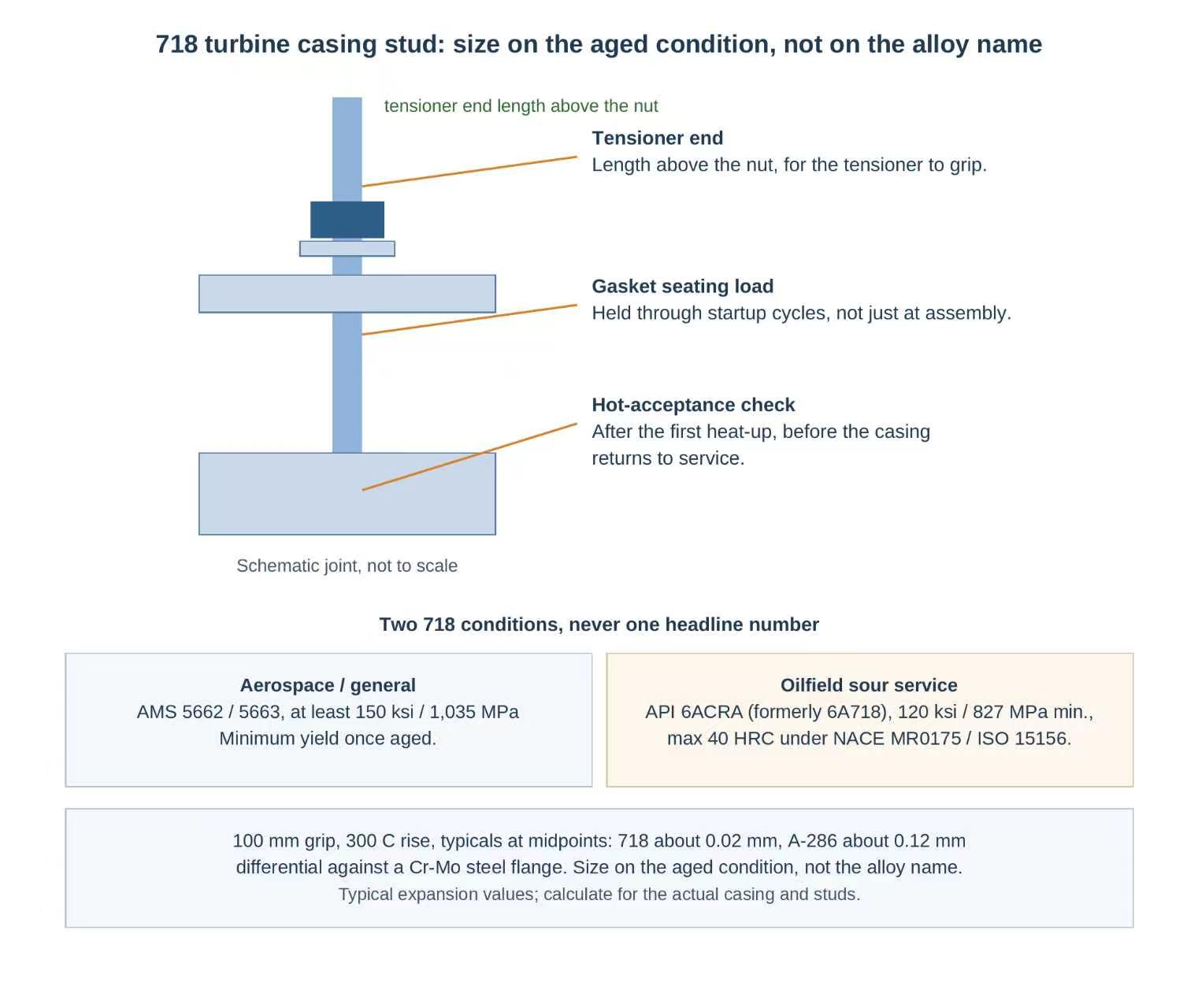
Once everything is hot, the expansion coefficients take over. If the studs grow more than the flanges they clamp, preload falls; if they grow less, it rises. The figure works through a 300°C rise over a 100 mm grip: the difference is roughly 0.02 mm for 718 in a Cr-Mo steel flange and 0.12 mm for A286. At a working stud temperature of 500–550°C, the A286 figure roughly doubles to around 0.2 mm, while 718 stays a few hundredths. For comparison, the elastic stretch that holds the preload in that grip is only about 0.2–0.35 mm, depending on how hard the stud is tightened. An A286 stud in a steel casing can therefore lose most of its preload on heating alone. These are typical coefficients, so give both materials and have the difference calculated for the real joint.
On top of both comes stress relaxation, the slow loss of preload at temperature. Our note on preload loss at high temperature covers how it builds up. Each start then begins from a slightly lower clamp load than the one before.
So the enquiry should give the casing material, the metal temperature at the stud shank, the startup rate, the number of starts and the hold time at temperature. A casing that starts once a year is a different stud duty from one that starts every week, even though both are called turbine service.
02 Specify the aged 718 condition
Inconel 718 is precipitation hardened: its strength comes from gamma-double-prime and gamma-prime particles formed during ageing. The Special Metals INCONEL alloy 718 bulletin rates it for service from cryogenic temperatures to 1300°F (about 705°C) and names aircraft and land-based gas-turbine casings among its uses. Long exposure above about 650°C gradually coarsens the strengthening phase, so give the design life along with the stud temperature.
The same alloy name covers conditions with very different strength:
- AMS 5662 / AMS 5663: bar supplied solution treated (5662, aged after machining) or solution treated and aged (5663), with a minimum yield of 150 ksi (1,035 MPa) once aged. This is the condition a casing joint is normally designed on.
- API 6ACRA 120K grade (formerly API 6A718), the common oilfield condition: 120 ksi (827 MPa) minimum yield, with hardness capped at 40 HRC under NACE MR0175 / ISO 15156 for sour service. It suits a wellhead, but its minimum yield is 20% below the aerospace condition.
- Solution treated but not aged: far lower strength again, and not fit for a casing load.
A stud in the wrong condition looks exactly like the right one, so the order should name the condition and the certificate should show the ageing treatment and the hardness of the finished studs, not just of the bar. State too whether threads are rolled before or after ageing. Rolling after ageing leaves compressive stress at the thread root that helps fatigue life, and the casing designer may require one sequence or the other.
03 718 against B16, 12% Cr steel, Nimonic 80A and A286
Casing studs step up through a fairly settled sequence of materials as temperature rises. Cr-Mo-V bolting to ASTM A193 B16 covers the cooler joints. Around 500°C and above, relaxation and creep in B16 start to limit how long a joint holds its preload, and designers move to 12% chromium turbine bolting such as ASTM A437 B4B or B4C, or to a nickel alloy. 718 is the high-strength choice among the nickel alloys; Nimonic 80A is the long-established alternative in European steam-turbine practice.
| Candidate | Specification | Where it fits a turbine casing | What to watch |
|---|---|---|---|
| B16 | ASTM A193 B16 (Cr-Mo-V) | Cooler casing joints, below about 500°C | Relaxation and creep bleed preload above that range |
| 12% Cr steel | ASTM A437 B4B / B4C | The step above B16 | Expansion close to the casing; check relaxation at the top of its range |
| Nimonic 80A | N07080, EN 10269 (NiCr20TiAl) or OEM specification | Hot steam-turbine joints where the OEM specifies it | Ageing condition and relaxation data from the OEM |
| Inconel 718 | N07718, ASTM B637, aged to AMS 5663 | High-load joints where a smaller stud is needed | Aged condition stated and proved; long-term limit about 650°C |
| A286 | S66286, ASTM A453 Grade 660 | Lower-load casings where the OEM drawing allows it | Lower aged strength than 718, and expansion well above a steel casing |
The A286 vs 718 comparison goes through the strength and temperature differences in more detail. ASTM B637 and AMS 5662/5663 describe the bar; the stud drawing, nut grade and any testing of the finished studs still have to be specified.
04 OEM drawing, tightening method and hot acceptance
Where an OEM drawing exists, it is the governing document. Give its number and revision, the stud size and thread, the nut standard and condition, the washer type and the tightening method. A stud made to a generic standard where the OEM requires a specific condition will be rejected at receipt, whatever its alloy.
The tightening method can change the stud itself:
- Torque or torque-angle. No change to the stud, but turning the nut a set angle after a snug torque gives more repeatable stretch than torque alone where friction varies.
- Hydraulic tensioning. The tool stretches the stud and the nut is run down by hand. The stud needs extra thread above the nut for the tensioner to grip, and that length has to be on the drawing.
- Heater rods. Large steam-turbine horizontal-joint studs are often bored through the centre. A heater in the bore lengthens the stud, the nut is turned through a set angle, and the stud tightens as it cools. The bore diameter and depth then belong on the drawing too.
Give the thread form, including a rounded-root UNR or UNJ thread where specified. 718 threads running against 718 nuts can gall, so name the anti-seize the OEM approves; at casing temperatures it has to be free of lead and sulfur.
Then define hot acceptance. State whether the joint is checked hot after the first startup, whether hot re-tightening is allowed and at what temperature, and what leakage or preload criterion passes the joint. A joint only ever checked cold will pass cold and can still leak hot.
At an overhaul, measure removed studs by position for permanent stretch, necking and thread damage. Stretch confined to one area of the joint points to a local temperature or load problem there. If every stud stretched by a similar amount, check the ageing record and the design temperature before ordering the same studs again.
| Settle before ordering | Why it matters | Document to ask for |
|---|---|---|
| OEM drawing number and revision | A generic stud where the OEM requires a condition is rejected | OEM drawing, revision stated |
| Casing material, stud temperature, start pattern | Decides the stud material and the relaxation check | Casing data, temperature history, start frequency |
| Aged condition and proof | Unaged or oilfield-condition 718 won't carry the design load | Ageing record, hardness report on finished studs |
| Tightening method and tool space | Tensioners and heater rods need length or a bore on the drawing | Drawing with tensioner length or bore |
| Hot acceptance and re-tightening | Cold preload doesn't prove hot preload | Hot acceptance procedure, pass criterion |
| Set list and certificates | A leak can only be traced if each stud's position and heat are known | Set list by casing position, EN 10204 3.1 certificates, PMI where specified |
05 Requesting a quote
A casing enquiry the engineering team can act on looks something like this: "M64 Inconel 718 stud bolts for a steam-turbine casing horizontal joint, aged to AMS 5663, about 600°C stud temperature (to be confirmed from the casing data), weekly starts, hydraulic tensioning, tensioner length per drawing." If you're replacing a set that leaked, measurements of a removed stud showing any permanent stretch help separate relaxation from overload.
That note is enough to start; send the OEM drawing as soon as you have it. The team will work through the remaining temperature, start and tightening details with you, then quote 718 stud bolts with matching 718 heavy hex nuts and EN 10204 3.1 certificates. Fastener orders start at 100 pieces. For other turbine and power-plant bolting, see power generation and turbines.