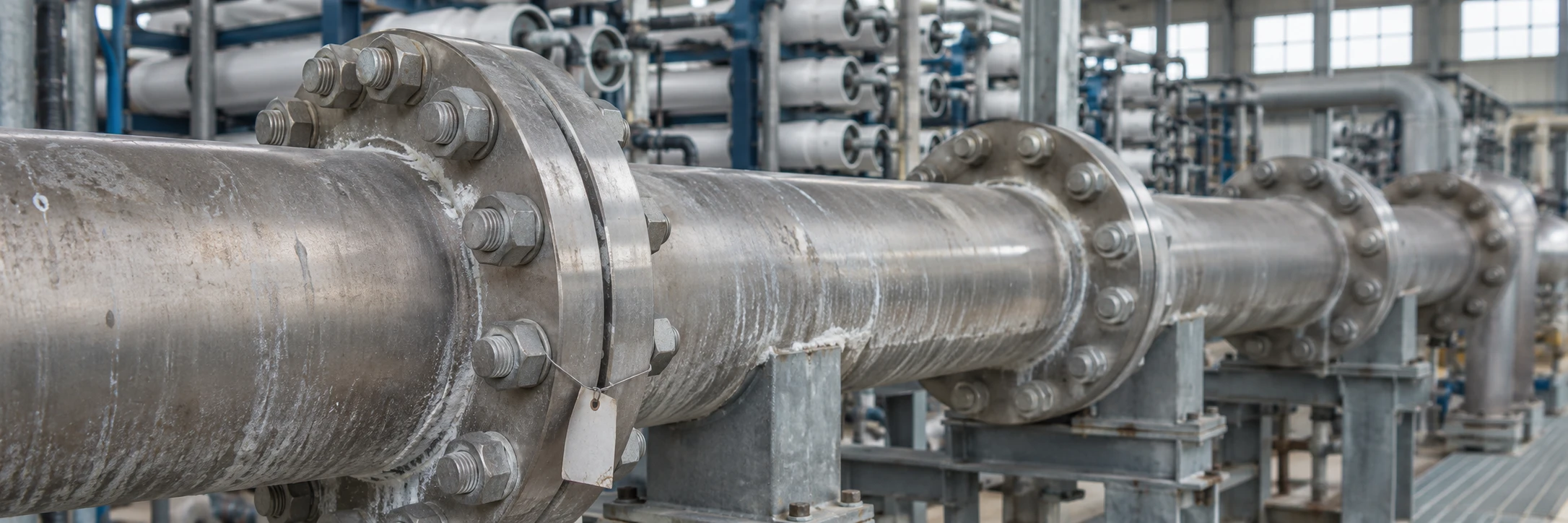
A desalination plant has hundreds of high-pressure flanges, most of them looking alike. When studs arrive as a pile of one grade, someone on site has to sort them by length, match them to gaskets and work out which line they belong to, and that is where mistakes get made. An itemized list moves that work to the order stage, where it can be checked.
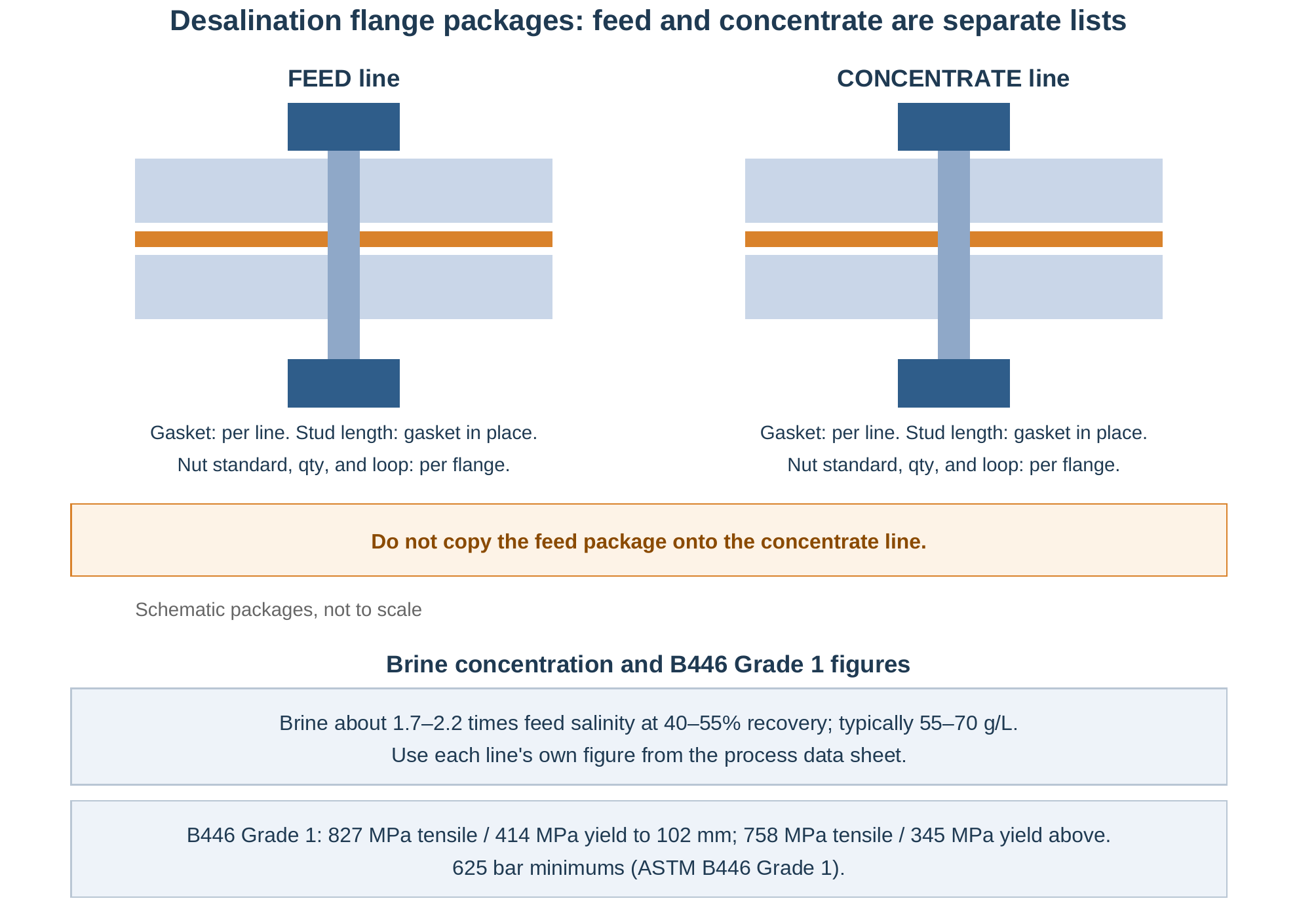
Split the packages by line
The feed and concentrate lines in a seawater RO train work at similar pressures but carry very different water. A review of RO brine management puts typical SWRO recovery at 40–55%, which concentrates the salts by roughly 1.7 to 2.2 times: about 60–80 g/L from a 35 g/L feed. Published surveys, such as an IntechOpen chapter on brine treatment, put typical discharge brine at about 55–70 g/L.
Higher salinity means more chloride in every crevice under a nut or gasket, and a higher scaling tendency. So the concentrate line usually deserves more corrosion margin than the feed line, and an intermittently flowing brine line more than a continuous one. For each line, give the fluid, its salinity or TDS from the process data sheet, its temperature range and pressure, and whether it runs continuously.
For thermal plants (MSF and MED), take the brine figures from that plant's own data sheet; their brine is usually less concentrated than RO brine but hotter.
One row of the list per flange
The list is only useful if each row describes one flange completely. For each flange, give:
- line and loop name, and the flange tag or isometric reference
- flange standard, size, pressure class and facing, for example ASME B16.5 Class 600 raised face
- gasket type, material and thickness
- stud size, thread, length and quantity
- nut standard, grade and quantity, and washers if required
- spare quantity
Stud length is the field most often wrong. It depends on the flange thickness, the gasket in its compressed state, the nut height and the thread projection required beyond the nut. A length taken from a table for one gasket type won't suit another, and spiral-wound and sheet gaskets differ by 1–2 mm once compressed, enough to lose a thread of engagement. Our guide to measuring stud bolt length explains the calculation.
Count spares by flange as well. A package that holds exactly the fitted quantity runs out at the first damaged thread or dropped stud, and the replacement then comes from whatever is on site.
Grade by line conditions
| Candidate | UNS and specification | Where it fits desalination flanges | What to watch |
|---|---|---|---|
| Super duplex 2507 | S32750, ASTM A479 bar, A182 F53 | HP feed and brine lines at moderate temperature | Warm brine erodes crevice margin; project hardness cap if sour |
| Inconel 625 | N06625, ASTM B446 Grade 1 | Warm, stagnant or creviced brine | 414 MPa minimum yield to 102 mm |
| 254 SMO | S31254 | Lower-pressure seawater and brine lines | Lower strength than 2507 |
| 316L | S31603 | Not for seawater or brine | Crevice corrosion in chlorides |
For the 254 SMO option in the comparison, see 254 SMO stud bolts.
Related references: Super duplex 2507 · Inconel 625 · 254 SMO
2507 is the workhorse because its 550 MPa minimum proof strength, from Alleima's bar data, keeps stud sizes compact at high pressure. Its limit is crevices in warm water; TWI notes that NORSOK M-001, a conservative offshore standard, restricts super duplex in seawater to 20°C. Our 625 vs 2507 seawater flange comparison sets out where each one fits.
Labels, records and receipt
Label each package with the line, the loop and the flange tags it serves, and keep the heat numbers and certificates in the same grouping, so that a package can be checked at receipt and traced after a leak.
At receipt, check a sample from each package against its list: grade marking, length, nut engagement with the stated gasket, and quantity including spares. A package that fails the check goes back as one unit rather than being sorted on site.
| Lock before ordering | Why it matters | Document to ask for |
|---|---|---|
| Line, fluid, salinity, temperature, pressure | Feed and brine need different margins | Process data sheet per line |
| Flange standard, class, facing per flange | Studs for one flange standard won't fit another | Line list or isometrics |
| Gasket type and thickness per flange | Sets the stud length | Gasket specification |
| Fitted plus spare quantity | Exact counts run out at the first damaged stud | Bolting list with spares |
| Labels and records per package | Lets each package be checked and traced | Package labels, EN 10204 3.1 certificates by heat |
Related references: EN 10204 3.1 certificates
Requesting a quote
The best enquiry is the bolting list itself, even a rough spreadsheet with one row per flange. If that isn't ready, a line list with flange sizes, classes and gaskets lets the engineering team build the list with you. Note which lines carry brine and their temperatures.
The team will check each line, calculate stud lengths against the stated gaskets and quote flange stud bolt kits in 2507 or 625, packed and labelled per flange or per line, with EN 10204 3.1 certificates. Other desalination and water-treatment bolting is covered under water treatment and desalination.