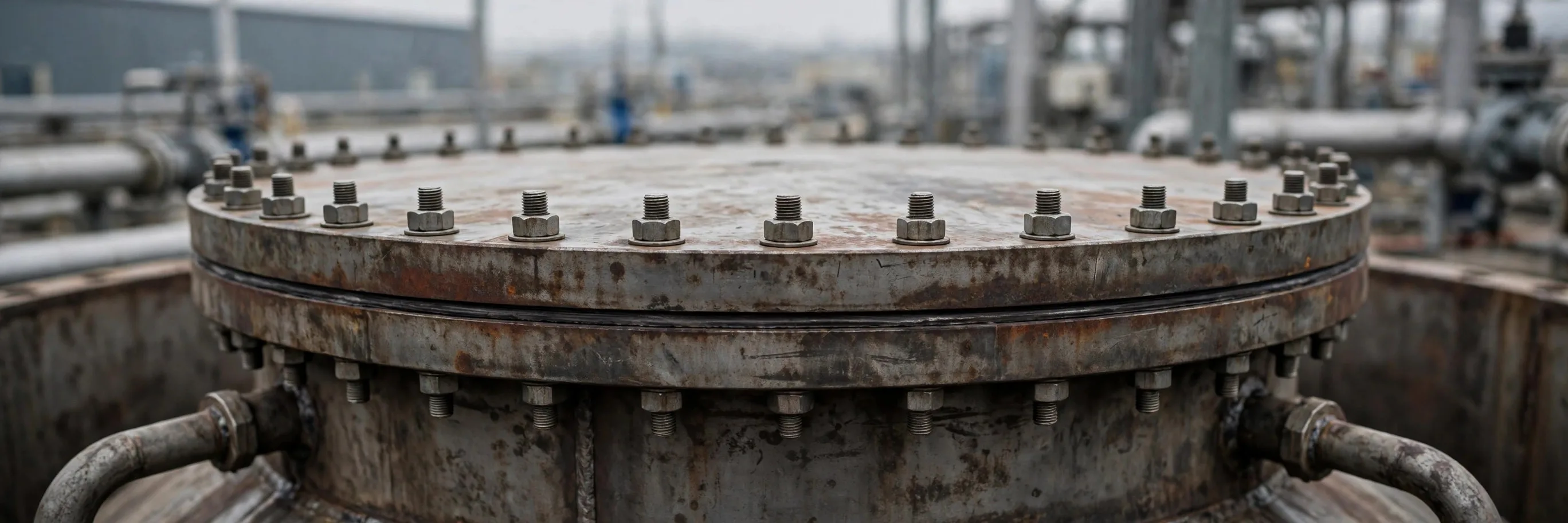
An evaporator inspection cover is bolted shut, opened for inspection and cleaning, and bolted shut again, many times over the plant's life. Ordering its studs as plain "seawater studs" ignores the scale, the wet and dry cycles and the repeated opening.
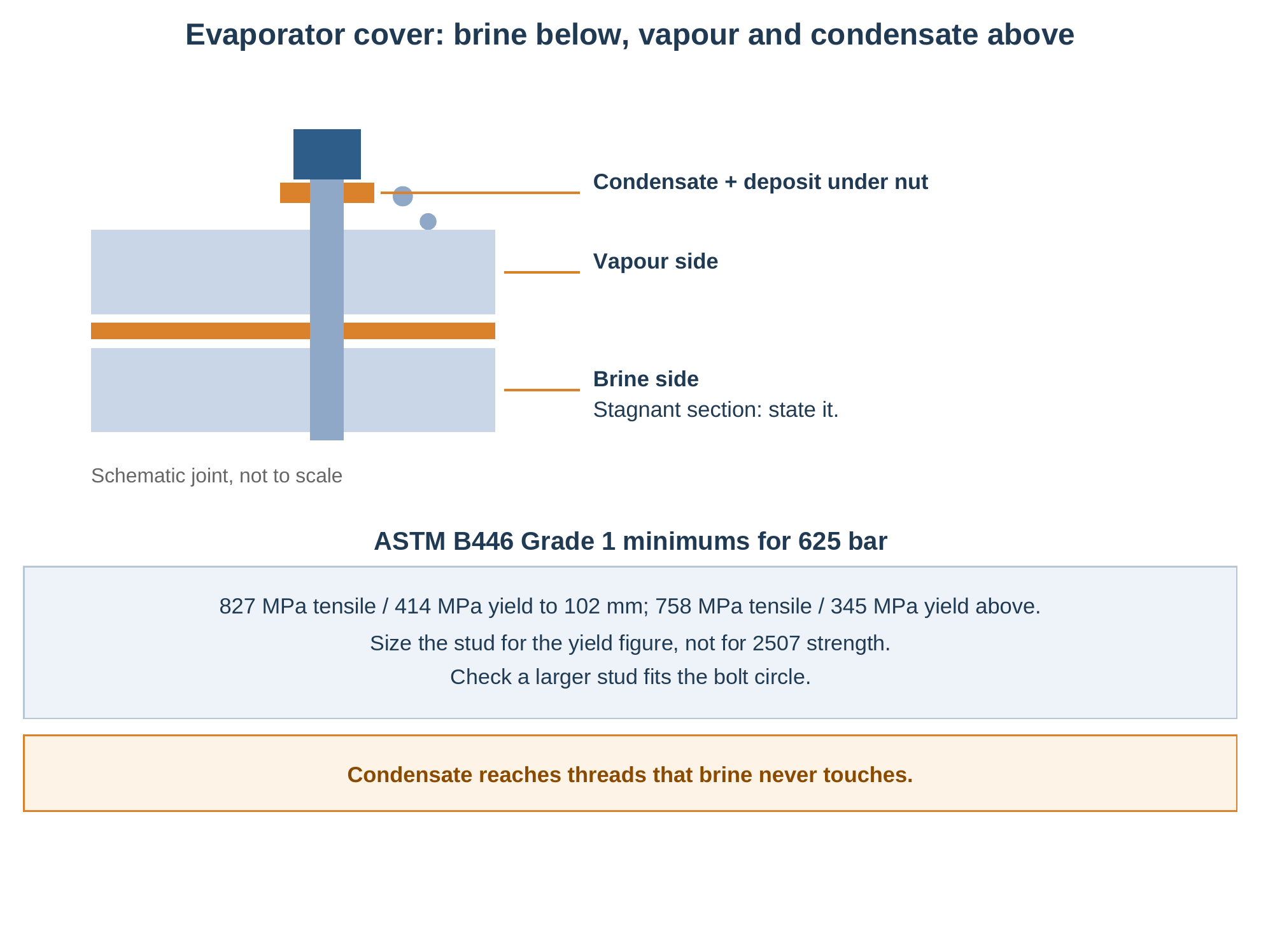
Stage temperature and what reaches the threads
Calcium sulfate scale is what caps the top brine temperature of an MSF plant; one recent study of calcium sulfate scaling puts current plants below 120°C. MED plants generally run lower top temperatures than MSF, and in both designs every later stage or effect is cooler than the one before.
Most cover studs sit outside the pressure boundary, so the question is how brine gets to them, not whether they are immersed. For each cover, state:
- the evaporator type and the stage or effect, with its temperature and pressure (many stages run below atmospheric)
- whether the studs are internal or external to the shell
- how brine reaches the threads: gasket weeps, external condensation, washdown, or splash during opening
- whether the section is deaerated, or open to air at vents and during shutdown
The damage on these joints usually comes from brine salts left in the crevice under the nut, which concentrate each time the joint dries out, and from oxygen where the section is not deaerated.
Scale, cleaning and the opening cycle
Calcium carbonate, magnesium hydroxide and calcium sulfate scale forms on brine-wetted hot surfaces, which includes any internal studs. Under external nuts the deposit is dried brine salt from leaks and washdown. Either one under a nut makes a new crevice and locks the thread, so the nut that came off easily at commissioning is the one that seizes after a year.
State how often each cover is opened, whether the studs are removed or cleaned in place, and which cleaning chemicals reach them. Descaling usually uses inhibited hydrochloric or sulfamic acid. 625 resists dilute cleaning acids at ambient temperature better than stainless studs, but its resistance to hydrochloric acid falls as concentration and temperature rise, so send the acid, its strength and its temperature with the enquiry.
625 nuts on 625 studs can seize by galling if assembled dry. A thread lubricant suitable for brine service, named on the order and used at every reassembly, reduces the risk of seizure through the cleaning cycle.
625 against 2507 and 316L
Inconel 625 gets its corrosion resistance from chromium and molybdenum: the Special Metals 625 bulletin gives at least 58% nickel, 20–23% chromium and 8–10% molybdenum. Strength is the trade-off. ASTM B446 Grade 1 bar has minimums of 827 MPa tensile and 414 MPa yield up to 102 mm, falling to 758 MPa and 345 MPa above. Size the stud from that yield, and check on the cover drawing that a larger stud fits the bolt circle and the nut clearance.
| Candidate | UNS and specification | Where it fits an evaporator cover | What to watch |
|---|---|---|---|
| Inconel 625 | N06625, ASTM B446 Grade 1 | Hot stages, aerated sections, frequent opening and cleaning | Lower strength; may need a larger stud |
| Super duplex 2507 | S32750, ASTM A479 bar / A1082 | Cooler stages in deaerated brine with high cover load | Crevice margin shrinks in hot, aerated brine |
| 316L | S31603 | Lightly loaded, dry or rarely wetted covers | Crevice attack and cracking in hot or aerated brine |
Related references: Super duplex 2507
Alleima lists a 550 MPa minimum proof strength for SAF 2507 bar, which is why it suits heavily loaded covers. In deaerated brine at the cooler stages it holds up well. On hot first stages, at aerated vents, or where brine dries and concentrates under the nuts, 625 has more headroom, the same trade-off we cover for seawater flanges.
Ordering the set
Order studs and nuts together as a set per cover, from one heat for the studs and one for the nuts, with the spare set ordered alongside. Evaporator covers often use thick gaskets, so give the stud length with the actual gasket rather than the standard one. Mark each set with its cover and stage.
When covers come off, compare removed studs stage by stage before reordering, and note whether the attack sits under the nuts or on the exposed thread.
| Confirm before ordering | Why it matters | Document to ask for |
|---|---|---|
| Evaporator type, stage, temperature and pressure | Hot first stages and cool last stages can need different grades | Evaporator datasheet |
| Internal or external studs, and how brine reaches them | External studs see leaks and wet/dry cycles, not immersion | Cover drawing |
| Deaerated or aerated section | Oxygen controls crevice risk | Process description by section |
| Cover and flange material | 625 studs in a carbon steel or copper-nickel cover can drive galvanic attack at the bolt holes | Cover drawing, isolation details |
| Scale, opening frequency and cleaning acid | Deposits lock nuts; acid strength and temperature decide whether 625 is enough | Maintenance procedure |
| Stud size against bolt circle | 625 may need a larger stud | Cover drawing |
| Heat and set marking | Ties each set to its cover | Set list with EN 10204 3.1 certificates |
Related references: EN 10204 3.1 certificates
Requesting a quote
Most of what the engineering team needs fits in one line: "M20 Inconel 625 stud and nut sets for MSF evaporator inspection covers, stages 1–6, 90–108°C, external studs, deaerated brine, inhibited HCl descaling twice a year, 3 mm gasket, 24 studs per cover, plus one spare set per stage."
For cleaning-acid exposure, read the hydrochloric-acid service selection guide; it is further reading on the cleaning conditions, not a qualification of 625 for every HCl solution.
With that, we can review the specified grade, dimensions and inspection requirements for each stage and quote 625 stud and nut sets packed per cover. Stud sizing against the cover load stays with the equipment designer; send the design inputs if you want them checked. Bolting for the reverse osmosis side of the same plant is covered under water treatment and desalination.