
Each time a strainer cover is opened, the threads wear a little, the gasket is changed and the cover is pulled down again, so a set specified only for its first assembly runs out of life long before the strainer does.
The filtered medium sets the grade
A strainer carries whatever its line carries, and the cover studs sit at the boundary between that fluid and the air, with fluid reaching them through a weeping gasket or the crevice under the nut. So the enquiry should name the medium, its temperature range, and whether it contains chlorides, acids or hydrogen sulfide. "Strainer service" on its own doesn't decide anything.
If the line is in sour service, NACE MR0175 / ISO 15156 controls hardness and condition for both studs and nuts, and the set must be ordered to it from the start.
| Medium | Usual stud grade | What to watch |
|---|---|---|
| Seawater, cooling water with chlorides | Super duplex 2507 or Inconel 625 | Warm water erodes 2507's crevice margin; 625 has lower strength |
| Chemical, acidic or chloride-rich | Inconel 625 or Hastelloy C-276 | Check the acid and temperature against the alloy |
| Sour hydrocarbon | Incoloy 925, Inconel 718 or 2507 | 925 max 38 HRC, 718 max 40 HRC; 2507 within its ISO 15156-3 limits, often capped at 28 HRC by the project |
| Clean water, no chlorides | 316 | Not for seawater or sour service |
Related references: Super duplex 2507 · Inconel 625 · Hastelloy C-276 · Incoloy 925 · Inconel 718
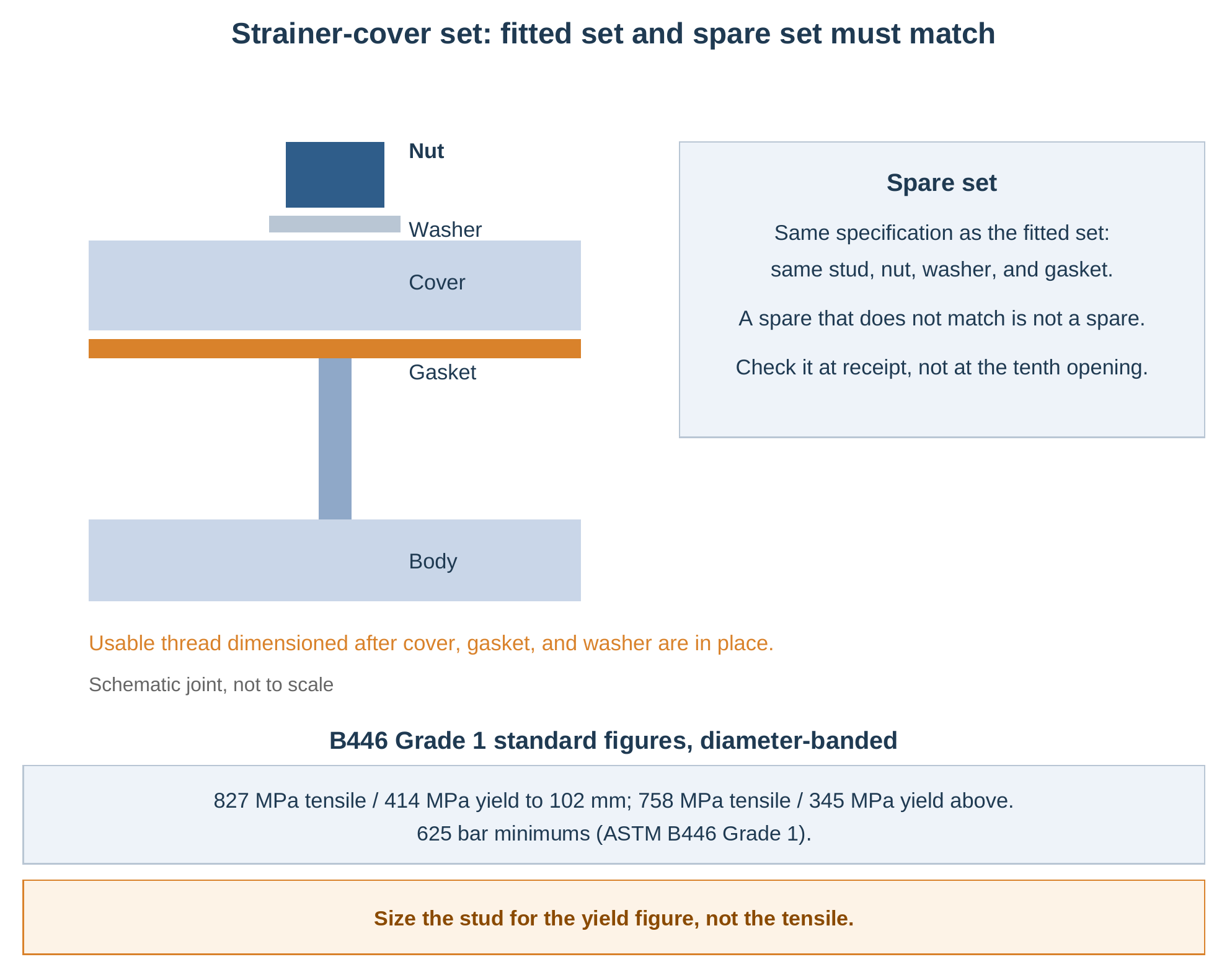
Alleima's SAF 2507 data give a 0.2% proof strength of at least 550 MPa for bar, against 414 MPa minimum yield for 625 to ASTM B446 Grade 1 up to 102 mm, so a 625 set may need a larger size to carry the same load. Our 625 vs 2507 comparison covers the seawater choice in more detail.
Galling and the nut
Galling is what limits most strainer sets. Stainless steels and nickel alloys rely on a thin oxide film; under the pressure and sliding of a nut running down a stud, that film breaks, the bare metal cold-welds and tears, and each assembly makes the damage worse until the nut seizes. Bossard's engineers describe the mechanism for stainless threads, and our note on galling in nickel-alloy fasteners covers the nickel side.
Three things reduce it: a named lubricant applied at every assembly, nuts of a compatible but not identical condition where the design allows, and slow, even tightening rather than power tools run at speed. The nut also has to suit the stud for corrosion, since two different metals in a wet crevice can drive one of them to corrode faster. The order should name the nut material, standard and condition, and the lubricant.
Usable thread, length and ends
The useful length of a strainer stud is the thread available beyond the cover, gasket and washer, which should cover the full nut height plus one or two pitches. Too short, and the nut isn't fully engaged; too long, and the exposed thread corrodes and won't take a nut at the next opening. State the usable thread with the actual gasket thickness, and check it again if the gasket type changes. Our guide to stud bolt length explains how to measure it.
A stud with a damaged or square end lets the nut start crooked and cut a false thread, and on a joint opened every week that happens sooner or later. Ask for chamfered or rounded ends, and replace any stud whose end thread is damaged.
The spare set
Strainer studs are the ones most often cut out, so the site needs spares. The spare set should be ordered with the fitted set, to the same grade, condition and dimensions, ideally from the same heat, and labelled for that strainer. Spares bought later from another source often turn out to be a different grade or length, and the mistake shows only at the next opening.
When studs come out, compare them by position: galled nuts, worn end threads, corrosion under the nut. Galling on every position points to lubrication or nut choice; damage on a few positions points to those positions' seating or access.
| Lock before ordering | Why it matters | Document to ask for |
|---|---|---|
| Medium, temperature, chlorides, H₂S | Decides the grade and any hardness limit | Line data sheet, sour-service classification |
| Nut material, standard, condition and lubricant | Dry same-alloy threads gall and seize | Nut specification, approved lubricant |
| Usable thread with the actual gasket | Sets full nut engagement without long exposed thread | Cover, gasket and washer stack-up |
| Chamfered ends | Prevents crooked starts and false threads | Stud drawing |
| Spare set, same grade and heat | Mixed spares show up only at the next opening | Set list for fitted and spare sets, EN 10204 3.1 certificates |
Related references: EN 10204 3.1 certificates
Requesting a quote
For example: "M20 super duplex 2507 stud and nut sets for seawater strainer covers, 12 per cover, 8 strainers, usable thread for a 3 mm gasket, plus one spare set per strainer, lubricant to be confirmed." If an old set has galled, a photo of the worst nut and stud helps the team decide whether the problem is the pairing or the lubrication.
The engineering team will confirm grade, nut pairing and lengths with you and quote matched 2507 stud and nut sets or 625 stud and nut sets, packed and labelled per strainer, with EN 10204 3.1 certificates; the stud and nut set range covers other grades.