
Most chemical pump covers that leak still have intact bolts. Usually the cover didn't seat flat, fluid sat under a bolt head long enough to eat the metal, or the replacement set was copied from bolts that had already corroded.
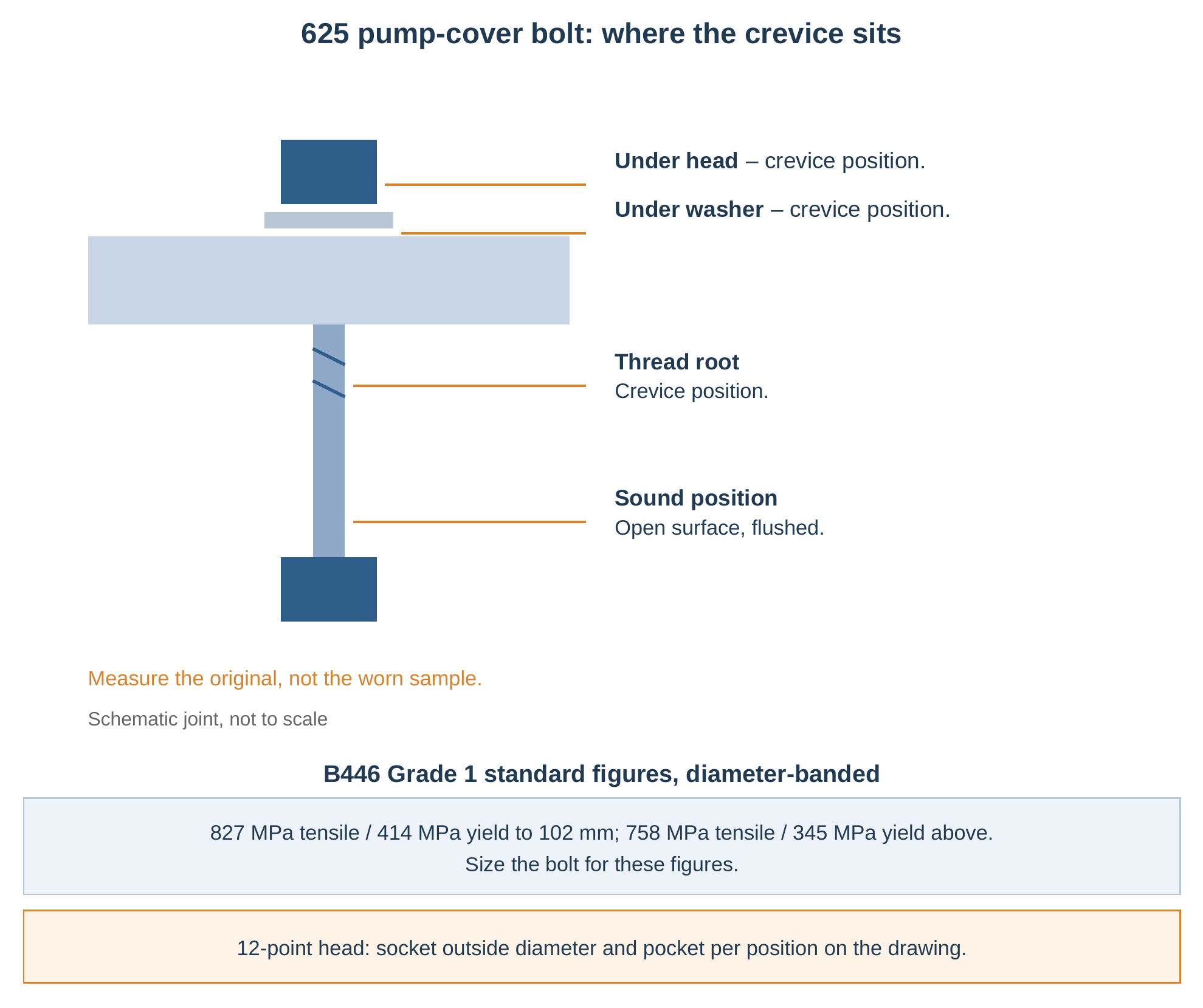
Read the old bolts before ordering
When the cover comes off, lay the bolts out in their positions and look at where each one was attacked:
- Under the head or washer: a crevice held stagnant fluid. Look at the gasket, the washer and the surface finish under the head.
- At the thread root inside the casing: fluid got past the gasket into the tapped hole or the clearance hole.
- On one side of the cover only: the cover seated unevenly and leaked there, or one area of the casing runs hotter.
- Nowhere: the bolts are being replaced for another reason, and the existing grade is probably adequate.
Record the fluid, its concentration and temperature range, and any cleaning chemicals used during maintenance, since a bolt can survive the process fluid and fail in the cleaning cycle.
Then size the new bolts from the original drawing or an unworn bolt from a sound position. A corroded bolt measures smaller than it was made, and a set copied from it starts life undersized.
Seating face, gasket and tightening
A cover seals when the cover, gasket and casing meet flat and stay flat under bolt load. A raised burr, a damaged face or a gasket that has taken a set will leak on the low side, and the bolts on that side then sit in the leak.
At each opening, inspect and clean the sealing faces without scratching them, and fit a new gasket rather than reusing the old one. The enquiry should name the gasket type and material and the condition of the seating faces, because the bolt load needed depends on both.
Work across the cover, pulling opposite bolts down in turn over several passes, and give the torque or torque-angle per pass and the lubricant. A cover tightened bolt by bolt around the circle tilts and seals on one side only. Since 625 threads can gall against 625 or other nickel-alloy threads in the casing, use a lubricant approved for the process fluid.
625 against C-276, Alloy 20 and 316
Inconel 625 is the general-purpose choice for chloride-bearing chemical service. The Special Metals 625 bulletin gives 58% minimum nickel, 20–23% chromium, 8–10% molybdenum and 3.15–4.15% niobium plus tantalum. ASTM B446 Grade 1 bar has minimums of 827 MPa tensile and 414 MPa yield up to 102 mm, falling to 758 MPa and 345 MPa above that. Our 625 specification guide explains what to write on the order.
| Candidate | UNS and bar specification | Where it fits a chemical pump cover | What to watch |
|---|---|---|---|
| Inconel 625 | N06625, ASTM B446 Grade 1 | Chloride-bearing and mixed process fluids | Moderate strength; may need a larger bolt than the original |
| Hastelloy C-276 | N10276, ASTM B574 | Hot, strongly reducing or chloride-rich acids | B574 minimum yield 283 MPa, lower than 625 |
| Alloy 20 | N08020 | Sulfuric acid service within its range | Acid strength and temperature must fit; chlorides shrink its range |
| 316 | S31600, ASTM A193 B8M | Clean, cool, chloride-free fluids only | Crevice attack in chlorides; much lower strength in Class 1 |
Related references: Hastelloy C-276 · Alloy 20
C-276 is the step up where 625 isn't enough: Haynes rates it for a wide range of oxidizing and reducing chemicals, but its bar is weaker still, so check the joint load before switching. For sulfuric acid, Carpenter's 20Cb-3 data shows where Alloy 20 holds up; outside that window it doesn't. Hastelloy vs Inconel fasteners compares the two families in more detail.
Watch the nuts too. A nickel-alloy bolt with a stainless nut can set up galvanic corrosion in the very crevice that caused the problem; our note on nickel-alloy bolts with stainless nuts covers when that matters.
Access and removal
Every pump-cover bolt has to come out again, often in a cramped pump bay. Give the head type, the socket outside diameter, the swing space for the wrench and the tool space above the cover at each position, and say whether the bolts come out with the pump in place or only with the pump removed.
Where hex heads crowd each other or sit close to the casing wall, 625 12-point flange bolts are worth considering. The 12-point head is smaller across the flats, takes a thin-wall socket and can be re-engaged every 30 degrees, and its flange spreads the load without a loose washer, which also removes one crevice.
| Lock before ordering | Why it matters | Document to ask for |
|---|---|---|
| Corrosion position on the old bolts | Shows whether the problem is crevice, gasket or seating | Photos of removed bolts by position |
| Fluid, concentration, temperature, cleaning chemicals | Decides 625, C-276 or Alloy 20 | Process data and maintenance procedure |
| Original dimensions, not worn ones | A copy of a corroded bolt is undersized | Pump drawing or an unworn bolt |
| Gasket, seating faces, tightening pattern | A crooked cover leaks and corrodes its own bolts | Gasket specification, tightening procedure |
| Head type, socket and swing space | A bolt that can't be reached won't be removed cleanly | Access drawing or photo |
| Traceability | Ties each bolt to its heat | EN 10204 3.1 certificates, dimensional report, PMI where specified |
Related references: EN 10204 3.1 certificates
Requesting a quote
A note like "M16 Inconel 625 hex bolts for a chemical pump cover, acidic process water at 70°C with about 2,000 ppm chlorides, corrosion under the heads on the old 316 set, original length from the pump drawing" gives the engineering team enough to start. Photos of the old bolts laid out by position save a lot of back and forth.
The team will confirm the grade against the fluid, check whether a larger bolt is needed, and quote 625 hex bolts, 12-point flange bolts or studs with EN 10204 3.1 certificates. Bolting for reactors, exchangers and other process equipment is covered under chemical processing.