Short answer
Inconel 601 (UNS N06601) is the usual first choice for bolts on heat-treatment fixtures, trays and baskets that cycle in and out of an oxidizing furnace. Its chromium and aluminium give it an oxide scale that stays attached through repeated heating and cooling, so the bolt loses very little metal per cycle, and it resists oxidation up to about 1200°C.
What 601 doesn't have is much creep strength. At typical fixture temperatures the stress it can carry for long periods is in the tens of MPa, and only single figures near 1000°C. A bolt sized on room-temperature strength will slowly stretch and let the workpiece move long before its scale becomes the problem. That makes the hot load, the metal temperature at the bolt and the hours at temperature the real sizing data. For bolts running above about 540°C, solution-treated material is the condition the published creep data refer to.
The furnace atmosphere decides whether 601 suits the job. It does well in air and clean combustion gas but is not recommended for strongly reducing, sulfur-bearing gas. Incoloy 800H is the stronger choice where a fixture bolt carries real load, Inconel 600 is common in nitriding furnaces, and 310S is a cheaper option for lightly loaded fixtures that don't cycle hard.
Geometry matters as much as the alloy. Seat the workpiece on a plain shoulder rather than on the thread, set clearances for the hot condition, and keep lead and sulfur out of the anti-seize.
A useful enquiry gives the atmosphere, the metal temperature at the bolt, the cycle count and heating rate, the load per bolt and the fixture drawing. BYBOLT makes 601 hex and flange-head bolts, and shoulder bolts machined to drawing, from 100 pieces with EN 10204 3.1 certificates.
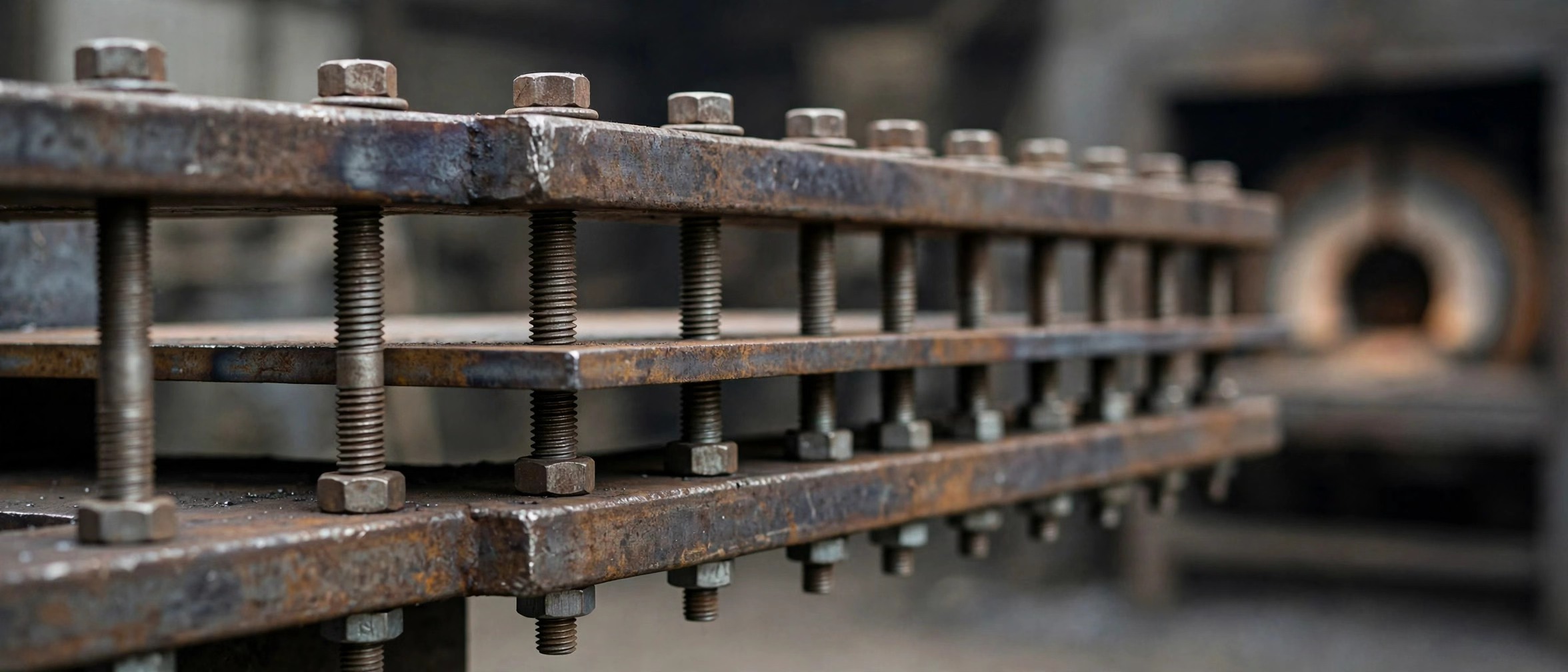
Bolts on heat-treatment trays, baskets and grids seldom fail in a way anyone notices at the time. They scale, thin and stretch a little on every cycle until a workpiece shifts, warps or drops.
A fixture bolt also has a narrower job than most bolting in furnace and heat-treatment equipment. It holds one part in one tray or frame, cycle after cycle, so its head, shoulder and clearance come from that job rather than from a catalogue size.
01 Oxidation takes section, cycle by cycle
In the furnace, the bolt surface grows an oxide scale. While the scale stays tight, it slows further attack. When it cracks and spalls on cooling, fresh metal is exposed and the next cycle takes another layer. After a few hundred cycles the shank is thinner and the thread shallower, and the bolt carries less load even though it never went above its rated temperature.
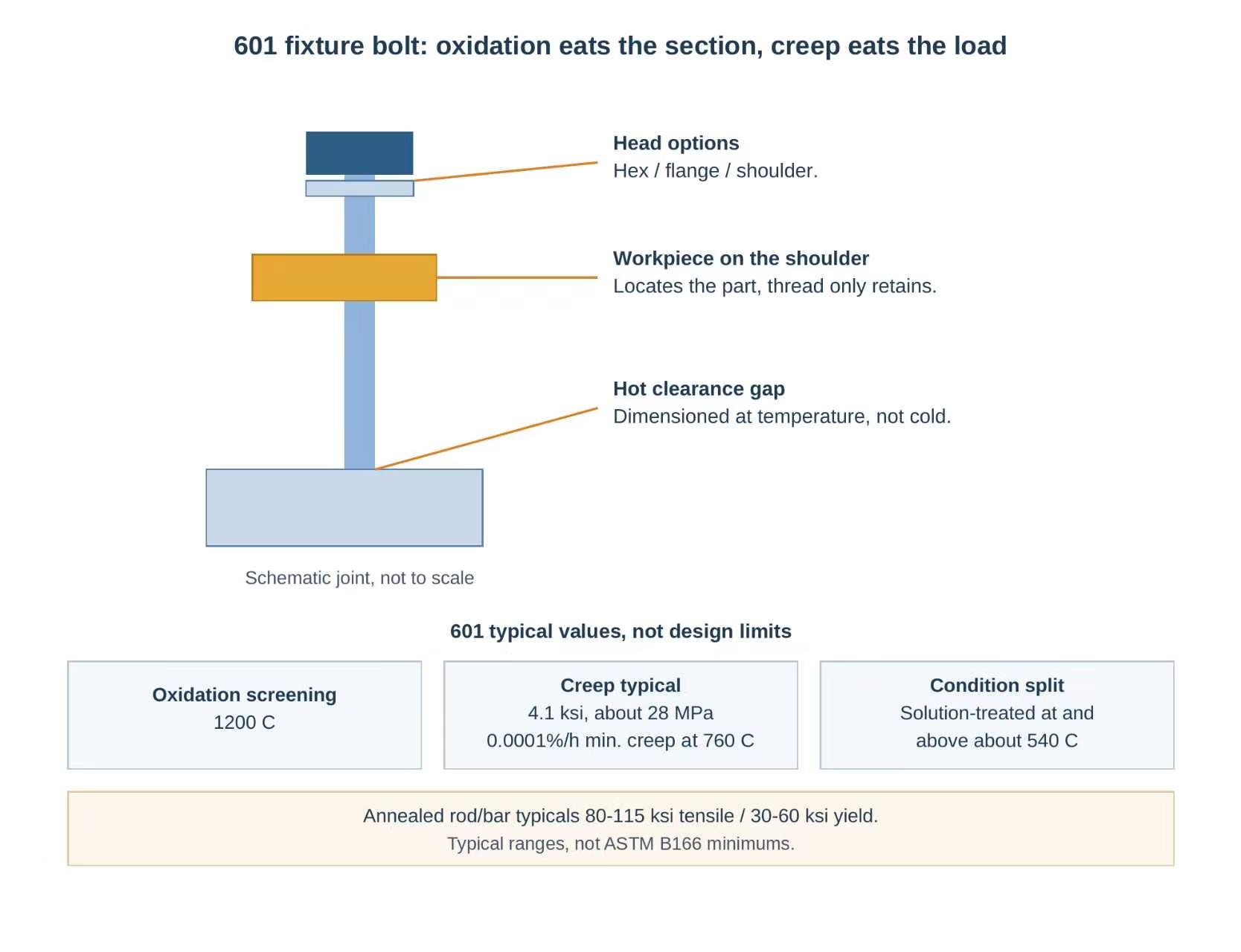
Inconel 601 handles this better than most fixture alloys. The Special Metals INCONEL alloy 601 bulletin gives 58–63% nickel, 21–25% chromium and 1.0–1.7% aluminium, rates oxidation resistance up to 1200°C (2200°F), and credits the chromium and aluminium together for the alloy's resistance to oxide spalling under cyclic heating.
The atmosphere sets the limits. Rolled Alloys' 601 datasheet rates the alloy highly resistant to carburization but says it is not suggested for strongly reducing, sulfur-bearing environments.
For the oxidation side of the enquiry, give:
- the atmosphere as well as the temperature: air, combustion gas and its sulfur content, carburizing gas or nitriding gas. Sulfur is the one most likely to rule 601 out.
- the cycle count and the heating and cooling rates. A bolt that survives a long soak can still spall over hundreds of fast cycles.
- where lost section costs the most: thread roots, shoulders and any thin section.
02 Load retention depends on creep, not cold strength
A fixture bolt holds the workpiece against gravity, thermal expansion and the knocks of loading and unloading. At temperature, creep lets the bolt stretch a little every hot hour, and the stretch stays when it cools. Clamp force falls at the same time through relaxation. Our note on preload loss at high temperature covers how the two work together.
601 can't be age-hardened. The bulletin's creep and rupture data are for material solution treated at about 1150°C, which gives a coarser grain and better creep resistance at some cost to room-temperature yield. It recommends that condition for rupture-limited service at about 540°C (1000°F) and above, and the annealed condition for tensile-limited service below it. Most fixture bolts sit above that line.
The creep numbers fall quickly with temperature. Rolled Alloys gives these typical values:
| Metal temperature | Stress for 0.0001%/h minimum creep rate (about 1% in 10,000 h) | 10,000-hour rupture strength |
|---|---|---|
| 760°C (1400°F) | 28 MPa (4.1 ksi) | 43 MPa (6.2 ksi) |
| 870°C (1600°F) | 14 MPa (2.0 ksi) | 18 MPa (2.6 ksi) |
| 980°C (1800°F) | 5 MPa (0.76 ksi) | 8 MPa (1.2 ksi) |
Compare that with annealed rod and bar at room temperature, which Special Metals puts at 550–790 MPa tensile and 205–415 MPa yield (nominal ranges, not ASTM B166 minimums). A fixture bolt at 950°C sits close to the bottom row of that table, so it has to be sized from the hot load and checked for creep by the fixture designer, whatever its cold strength.
03 601 against 800H, 600, 625 and 310S
601 bar to ASTM B166 is the starting point where oxidation and cycling govern. The other candidates fit narrower cases.
| Candidate | UNS and bar specification | Where it fits a fixture | What to watch |
|---|---|---|---|
| Inconel 601 | N06601, ASTM B166 | Oxidizing, cyclic service: trays, baskets, grids | Low creep strength; size for the hot load |
| Incoloy 800H | N08810, ASTM B408 | Fixture bolts that carry real load at temperature | Order by UNS number; carbon, grain size and anneal on the certificate |
| Inconel 600 | N06600, ASTM B166 | Nitriding furnaces, where its high nickel resists nitrogen pickup | No aluminium, so its scale spalls more readily under hard cycling |
| Inconel 625 | N06625, ASTM B446 | Short-term strength in the lower part of the range | Strength advantage fades above about 870°C; long holds at roughly 650–870°C reduce its ductility |
| 310S | S31008, ASTM A479 | Cheaper option for lightly loaded fixtures | Slight embrittlement in continuous service at 600–900°C |
Outokumpu's Therma datasheet suggests 310S for use up to about 1050°C in air and notes the slight embrittlement band, which is why it suits fixtures with light loads and gentle cycling. For 800H, the retort cover stud article shows how its creep data are used.
Whichever grade is chosen, ASTM B166, B408, B446 and A479 cover bar, not finished bolts. Put the finished dimensions on the order, together with a rolled thread with a rounded root (UNR or UNJ), whether threads are rolled before or after the final heat treatment, and the matching nut and washer.
04 Head, shoulder and hot clearance
Choose the head for the job. A hex head suits positions with room for a wrench, and a flange head spreads load on a thin or soft part. Where the workpiece has to be located, use a shoulder bolt: the part sits on a plain, unthreaded diameter that takes the side load, and the thread only clamps. A workpiece resting on the thread damages it and drifts out of position over the cycles.
Bolt, fixture and workpiece also expand at different rates. A fit that's right cold can bind hot, and a clearance set for the hot condition leaves the part loose when cold. The drawing needs the three materials, the temperature range and the clearance at temperature, and it should mark which positions clamp the part rigidly and which let it slide as it grows.
Order the nut and anti-seize with the bolt, ideally 601 heavy hex nuts from the same heat. 601 threads running in 601 nuts can gall when dry. A nickel-based high-temperature compound is the usual choice. Avoid lead, which melts at 327°C and can embrittle nickel alloys, and sulfur, which forms a low-melting nickel sulfide along the grain boundaries.
When fixtures come out for repair, lay the removed bolts out by position and compare scale thickness, section loss at the thread root and shoulder wear. Thinning concentrated at the thread roots points to the thread form or a local atmosphere problem. Even thinning across every bolt means the alloy or the temperature assumption is wrong.
| Settle before ordering | Why it matters | Document to ask for |
|---|---|---|
| Atmosphere, temperature, cycle count | Decides the alloy and the oxidation life | Furnace data, atmosphere and cycle description |
| Load per bolt and hours at temperature | Creep, not cold strength, sizes the bolt | Load calculation, cycle specification |
| Head, shoulder and workpiece location | A part resting on the thread will move | Fixture drawing with head and shoulder dimensions |
| Hot clearance, clamp or slide by position | A rigid clamp in the wrong place bends the part or fixture | Drawing with hot clearances |
| Nut and anti-seize | Dry 601 threads gall | Nut grade and condition, approved compound |
| Traceability | Shows which heat and anneal each bolt came from | EN 10204 3.1 certificates, dimensional report, PMI where specified |
05 Requesting a quote
Describe the fixture as well as the bolt. For example: "M12 Inconel 601 hex bolts for a heat-treatment basket, air atmosphere, about 950°C at the bolt (to be confirmed from the furnace survey), 24 per fixture, workpiece seated on a shoulder." If you're replacing bolts that scaled or loosened, a photo of a removed one shows whether the problem was oxidation, creep or fit.
The engineering team will work through any missing atmosphere, load or clearance details with you, and at 950°C will check whether 601 still carries the load or 800H is the better bet. They can then quote 601 hex bolts or shoulder bolts machined to your drawing. Fastener orders start at 100 pieces, which usually covers several fixtures plus spares.