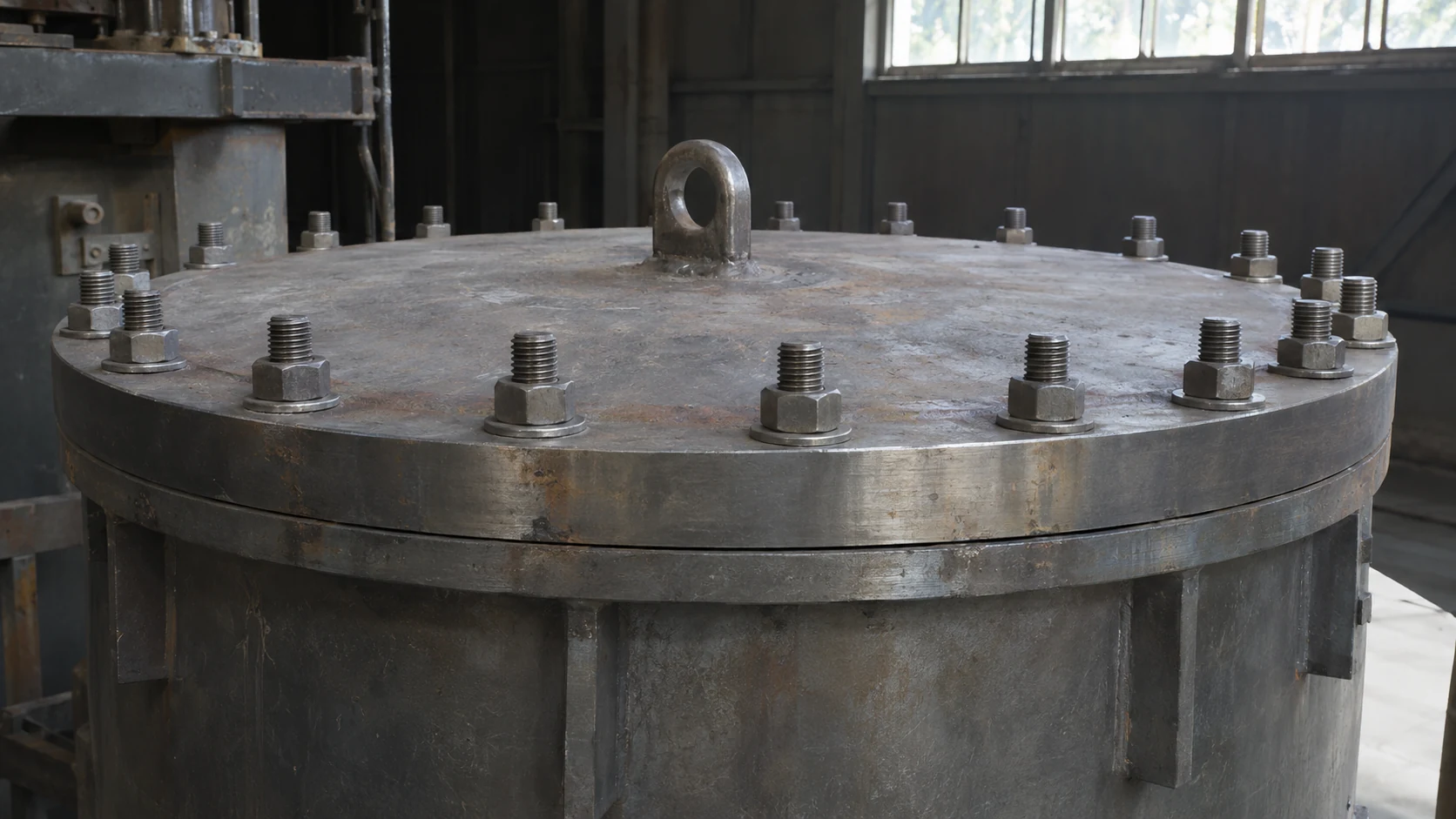
This article is about ordering a retort cover stud set for sustained heat, not for a single temperature number. The metal temperature, the hold time, the stud condition, and the test that proves that condition all have to be stated together. A stud ordered as plain 800 when the design assumed 800H looks identical on delivery and fails years early in service.
A retort cover is a sealing joint that lives hot. Its studs carry the cover load for the whole cycle, and the gasket, the stud length, and the re-tightening procedure all follow from that sustained load, not from a room-temperature bolt size.
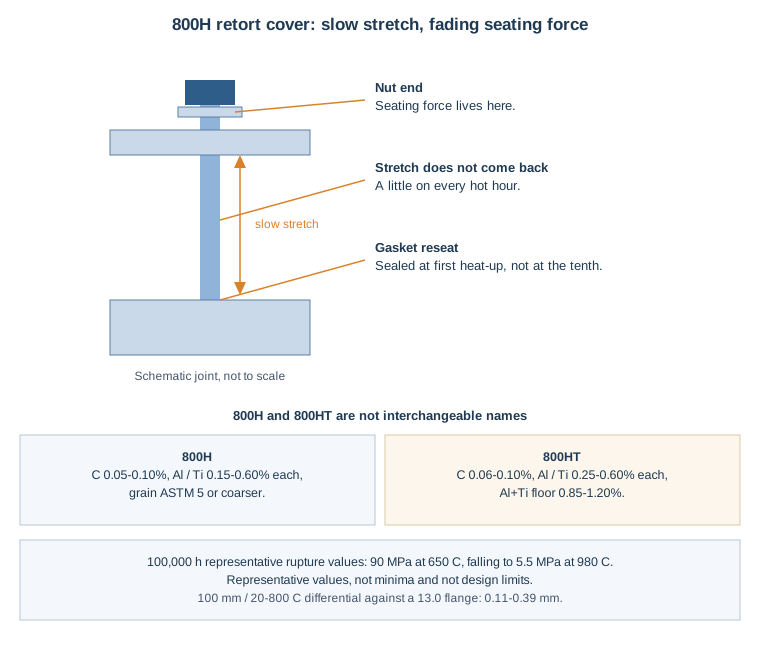
Figure: 800H retort cover — slow stretch fades the seating force; 800H and 800HT chemistry differ, and rupture values are representative, not design limits.
01 Creep is the failure, and it is slow by design
Under a steady load at high temperature, a stud deforms slowly and permanently. A hot stud stretches a little on every hot hour, and that stretch does not come back on cooling. Over thousands of hours, the stretch adds up, the preload falls, and the cover that sealed at the start of the campaign leaks before the campaign ends. Stress relaxation is the matching loss: Bolt Science's stress relaxation technical page describes preload falling with no rotation of the fastener, so a joint can lose clamp load at temperature even when no nut has turned.
That is why a retort cover stud must be specified by its creep condition, not just by its alloy name. Special Metals' INCOLOY 800H/800HT bulletin gives representative rupture-strength values for 800H and 800HT, falling from 90 MPa at 650°C to 5.5 MPa at 980°C over 100,000 hours. Those are representative values from the bulletin, not minima and not design limits, and code allowable stresses sit lower. The same bulletin explains the mechanism behind the numbers: the controlled chemistries and the solution annealing treatment are designed to produce optimum creep-rupture properties, with coarse grains minimizing grain-boundary sliding during creep.
| Temperature | 100,000-hour representative rupture strength |
|---|---|
| 650°C | 90 MPa |
| 705°C | 55 MPa |
| 760°C | 37 MPa |
| 815°C | 26 MPa |
| 870°C | 17 MPa |
| 925°C | 8.3 MPa |
| 980°C | 5.5 MPa |
Bulletin typicals for annealed plate tell the same story: yield falls from 150 MPa at room temperature to 93 MPa at 650°C, and tensile from 536 MPa to 378 MPa over the same range. Those are plate typicals, not bar minima, and they show why a stud sized from a room-temperature number alone will not hold sealing load through a campaign.
- State the metal temperature at the stud: not just the furnace setpoint, since the stud at the cover flange can run cooler than the retort interior, or hotter where insulation or a heating element changes the picture.
- State the hold time and the design life in hours: a retort that holds at 800°C for 10,000 hours is a different stud duty from a retort that holds at 650°C for 100,000 hours, even though both are called high-temperature service.
- State the cycle count: the number of heat-ups and cool-downs the set must survive beside the sustained hold.
02 800, 800H, and 800HT are not interchangeable names
Plain Incoloy 800, UNS N08800, has carbon at 0.10% maximum with no lower limit and no grain-size requirement. Special Metals' INCOLOY 800H/800HT bulletin records the history: Grade 1 material, annealed at approximately 1800°F (980°C), carried design stresses to 1100°F (593°C), while Grade 2 material, annealed at approximately 2100°F (1150°C), carried design stresses to 1500°F (816°C). That anneal temperature is the dividing line between a general high-temperature alloy and a creep alloy.
Incoloy 800H, UNS N08810, fixes carbon at 0.05–0.10% and requires an average grain size of ASTM 5 or coarser, produced by a high-temperature anneal at approximately 2100°F (1150°C). Aluminium and titanium are controlled individually at 0.15–0.60% each, with a combined aluminium-plus-titanium range of 0.30–1.20%. Incoloy 800HT, UNS N08811, tightens the chemistry further: carbon 0.06–0.10%, aluminium 0.25–0.60%, titanium 0.25–0.60%, and a combined aluminium-plus-titanium floor of 0.85–1.20%, with a heat treatment of 2100°F (1149°C) minimum and the same ASTM 5 or coarser grain requirement. The bulletin is explicit on certification: all material supplied as 800HT meets the requirements for 800H, while other material produced to UNS N08810 cannot be certified as UNS N08811 unless it meets the additional requirements for that designation.
The substitution warning follows directly: if the retort was designed on 800H creep data and the supplier ships plain 800, the certificate will still say nickel-iron-chromium, the studs will still look right, and the creep life will still be wrong.
- Identify the UNS number on the order: N08800, N08810, or N08811, never the bare name 800.
- Record the carbon range and the aluminium and titanium controls: the carbon range, the individual aluminium and titanium ranges for 800H, or the combined aluminium-plus-titanium floor for 800HT only.
- Fix the grain-size requirement and the anneal on the order: ASTM 5 or coarser, with the anneal record, and require those items on the certificate, not just the alloy name.
- Verify the condition with the right tests: the grain-size report, the heat-certificate analysis, and the anneal record, not a room-temperature tensile test alone.
03 The candidate alloys, and where each one stops
Incoloy 800H, UNS N08810, bar to ASTM B408, is the retort cover starting point where sustained heat and creep govern. Room-temperature requirements must be checked against the governing ASTM B408 edition and the specified bar condition. ASTM B564 forging minima are not B408 bar minima and are not the sizing basis for a stud machined from bar. The hot campaign must be checked against creep-rupture data for the actual temperature and life.
| Candidate | UNS and form | Where it fits a retort cover | Boundary to watch |
|---|---|---|---|
| Incoloy 800H | UNS N08810, bar to ASTM B408 | Sustained heat, creep-governed cover load | Carbon, grain, and anneal must be on the certificate; verify the specified B408 bar condition separately from the hot-service creep assessment |
| Incoloy 800HT | UNS N08811, bar to ASTM B408 | Highest rupture strength near 980°C | Combined aluminium-plus-titanium floor 0.85–1.20%; name the specification on the order |
| Inconel 601 | UNS N06601, bar to ASTM B166 | Cyclic oxidation service | Bulletin typical 1% flow at 760°C in 1000 hours is only about 28 MPa, and oxidation screening is about 1200°C; not a like-for-like creep substitute for 800H |
| 310S | UNS S31008, bar to ASTM A479 | Economical, non-cyclic, lower-load covers | Oxidation guidance to about 1050°C, with embrittlement susceptibility in continuous service at 600–900°C; not a sustained-load retort stud at the top of that range |
For 310S, Outokumpu's Therma range stainless datasheet describes Therma 310S/4845, UNS S31008, as an austenitic heat-resisting grade with very good oxidation resistance, best employed in temperatures up to 1050°C, with a slight susceptibility to embrittlement during continuous operation between 600–900°C.
Expansion sets a second check. Special Metals' INCOLOY 800H/800HT bulletin gives a mean coefficient of thermal expansion rising from about 14.4 µm/m·K at 100°C to about 18.0 µm/m·K at 800°C. Against a carbon or low-alloy steel flange at about 13.0 µm/m·K, the differential runs about 1.4–5.0 µm/m·K across that range. Over a 100 mm grip and a rise from 20°C to 800°C, that differential alone accounts for about 0.11–0.39 mm of relative movement. The order must state the actual flange alloy and the stud temperature, since a joint sized on cold dimensions alone will not keep its seating force hot.
ASTM B408, ASTM B166, and ASTM A479 are bar standards, not finished-stud specifications. The order still has to state finished-stud dimensions for flange bolting per ASME B16.5, a rounded-root thread form such as UNR or UNJ, whether threads are rolled before or after the final solution anneal, and the matching nut and washer. A bar certificate alone does not prove the finished, threaded stud meets the carbon, grain, and anneal conditions the retort was designed on.
04 Sealing load, gasket, and the set that arrives
A retort cover stud set must be sized for sealing load first, then checked for creep, not the other way around. Give the cover load, the gasket seating load, the bolt circle, and the number of studs, since an 800H set that fits the creep envelope but is undersized for the cover load will not seal, and a larger set that seals may not fit the retort. State the stud temperature separately from the furnace temperature, with the gasket type and stack, the washer type, and whether re-tightening at operating temperature is part of the procedure: a gasket that relaxes with creep needs a re-tightening plan, not just a first tightening.
State the nut alloy, UNS, and condition separately: an unstated nut changes the creep picture, the galvanic risk, and the galling risk. State the approved lubricant and the tightening sequence around the cover, and inspect removed studs by position at turnaround: permanent stretch, necking, thread-root creep damage, and any stud that needed cutting to remove. One stretched stud points to a local temperature, load, or clearance problem; a set stretched everywhere points to the wrong creep condition or temperature description.
Send the retort drawing, the cover load, the temperature and life, and the stud condition to the BYBOLT engineering team for a check before ordering. That check is where an 800H set is caught ordered as plain 800, a nut pairing is caught that changes the joint picture, or a stud length is caught that seats the gasket on one side of the cover and not the other.
At receipt, the BYBOLT quality pack should tie each stud set to its heat, its solution-annealing record, its grain-size report, and its hardness report for the finished condition. Ask for EN 10204 3.1 certificates, a dimensional report for the actual studs, and a PMI report where the project requires it. The receipt pack must evidence the finished, threaded stud, since the retort was designed on that stud's carbon, grain, and anneal conditions, not on the bar alone.
| What to lock before ordering | Why it changes the joint | Document to ask for |
|---|---|---|
| Metal temperature, hold time, and design life | Decides creep-rupture data, not room-temperature strength | Retort datasheet, temperature and life specification |
| UNS, carbon, individual aluminium and titanium (or combined aluminium-plus-titanium for 800HT), grain size, and anneal | Plain 800 looks like 800H but does not creep like 800H | Heat certificate with carbon, individual aluminium and titanium (combined aluminium-plus-titanium for 800HT), grain-size report, anneal record |
| Cover load, bolt circle, and stud count | An undersized set will not seal, whatever the creep data | Cover load calculation, retort drawing |
| Gasket stack, washer, and re-tightening procedure | Creep relaxation needs a re-tightening plan | Gasket specification, tightening procedure |
| Nut alloy, UNS, and condition | An unstated nut changes creep, galvanic, and galling risk | Nut standard and condition on the certificate |
| Set list and records | Mixed sets on a cover leave no auditable trail after a leak | Set list by cover position, EN 10204 3.1 certificates, PMI where specified |
05 Ask for a quote with the retort, not just the grade
If a retort cover is being re-specified, or if an 800H set is being considered to replace a stretched set, send the retort with the size. A note like "M20 Incoloy 800H stud set for a retort cover, 800°C stud temperature to be confirmed from the retort datasheet, 10,000-hour design life, carbon 0.05–0.10%, grain ASTM 5 or coarser, 12-bolt set" gives the BYBOLT engineering team enough to check creep, condition, load, and sealing before quoting. Even a photo of a removed stud, showing permanent stretch or necking, helps show whether the last failure was creep, overload, or a temperature excursion.
A note like that, with the drawing when one exists, lets the team start without a full specification: they will pin down the remaining temperature, life, and condition details with you, then quote a small batch or a full set with EN 10204 3.1 traceability.