The common mistake on a solar-thermal bolt list is ordering everything for "565°C". Some joints never see that temperature, and some see much more. What limits the bolt also differs by position: sustained load at temperature, oxidation of an irradiated surface, or relaxation through daily cycles.
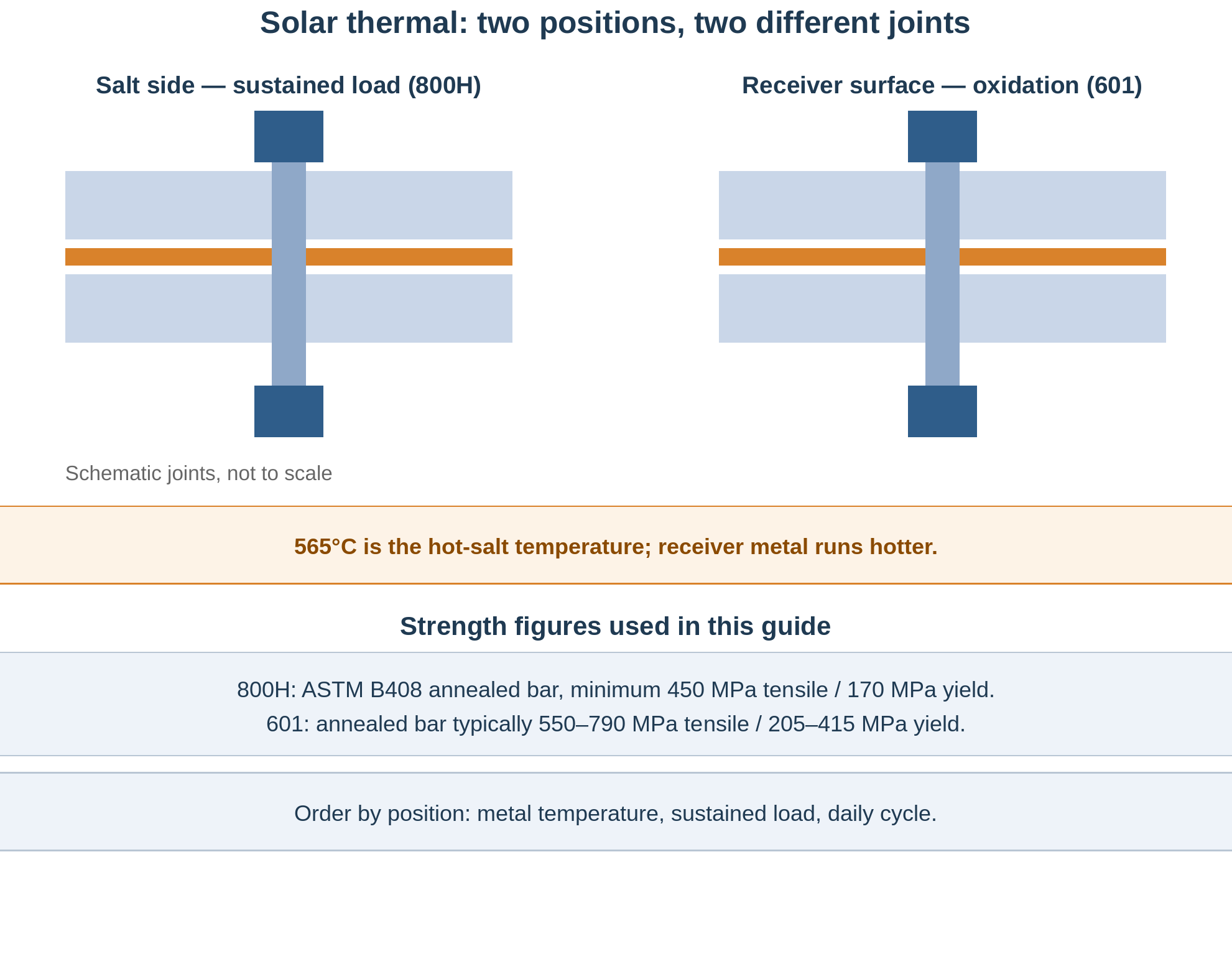
Salt temperature and metal temperature
An NREL report on CSP thermal storage puts the hot salt of tower plants at about 565°C, held in 347H stainless tanks, and nitrate-salt storage in trough plants at up to about 390°C. The receiver runs hotter than the salt it carries, and the structure around it takes heat from concentrated sunlight as well as from the tubes.
For each joint, state:
- the metal temperature at the joint, not the salt or steam temperature of the line
- where it sits: the receiver area, the salt piping and tanks, or the steam generator
- the daily cycle: starts per year, heat-up rate and night temperature, including whether the line is drained or kept warm
Solar salt freezes at roughly 220–240°C, so salt lines and flanges are heat-traced. A flange that drops below that temperature, or one that leaks, ends up with solidified salt around the nuts, and the salt has to be cleared before the joint can be opened.
Where 800H studs fit
Incoloy 800H gets its creep strength from chemistry and grain size: carbon held at 0.05–0.10%, aluminium plus titanium at 0.30–1.20%, and grain size ASTM 5 or coarser, according to the Special Metals 800H/800HT bulletin. ASTM B408 annealed bar has minimums of 450 MPa tensile and 170 MPa yield. The bulletin's representative 100,000-hour rupture strength is about 37 MPa at 760°C and 17 MPa at 870°C. These are averages; the design stress comes from the project code.
The creep advantage shows at the hotter positions, around the receiver and in high-temperature ducting. On the salt side, size the studs from the design code's allowable stress at the metal temperature for the specified condition; the 170 MPa room-temperature minimum yield is not a design allowable. That makes 800H stud bolts a good fit for supports, hangers, clamps and low-pressure covers with modest steady loads, fitted with 800H heavy hex nuts so stud and nut relax together. A high-pressure salt or steam flange needing high preload would need very large 800H studs, so those flanges usually take 718 stud bolts, provided the code allowable stress at the metal temperature supports the design. For hotter high-preload joints, Nimonic 80A is the traditional bolting alloy.
Where 601 bolts fit
Inconel 601 is chosen for surfaces that oxidize. Its aluminium addition forms an oxide that stays adherent through repeated heating and cooling, which suits receiver structures, heat shields and supports that cycle daily. The Special Metals 601 bulletin gives annealed rod and bar a typical range of 550–790 MPa tensile and 205–415 MPa yield. It recommends the solution-treated condition for service at about 540°C and above, where creep governs.
Its creep strength is modest. Rolled Alloys' 601 data reports typical stresses of about 28 MPa at 760°C and 14 MPa at 870°C for a minimum creep rate of 0.0001%/h, with typical 10,000-hour rupture strengths of about 43 MPa and 18 MPa at those temperatures. These are material data, not bolt design allowables. Whether a 601 bolt suits a shield, bracket or flange depends on the actual bolt stress, metal temperature, required life and governing design rules.
| Candidate | UNS and specification | Where it fits in a solar-thermal plant | Limit to check |
|---|---|---|---|
| Incoloy 800H | N08810, ASTM B408 | Hot joints with modest sustained load | 170 MPa minimum yield; check code allowables above about 550°C |
| Inconel 601 | N06601, ASTM B166 | Receiver structure, shields, oxidizing surfaces | Low creep strength; check bolt stress at metal temperature and design life |
| Inconel 718 | N07718, ASTM B637 | High-preload salt and steam flanges | Code allowable stress at the metal temperature |
| Nimonic 80A | N07080, ASTM B637 | High-preload joints hotter than 718 suits | Grade and heat treatment per the design code |
| 310S | S31008 | Lightly loaded shields and supports | Embrittlement in long service at 600–900°C |
Outokumpu's Therma datasheet notes that 310S can embrittle in continuous service between 600 and 900°C. Keep 310S to lightly loaded shield fastenings.
Daily cycling, expansion and retightening
A solar-thermal joint heats and cools every day, and the bolt and the flange rarely expand at the same rate. Nickel alloy studs such as 718 expand less than austenitic stainless flanges like 347H, so preload rises on heat-up and can crush the gasket or yield the stud; 800H expands at a rate much closer to the stainless flange. State the flange material so the stud can be checked against it.
Relaxation adds up through the cycles, most of it in the first few. Bolt Science explains the mechanism, and our note on preload and creep at temperature applies it to nickel alloy studs. For each joint, state:
- whether it is retightened after the first heat-up, at what temperature, and to what torque
- the tightening pattern and the torque for each pass
- a carbon-free anti-seize rated for the metal temperature and accepted by the plant for contact with nitrate salt, since graphite and hydrocarbon carriers react with leaking salt
- whether the joint is a pressure joint with a gasket or a structural joint that needs only clamp load
| Confirm before ordering | Why it matters | Document to ask for |
|---|---|---|
| Metal temperature per joint | Salt temperature understates receiver positions | Joint list with metal temperatures |
| Sustained load, design life and design stress | Design stress comes from the code | Load list, project design code |
| Stud and flange materials | Expansion mismatch changes preload on heat-up | Joint drawing, flange specification |
| Daily cycle and night condition | Relaxation adds up cycle by cycle | Operating philosophy |
| Pressure or structural joint | Decides preload and grade | Joint drawing |
| Retightening plan and anti-seize | First heat-up loses the most preload | Tightening procedure |
Requesting a quote
Group the enquiry by joint, for example: "M16 Incoloy 800H studs and nuts for salt-piping support clamps, 570°C metal, sustained load per the attached list, 30-year design life, daily cycling; M10 Inconel 601 bolts for receiver heat shields."
With a list like that, we can review the specified grade, dimensions and inspection requirements for each position and quote 800H studs and nuts alongside 601 hex bolts, each lot with its EN 10204 3.1 certificate, from 100 pieces per grade. Molten-salt storage and receiver bolting sits within our renewable energy work.