Ask a maintenance crew why thickener and filter bolts get replaced and the answer is usually "they were damaged". That word covers three different problems with three different remedies, and a replacement order based on it tends to repeat the failure.
Deposits and access
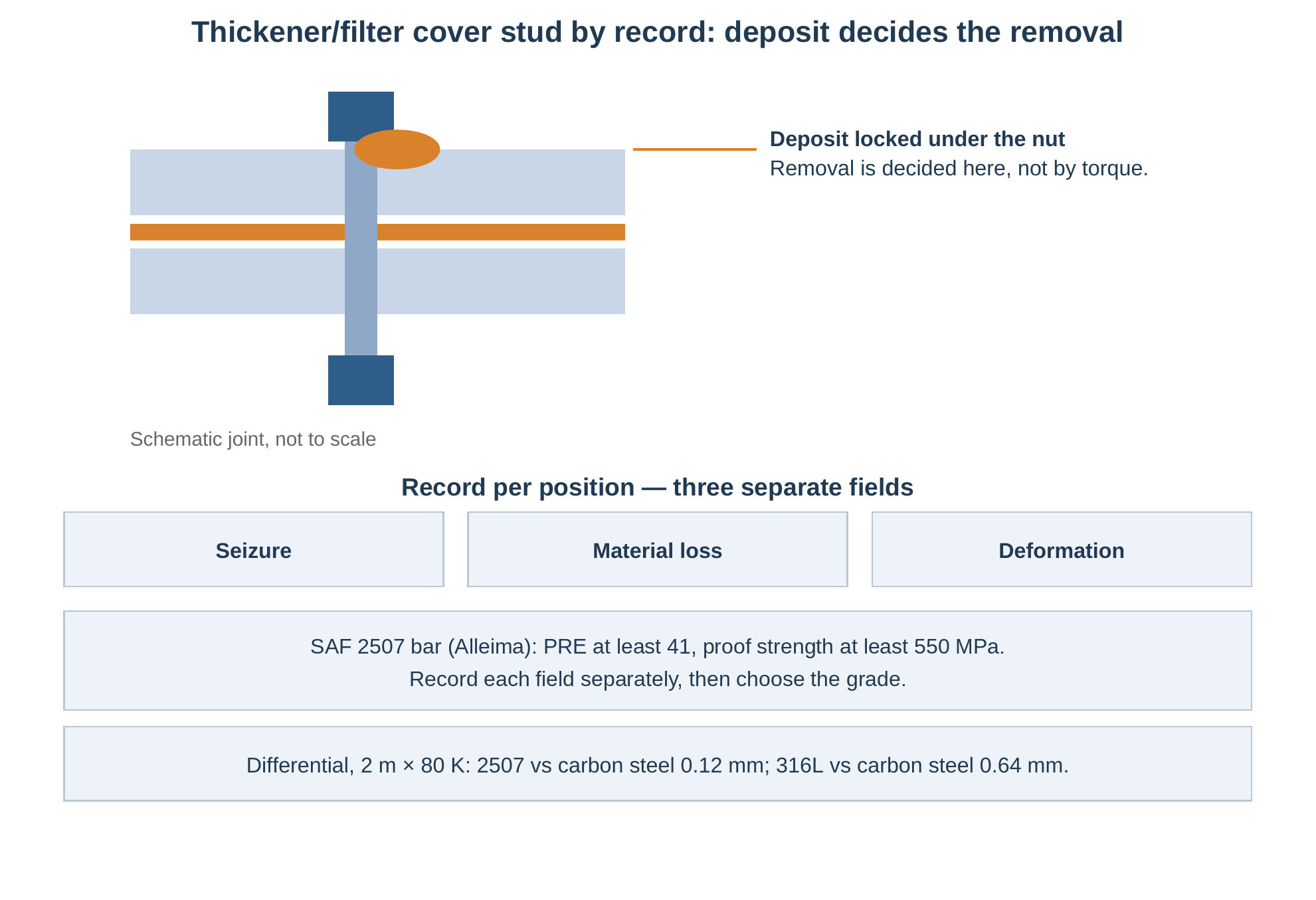
Thickeners and filters exist to separate solids from liquor, so their covers, launders and feedwells sit exactly where solids settle and liquor dries. Gypsum, carbonate scale, metal sulfide fines and dried process salts build up around the bolt heads and under the nuts, and they set hard.
For each cover or bolted connection, state:
- the deposit type and how fast it builds
- the cleaning method and whether it reaches the threads
- how often the cover or panel is opened
- whether each bolt can be reached with a spanner or socket with the cover in place, or only once it is lifted
Bolts that need a cover lift or special access are opened less often than planned, and those are the ones that seize.
Three fields in the removal record
Log each removed bolt by position, with three separate fields:
| Field | Typical cause | What changes on the next order |
|---|---|---|
| Seizure | Deposit in the thread, galling, nut corroded onto bolt | Lubricant, nut material, cleaning method |
| Material loss | Crevice corrosion under the nut, erosion | Higher grade, or wear protection |
| Deformation | Overtightening, misalignment, forcing a seized nut | Bolt size, tightening method, tools |
For purchasing requirements, read the duplex and super-duplex bolting specification guide. See also mining and mineral-processing applications.
A bolt can show more than one. Recording them separately is what makes the pattern visible: seizure on every position of one cover points to that cover's deposits; material loss only on the splash side points to wetting and drying.
Galling is a common cause of seizure in stainless and duplex threads tightened dry or fast. Stainless steels are among the materials most prone to it, as Fastener + Fixing's note on galling explains, because the protective oxide is wiped off under thread pressure and the bare metal surfaces weld together. The usual remedies are a thread lubricant, slower tightening, and a nut of a different material or hardness from the bolt. Our article on fastener galling covers the same problem for nickel alloys.
Choosing the grade
| Candidate | UNS and specification | Where it fits thickener and filter covers | Limit to check |
|---|---|---|---|
| 316L | S31603 | Fresh-water liquor, dry external fixings | Pitting once chloride and drying combine |
| Duplex 2205 | S32205, ASTM A479 | Moderate chloride, splash and drying zones | Less crevice margin than 2507 |
| Super duplex 2507 | S32750, ASTM A479 bar / A1082 | Saline or acidic liquor, heavily loaded filter covers | Ferrite content and heat treatment |
| Inconel 625 | N06625, ASTM B446 Grade 1 | Hot acidic chloride liquor | Lower yield than 2507 |
Related references: Duplex 2205 · Super duplex 2507
Alleima's SAF 2507 bar data gives a PRE of at least 41, a proof strength of at least 550 MPa and tensile strength of 760–930 MPa. That is closer to carbon steel bolting than 316L offers, but still below B7 or class 8.8, so check the diameter on a filter press head or pressure filter cover against the original grade.
Nut choice and spares
Order nuts with the bolts and name the lubricant. A higher-alloy nut does not by itself prevent galling, and same-material pairs can still gall. Choose the nut for corrosion resistance, strength and supply condition, then control galling through surface finish, thread fit, lubrication and assembly practice; don't change a duplex nut's condition just to make it harder. Never drop the nut to a lower grade than the bolt: it corrodes onto the thread.
Keep spares per cover, labelled by position, so a removed bolt is replaced with the same grade and length. Record the three fields again at the next opening; that is how you see whether the new order solved the problem.
| Confirm before ordering | Why it matters | Document to ask for |
|---|---|---|
| Removal record: seizure, material loss, deformation | Each points to a different fix | Maintenance record per position |
| Liquor chemistry and drying | Decides 316L, 2205 or 2507 | Process datasheet |
| Deposit type and cleaning method | Deposits cause most seizures | Maintenance procedure |
| Access per bolt | Covers that need a lift get opened late | Cover drawing |
| Nut material and lubricant | Controls galling and corrosion lock | Fastener specification |
| 2205 UNS designation | Some specifications accept only S32205 (dual certification) | Project material specification |
Related references: dual certification
Requesting a quote
Send the removal record with the drawing: "Pressure filter cover bolts M36, 2205 at present, 14 of 20 seized and 6 with thread loss under the nut on the feed side, saline liquor at 12 g/L chloride, 45°C, cover opened weekly for element inspection."
That record shows whether the next order needs a different grade, a different nut and lubricant, or both; we can then review the specified grade and dimensions and quote 2507 stud bolts, 2507 heavy hex nuts or other combinations by position.