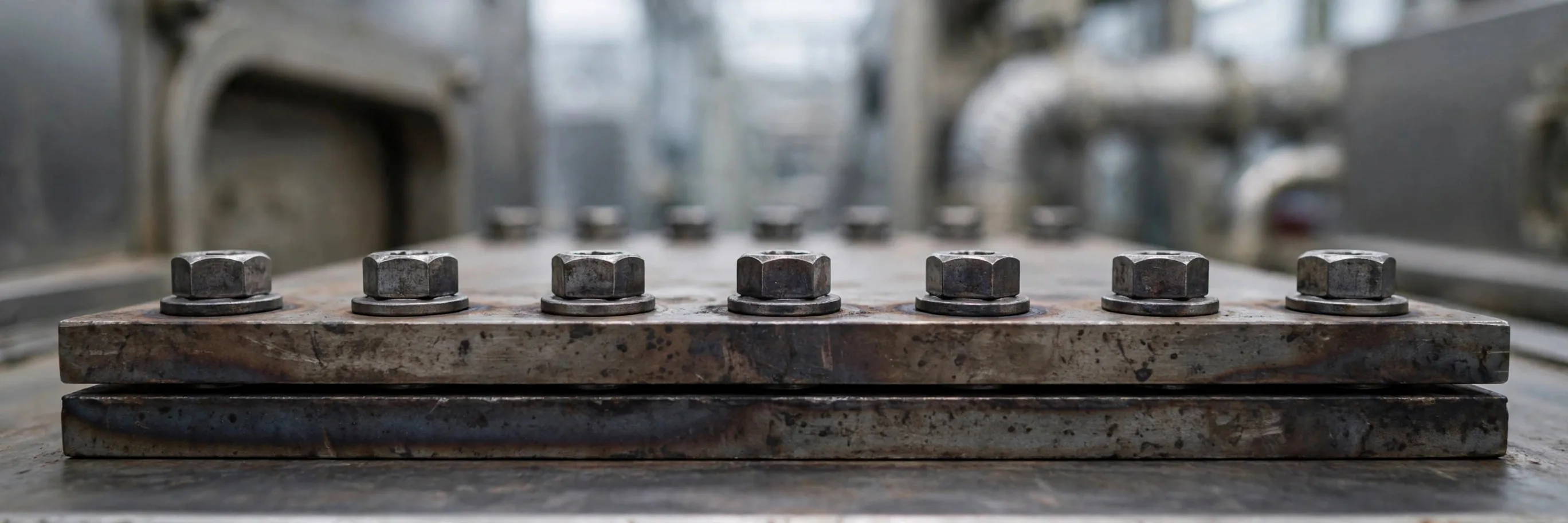
A bolt that slides in easily on the bench can be locked in its hole after the first hot cycle, and drilling it out means taking the tool down and qualifying it again.
Atmosphere at temperature
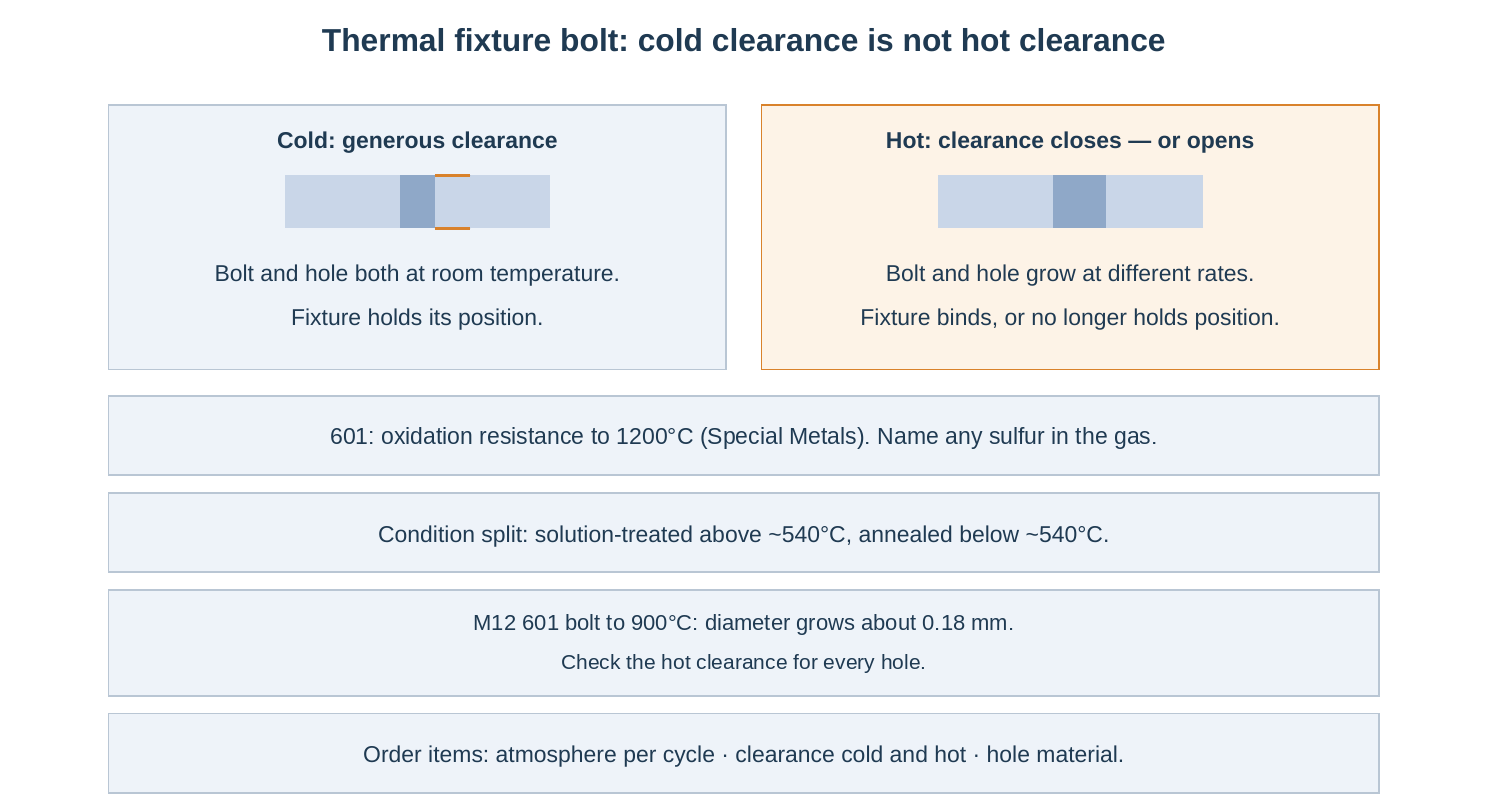
The Special Metals INCONEL alloy 601 bulletin highlights 601's resistance to oxidation up to 1200°C, and its good resistance to carburization and carbonitriding. That makes it a good fit for oxidizing and inert anneals, and for fixtures that see carbon-bearing gases.
Check for reducing gas, sulfur and halogens. Nickel alloys can be attacked by sulfidation in reducing gas containing sulfur; Special Metals' H₂S–hydrogen data cover only 650–760°C, so compare them with your own process conditions. Chlorine and fluorine compounds, such as HCl used in some oxidation steps or halogen by-products in the exhaust, attack nickel alloys at temperature, so name them and their concentration on the order.
Where the gas changes through a recipe, describe each step, because the bolt sees every one of them in turn.
Hot clearance
A bolt and its hole grow at different rates, so the clearance at temperature is not the clearance on the drawing. If the bolt grows faster than the hole, the gap closes and the bolt binds or galls. If the hole grows faster, the gap opens and the fixture can shift.
The Special Metals bulletin gives 601 a mean expansion coefficient, measured from 27°C, of 13.75 µm/m·°C to 100°C, 17.24 µm/m·°C to 900°C and 17.82 µm/m·°C to 1000°C. For a 12 mm bolt taken from 27°C to 900°C:
12 mm × 17.24 × 10⁻⁶ /°C × 873°C ≈ 0.18 mm of diameter growth
Now the hole. High-alumina ceramics typically expand around 8 µm/m·°C over a similar range; take the actual figure from the grade's datasheet. A 12 mm hole in such a part grows about 12 × 8.2 × 10⁻⁶ × 873 ≈ 0.09 mm, so the clearance closes by roughly 0.18 − 0.09 ≈ 0.09 mm. Graphite and other ceramics vary widely with grade, direction and temperature, so never assume zero expansion. In a metal fixture, use the difference between the two coefficients over the same temperature range. Do the same calculation for length where the bolt spans a slot or a stack of plates.
State on the drawing, for each hole:
- cold clearance and calculated hot clearance
- the bolt and fixture materials the calculation used
- whether the bolt must be removable after a hot cycle
Choosing the alloy
| Candidate | UNS and form | Where it fits a thermal fixture | Limit to check |
|---|---|---|---|
| Inconel 601 | N06601, bar to ASTM B166 | Oxidizing, inert and carburizing atmospheres, roughly 600–1100°C | Sulfur in reducing gas; low strength in the annealed condition |
| 310S | S31008, bar to ASTM A479 | Lighter-duty oxidizing service at lower cost | Embrittlement in long service between roughly 600 and 900°C |
| Inconel 625 | N06625, bar to ASTM B446 | Higher strength at moderate temperatures; some chloride-bearing processes | Less oxidation resistance than 601 at the top of the range |
| 316L | S31603, ISO 3506-1 A4-70 or A4-80 | Fixtures that stay below about 400°C | Scaling and strength loss at high temperature |
Inconel 601 is a solid-solution alloy, so its strength comes from its composition and condition, not from age hardening. Room-temperature strength in the annealed condition is modest. At high temperature the limit is creep, which is why Special Metals uses the solution-treated condition for rupture-limited parts above about 540°C. A bolt holding a light heat shield is a different case from one that clamps a heavy plate, so check the bolt stress at the operating temperature. Our note on preload and creep at high temperature covers why clamp load falls with time.
310S costs less and suits lighter oxidizing duty. Our comparison of 310, 310S and 310H explains the carbon difference. For long holds between about 600 and 900°C, check for embrittlement.
Removal, galling and records
Nickel alloy threads gall easily at temperature, especially in a tight hole. Leave hot clearance in the threads as well as in the bore, and use a thread compound that suits the process and temperature, if the process allows one. Our note on galling in nickel alloy fasteners covers the causes.
When fixtures are serviced, record by position:
- bolts that bound or had to be drilled out
- scale, discoloration or distortion
- clamp loss: loose parts or shifted fixtures
Bolts that bind only in certain holes usually point to a clearance problem in those holes rather than an alloy problem.
Requesting a quote
List the bolts by position, for example: "M8 × 30 Inconel 601 hex bolts, solution-treated, 60 pieces, heater element mounting brackets outside the process tube; furnace air with scavenger exhaust nearby, metal temperature up to 950°C, three cycles per day; brackets in 601 plate; hot clearance calculated at 0.15 mm."
After checking grade, condition, dimensions and inspection requirements, we quote 601 hex bolts with 601 heavy hex nuts. Industrial heat-treatment furnaces have their own guide, on 601 heat-treatment fixture bolts, and more tool bolting is on the semiconductor manufacturing equipment page.