A drawing that says only “310 stainless” can leave purchasing, machining and inspection working to different assumptions. The difference between 310, 310S and 310H matters most when a part will be welded, remain under load at temperature, or be made from a different stock form than the designer originally considered.
Which grade should be specified?
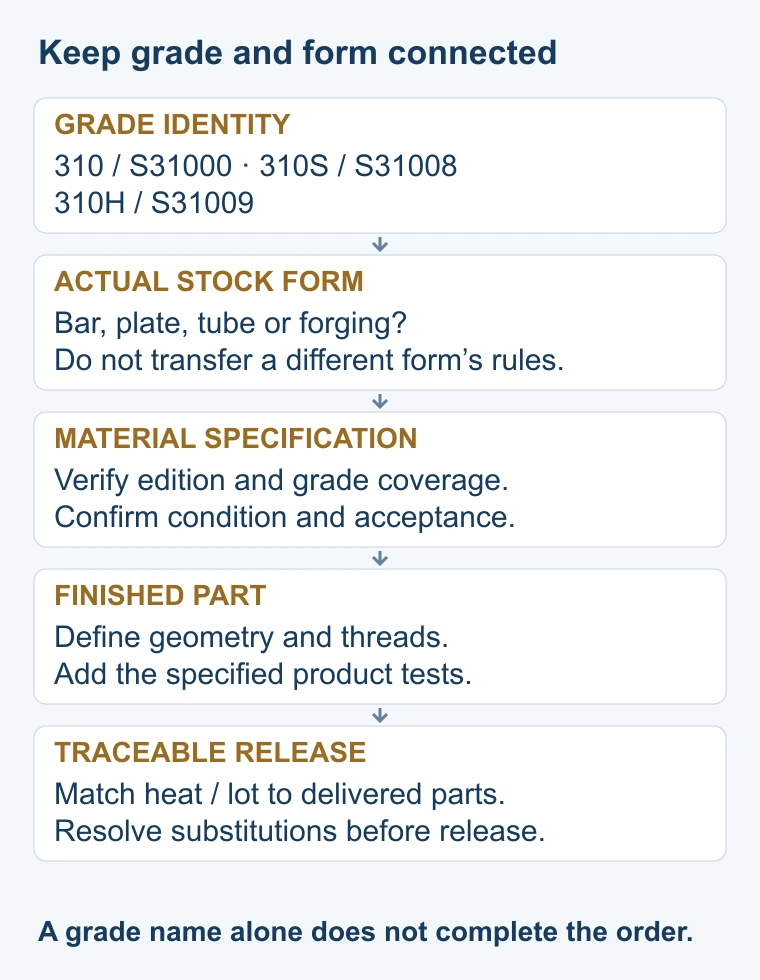
Use the exact grade and UNS required by the design, together with a material specification that covers the ordered product form. 310 is UNS S31000, 310S is S31008 and 310H is S31009. The S grade limits carbon more tightly than 310; the H grade has both a carbon minimum and maximum. They are separate purchasing identities, even when an individual heat may satisfy more than one set of requirements. [1]
For a welded fabrication, review sensitization and the post-weld condition. For a loaded hot component, review the time-dependent design basis. For a machined fastener, confirm the stock specification and finished-part requirements separately. Choosing the suffix is only one part of writing the order.
What the carbon limits do—and do not—tell you
| Designation | UNS | Carbon in the cited table | Purchasing implication |
|---|---|---|---|
| 310 | S31000 | 0.25% maximum | A 310 certificate does not by itself establish either the S or H requirements. |
| 310S | S31008 | 0.08% maximum | A lower maximum than 310; it does not establish the minimum required for 310H. |
| 310H | S31009 | 0.04–0.10% | Check both boundaries and all other requirements of the applicable specification. |
ATI attributes this chemistry table to ASTM A167/A240. It is a producer reference for the comparison, not a replacement for the edition and product-form requirements on a new order. Outokumpu also lists 310S and 310H separately within its 4845 offering. [1] [2]
The overlap between the S and H carbon ranges is not a dual-certification rule. For example, a hypothetical heat with 0.06% carbon clears the carbon checks shown for both, but chemistry beyond carbon, processing, testing and the specified product form still need to match. A carbon result is one acceptance item, not the whole certificate.
Separate welding concerns from sustained hot loading
Lower carbon slows chromium-carbide sensitization; it does not make 310S immune. ATI describes the S versions as more resistant to sensitization, while warning that exposure history still matters. [1]
That makes “will this part be welded?” a useful first question, but not a complete grade-selection method. Record the welding route, any subsequent heat treatment, and whether the material will later encounter an environment in which sensitization is relevant. An unwelded bolt holding a welded bracket is not automatically exposed to the bracket’s weld thermal cycle.
High-temperature selection introduces a separate issue: resistance to oxidation is not the same as resistance to deformation under load. Outokumpu’s Therma guidance distinguishes high-temperature corrosion from creep-controlled design. [2] A furnace temperature quoted on a material brochure therefore cannot be copied onto a bolt drawing as its safe loaded operating temperature.
For retained clamp load, define metal temperature, load, duration and cycling before considering a substitute. The guide to preload, creep and relaxation explains the joint-level questions; this article resolves the grade and stock-form questions.
Why a 310H tube or plate reference cannot certify a bar
| What is being purchased? | Relevant source boundary | What to verify |
|---|---|---|
| Plate, sheet or strip | ASTM A240/A240M is a flat-product specification. | Exact grade coverage, edition, condition and applicable acceptance requirements. |
| Seamless tube or pipe | Alleima lists TP310S/TP310H with A213 and A312 for its 7RE10 tubular product. | Use the tubular product’s applicable route; do not transfer its certification to solid bar. |
| Round bar or another bar shape | A276/A276M and A479/A479M address bars and shapes, with different application scopes. | Confirm that the selected edition actually covers the required grade, size and condition. |
| Finished bolt, stud or machined part | The material certificate covers its stated material scope. | Specify dimensions, threads, finished-part acceptance and lot traceability separately. |
The tubular example is documented by Alleima; the ASTM catalogue titles establish the flat-product and bar scopes. They do not establish every grade entry or acceptance value in the full standards. [3] [4] [5] [6]
If a quotation offers “310H bar to A276”, ask for the exact edition and grade provision before accepting the claim. Do not infer coverage from the standard’s general title, or from a 310S bar listing. If the proposed form/grade combination is not covered, the purchaser and engineering authority need to agree a valid material specification or a clearly defined special requirement. Renaming the stock on the order does not resolve the mismatch.
A useful clarification for an incomplete stud drawing
Consider a proposed order for studs carrying the note “310H, ASTM A240”. The buyer wants a machined stud; the named material specification describes flat products. The right next step is to clarify the feedstock and acceptance route before requesting a price against that note.
| Drawing or order field | Information to resolve |
|---|---|
| Identity | 310H, UNS S31009; no substitution without written approval. |
| Feedstock | State bar, forging or other intended form and its required condition. |
| Material acceptance | Agree a specification and edition with verified grade/form coverage; identify any supplementary requirements. |
| Finished geometry | Controlled drawing and revision, thread designation, tolerance class and mating-part requirements. |
| Service and release | Metal temperature, sustained/cyclic loading, required life, inspection scope and traceable documents. |
A supplier response should identify exactly which requirement it can meet and which item needs clarification. “Equivalent to 310H” without the proposed UNS, condition and material route leaves the same uncertainty in place.
Before releasing the order
- Match the drawing, quotation and material certificate to the same grade and UNS.
- Confirm the material specification against the actual stock form; retain the agreed edition.
- Identify the supplied condition and any heat treatment or cold work after the material was certified.
- Keep material evidence separate from dimensional/thread inspection and any specified finished-part tests.
- Record who approves an alternative grade, stock form or processing route before production.
Compare the 310, 310S and 310H material pages for grade-specific reference information. For a stock enquiry, use round bar or plate and sheet. For a finished component, start from stud bolts or custom fasteners and attach the controlled drawing. These are different enquiry routes, not interchangeable material certifications.
The raw-material specification guide helps organize the stock order. Send unresolved grade/form questions with the drawing through Request a quote.