
A process-valve bonnet leaks for the same mechanical reasons as any bonnet: a body end that pulls out, a nut that runs out of thread, a crooked bonnet. Sour and chloride service add a second set of failures that don't show on a dimensional check, because they come from the condition of the stud and the fluid that reaches it.
Where the fluid reaches the stud
The bulk of a bonnet stud never touches the process fluid. The risk is concentrated in three places: the shank next to the gasket, if the gasket weeps; the crevice under the nut and washer, where moisture collects and oxygen runs out; and the body end in the tapped hole, if fluid gets past the gasket into the thread. Crevices are where chlorides concentrate and pH drops, so a stud can crack or pit there while its exposed surface looks clean.
The enquiry should state the fluid, its temperature, its chloride content, and whether it contains hydrogen sulfide. It should also say whether the valve is classed as sour service under NACE MR0175 / ISO 15156, because that classification controls the stud's hardness and condition, not just its alloy. If the bonnet is insulated or sits outdoors, say so too: condensation under insulation is a common way for chlorides to reach a stud on a line that is nominally dry.
The aged condition is what you are buying
Incoloy 925 gets its strength from fine titanium-and-aluminium-rich particles formed during ageing. The Special Metals 925 bulletin gives 42–46% nickel, with chromium, molybdenum and copper for corrosion resistance and titanium and aluminium for age hardening. Solution-annealed 925 without the ageing step is much weaker and won't carry a bonnet load.
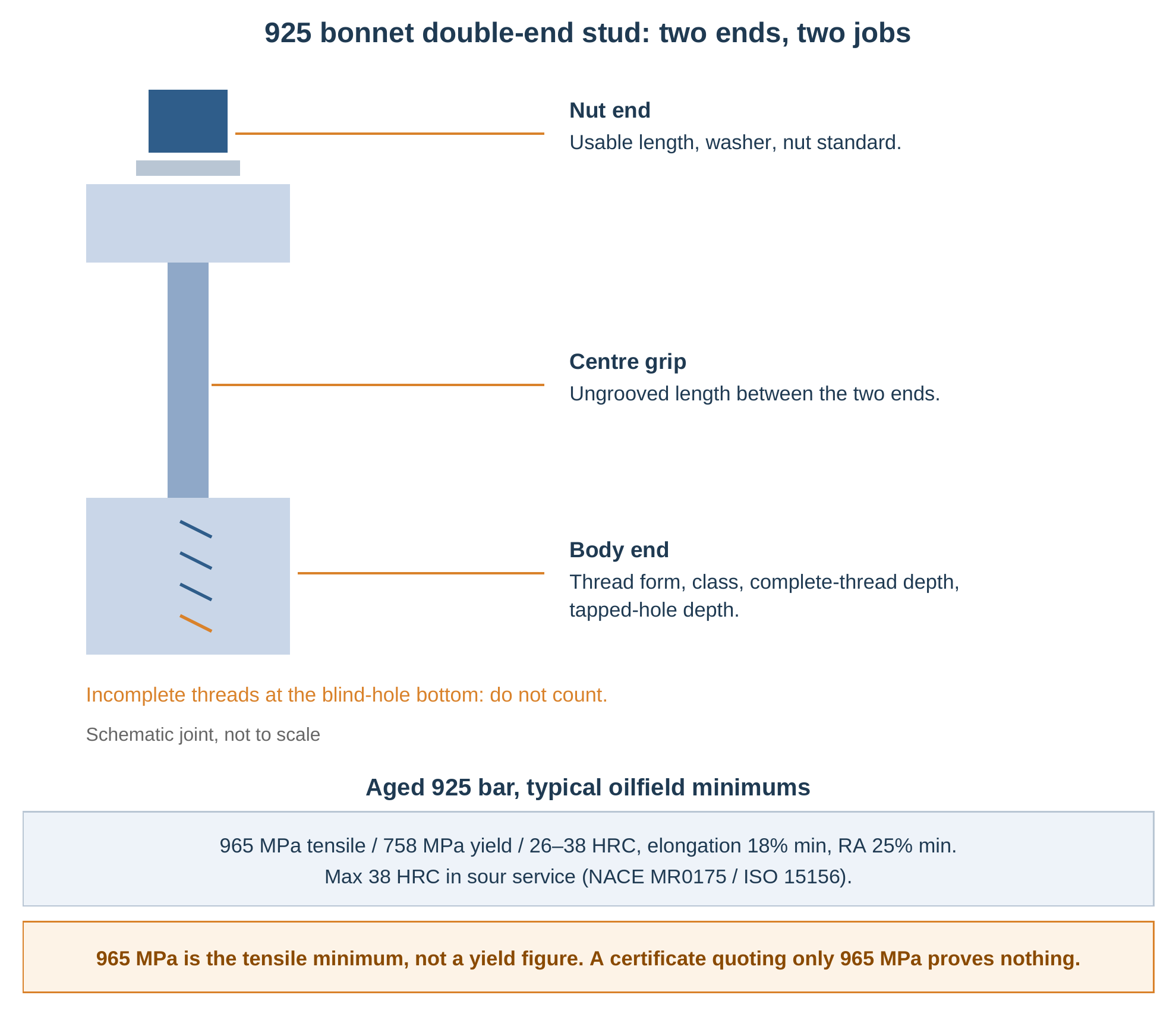
Oilfield specifications for aged 925 bar, such as those written to API 6ACRA, typically call for:
| Property | Typical minimum or range for aged 925 bar |
|---|---|
| Tensile strength | 140 ksi (965 MPa) min |
| 0.2% yield strength | 110 ksi (758 MPa) min |
| Elongation | 18% min |
| Reduction of area | 25% min |
| Hardness | 26–38 HRC |
The figures to check on the certificate are the yield, the tensile and the hardness, each labelled. In sour service the ceiling for solution-annealed and aged 925 is 38 HRC, and the certificate should show the hardness measured on the finished studs, not only on the bar. If the stud supplier ages the bar after machining, the ageing record belongs in the certificate pack. Our 718 vs 925 comparison explains how the two grades are qualified differently.
925 against 718, 625 and 316
| Candidate | Specification | Where it fits a sour or chloride bonnet | What to watch |
|---|---|---|---|
| Incoloy 925 | N09925, ASTM B805, solution annealed and aged | Sour and chloride bonnets needing high strength | Max 38 HRC in sour service; aged condition proved |
| Inconel 718 | N07718, aged, oilfield grade to API 6ACRA | Higher-load bonnets where the fluid allows it | Max 40 HRC in sour service; check its own ISO 15156-3 environmental limits |
| Inconel 625 | N06625, ASTM B446 | Fluids that need more corrosion margin than 925 | B446 Grade 1 minimum yield 414 MPa to 102 mm; needs a larger stud |
| 316 | S31600, ASTM A193 B8M | Not a substitute in sour bonnets | Same size, far lower strength; limited sour acceptance |
Related references: Inconel 718 · Inconel 625
Each grade is qualified under ISO 15156-3 within its own environmental limits, so the fluid data decide which ones are even eligible before strength is compared. Where a bonnet was designed for 925 studs, a 625 stud of the same diameter carries much less load, so a like-for-like swap leaves the joint under-tightened even though the corrosion side has improved.
Ends, nuts and the tightening sequence
The end dimensions follow the same rules as any bonnet stud: tapped-hole depth, depth of complete thread, body-end length, grip and nut-end length, each given separately and checked against the original stud.
The nut needs as much care as the stud. In sour service the nut must also meet NACE MR0175 / ISO 15156, so state its grade, condition and standard. A nut of a different alloy can set up galvanic corrosion in the crevice where the two meet. Nickel-alloy threads can also gall, and galled nuts on sour valves usually end up being cut off, so the lubricant should be named and approved for the process.
Use the valve maker's tightening pattern and passes, with the torque or tension for each pass written into the procedure. At overhaul, look at removed studs by end: body-end thread wear or pull-out marks, nut-end damage, and pitting or cracking in the crevice under the nut. Damage under the nut on several studs points to the fluid reaching the crevice, which a gasket or insulation change may fix better than a new alloy.
| Lock before ordering | Why it matters | Document to ask for |
|---|---|---|
| Fluid, chloride, H₂S, sour classification | Decides grade and hardness limit | Process data sheet, sour-service classification |
| Aged condition, yield, tensile, hardness | Unaged or over-hard 925 fails in service | Ageing record, labelled test results, hardness on finished studs |
| Body end, grip and nut-end dimensions | Wrong ends fail even in the right alloy | Valve drawing or measured original stud |
| Nut grade and condition | The nut must meet the same sour rules | Nut specification and certificate |
| Set list and records | Traceability after a leak | Set list by valve, EN 10204 3.1 certificates, PMI where specified |
Related references: EN 10204 3.1 certificates
Requesting a quote
A useful enquiry reads like this: "M20 Incoloy 925 double-end studs for a sour-service process valve bonnet, solution annealed and aged, max 38 HRC per NACE MR0175 / ISO 15156, body-end and grip lengths from the original stud, nuts to the same standard." A photo of a removed stud showing where corrosion or cracking started helps the team separate fluid, condition and dimension problems.
The engineering team will confirm the condition, hardness and both ends with you, then quote 925 double-end studs with EN 10204 3.1 certificates. Sour-service bolting for wellheads and process plant is covered under oil and gas.