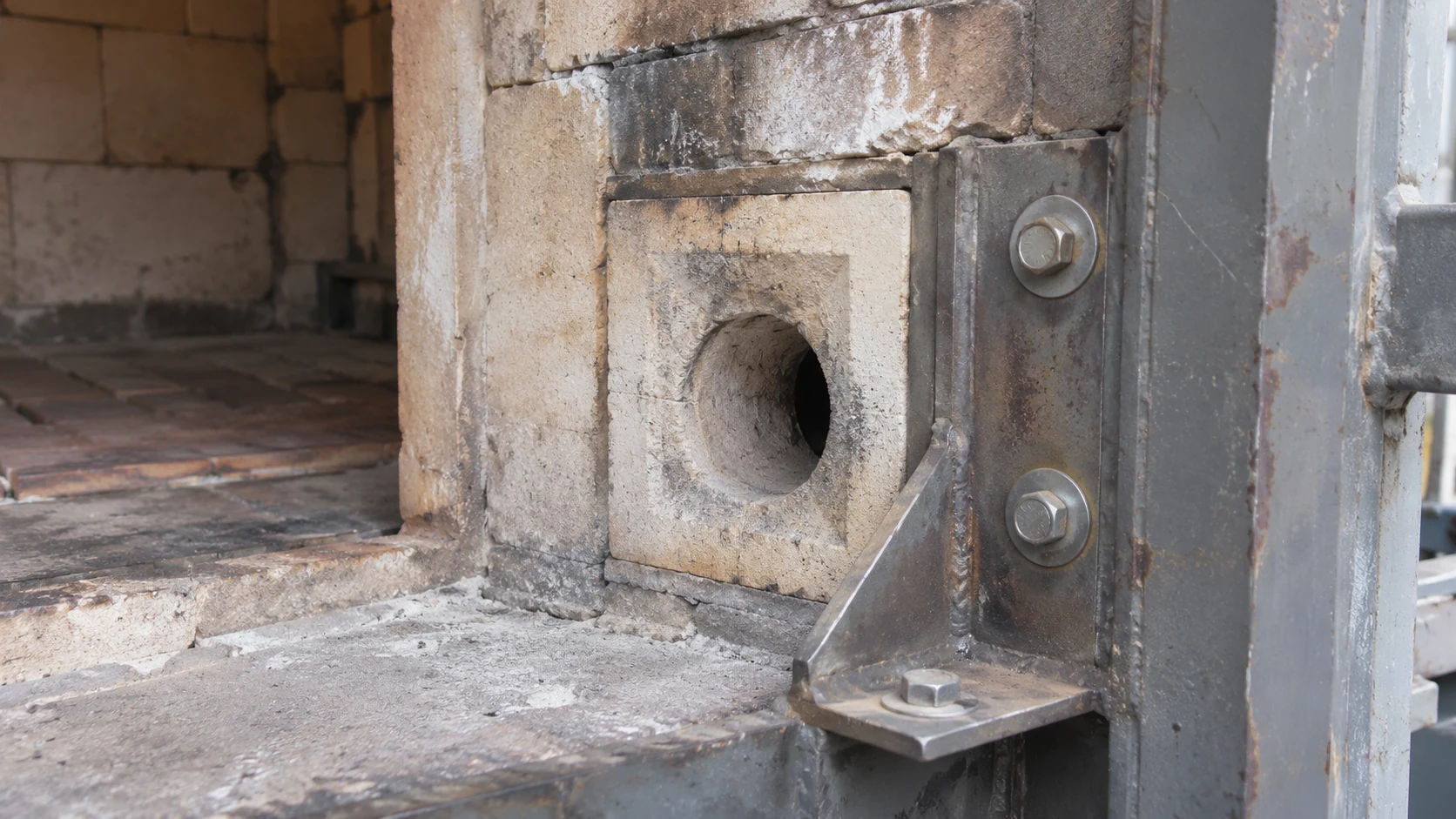
This guide is about ordering a burner-area bolt by measured metal temperature, not by furnace setpoint. The measurement points, the fuel and atmosphere, and the expansion clearance all have to be stated together: a bolt ordered for the control temperature will be undersized for the hot spot, and a bolt ordered for the hot spot without clearance will bind the part it holds.
A burner-area bolt is not a general furnace bolt. It lives in the hottest, least uniform part of the furnace, and its alloy, its clearance, and its inspection interval all follow from that local duty, not from a catalogue temperature range.
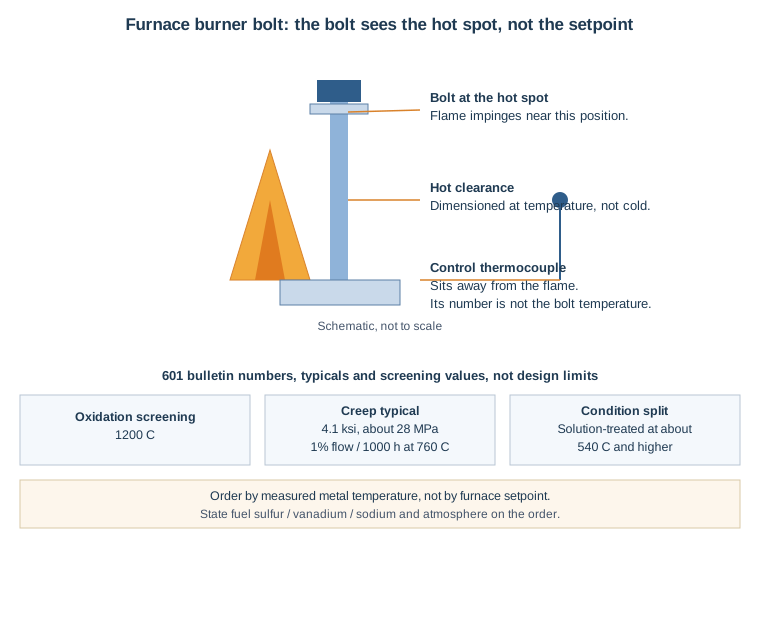
Figure: Furnace burner bolt — the bolt sees the hot spot, not the furnace setpoint; 601 bulletin numbers are typicals and screening values, not design limits.
01 The control temperature is not the bolt temperature
A furnace controller measures temperature at its own thermocouple, usually in a representative position away from direct flame. A bolt near a burner sits in a different thermal field: flame touches the part directly, a burner runs above its design rate, or the layout concentrates heat where two flames meet, and each of those pushes a local spot above the control temperature. Outokumpu's Therma range stainless datasheet notes that the oxide growth rate increases with temperature until the rate becomes unacceptably high or the oxide layer cracks and falls off, so the bolt at the hot spot oxidizes faster, creeps faster, and loses section faster than a bolt a metre away at the control temperature.
- Identify the measurement points: the bolt position relative to each burner, the flame direction, and the distance from the burner tip.
- Record the metal temperature measured or modelled at that position, not just the furnace setpoint.
- Map whether firing is steady or cycling, since a cycling burner creates a cycling hot spot, and a bolt that survives a steady hot spot can still lose scale over hundreds of cycles.
- State whether the burner runs on natural gas, fuel oil, or another fuel, since fuel decides the atmosphere the bolt sees as well as the heat.
02 Atmosphere at the burner decides the alloy, not temperature alone
Fuel brings chemistry as well as heat. Fuel oils carry sodium, vanadium, and sulfur, and where those condense as molten sulfate salts on the bolt, the salts dissolve the protective oxide layer instead of letting it protect the metal, so the bolt thins far faster than oxidation alone would predict. JMST molten sulfate hot corrosion review identifies sodium sulfate as the predominant reactant in molten-salt hot corrosion, formed from sulfur and alkali-metal impurities in fuel and air. No single condensation temperature is stated here, since published ranges for salt melting and low-temperature attack disagree, so the order states the fuel impurities and the atmosphere and lets the alloy choice follow from them.
That is why a burner-area bolt cannot be ordered by temperature alone. State the fuel, the sulfur, vanadium, and sodium content where known, whether the local atmosphere is oxidizing or reducing, and whether the burner runs with incomplete combustion. A bolt in a sulfur-bearing, reducing pocket needs a different alloy conversation from a bolt in clean, oxidizing gas at the same temperature, and a bolt that holds in one burner position can fail in another position in the same furnace where the atmosphere differs. Special Metals' INCONEL alloy 601 bulletin states that 601 is not suggested for use in strongly reducing, sulfur-bearing environments, which is the mill-level reason a reducing pocket changes the alloy choice even before any temperature comparison.
03 The candidate alloys, and where each one stops
Inconel 601, UNS N06601, bar to ASTM B166, is the burner-area starting point where oxidation and cycling govern. Special Metals' INCONEL alloy 601 bulletin gives nickel 58–63%, chromium 21–25%, and aluminium 1.0–1.7%, with oxidation through 1200°C and a scale that resists spalling under severe thermal cycling. Its load story rests on a bulletin creep typical of 4.1 ksi, about 28 MPa, for 1% flow in 1000 hours at 760°C, with solution-treated material for rupture-limited duty at about 540°C and higher and annealed material for tensile-limited duty below. Annealed rod and bar typicals run 80–115 ksi tensile and 30–60 ksi yield, labelled as typical ranges, and no B166 bar minima are stated. A burner bolt must be sized for hot load, not for scale life alone.
Inconel 625, UNS N06625, bar to ASTM B446, is the stronger annealed alternative, where a burner-area part needs more hot strength and the atmosphere is not the limiting factor. Its ASTM B446 Grade 1 bar minima run 827 MPa tensile and 414 MPa yield to 102 mm diameter, and 758 MPa tensile and 345 MPa yield above that diameter, to be confirmed against the governing B446 edition. Its oxidation and carburizing behaviour under cycling must be checked against the project specification, since it has no aluminium addition. Incoloy 800H, UNS N08810, bar to ASTM B408, is the creep-led alternative where a burner-area support carries sustained load, with carbon 0.05–0.10%, aluminium 0.15–0.60% and titanium 0.15–0.60% individually, and grain size ASTM No. 5 or coarser. Room-temperature requirements must be checked against the governing ASTM B408 edition and the specified bar condition. ASTM B564 forging minima are not B408 bar minima and are not the sizing basis for a bolt machined from bar. A 310S set, UNS S31008, bar to ASTM A479, is the economical boundary: Outokumpu's Therma range stainless datasheet gives Therma 310S/4845 a maximum application temperature of 1050°C for air, for guidance only, with a slight susceptibility to embrittlement during continuous operation between 600°C and 900°C, so it fits low-load, mild-cycling burner areas and not a loaded bolt at the top of the range.
| Candidate | UNS and form | Where it fits near a burner | Boundary to watch |
|---|---|---|---|
| Inconel 601 | UNS N06601, bar to ASTM B166 | Oxidation and cyclic burner service | Creep typical 4.1 ksi, about 28 MPa, 1% flow in 1000 h at 760°C; solution-treated at about 540°C and higher; not suggested for strongly reducing, sulfur-bearing environments |
| Inconel 625 | UNS N06625, bar to ASTM B446 | Higher hot strength where atmosphere is not limiting | B446 Grade 1 minima 827 MPa tensile / 414 MPa yield to 102 mm, 758 MPa tensile / 345 MPa yield above, edition hedge; check oxidation and carburizing behaviour under cycling |
| Incoloy 800H | UNS N08810, bar to ASTM B408 | Sustained-load burner supports, creep-governed | Carbon, Al, Ti, grain, and anneal must be on the certificate; verify the specified B408 bar condition separately from the hot-service creep assessment |
| 310S | UNS S31008, bar to ASTM A479 | Economical, low-load, mild-cycling burner areas | Maximum application 1050°C for air, guidance only; slight embrittlement susceptibility, continuous 600–900°C |
Bar and material specifications such as ASTM B166, B446, B408, and A479 do not by themselves specify a finished bolt. Thread form, dimensions, finish, nut pairing, and finished-part testing still need to be stated separately on the order.
04 Expansion clearance is a hot dimension, not a cold gap
A burner-area bolt, the part it holds, and its support expand at different rates, and a clearance that fits cold can bind hot, while a clearance that fits hot can leave the part loose cold. State the bolt material, the held part material, the support material, the temperature range at the bolt position, and the required clearance at temperature, not just at room temperature. State whether the joint must clamp the part rigidly, or allow it to slide as it expands: a rigid clamp in the wrong place will bend the part or the support, while a sliding joint in the wrong place will let the part wander into the flame path.
Head type follows from that decision and from access. A hex head suits wrench access in open burner areas, while a flange head spreads load on a thin or soft part and gives a larger bearing face where a standard washer would sink into scale. State the head type, the washer diameter, and the tool space at the bolt position. A burner-area bolt that cannot be reached with a wrench at temperature will not be re-tightened, and a joint that is never re-tightened will loosen first at the hot spot. Bolt Science's stress relaxation technical page describes preload loss with no rotation of the fastener, which is the loss a re-tightening plan must recover. Nickel-alloy threads can also cold-weld and tear when the same alloy turns against itself under load, and Bossard's technical note on galling describes the oxide-breakdown picture for stainless threads, so apply the same lubricant discipline to nickel-alloy threads as an assembly control. At turnaround, inspect removed bolts by position: scale thickness, section loss at the thread root, and any bolt that needed cutting to remove. A bolt that thinned only at a burner-facing position needs a position, atmosphere, or clearance change, while a set that thinned everywhere needs a different alloy or a different temperature description.
Send the burner layout, the measurement points, the fuel and atmosphere, and the expansion requirement to the BYBOLT engineering team for a check before ordering. That check is where a burner bolt is caught ordered for the control temperature instead of the hot-spot temperature, a clearance is caught that binds the part hot, or a head type is caught that cannot be reached at the burner position.
At receipt, the quality pack should tie each bolt set to its heat, its annealing record, and its hardness report for the finished condition. Ask for EN 10204 3.1 certificates, a dimensional report for the actual bolts, and a PMI report where the project requires it. A bar certificate alone does not prove the finished, threaded bolt meets the condition the burner area was sized on.
| What to lock before ordering | Why it changes the joint | Document to ask for |
|---|---|---|
| Metal temperature per bolt position, not furnace setpoint | A hot spot runs above the control temperature | Temperature map, measurement points, burner layout |
| Fuel, sulfur, vanadium, sodium, oxidizing or reducing atmosphere | Molten sulfate salts dissolve the oxide film the bolt depends on | Fuel specification, atmosphere description |
| Bolt, part, and support materials and temperature range | Decides expansion clearance at temperature, not cold | Material list, temperature range per position |
| Clamp or slide per position, head type, washer, tool space | A rigid clamp in the wrong place bends the part; an unreachable bolt is never re-tightened | Drawing with head, washer, and tool space per position |
| Nut, washer, and lubricant | An unstated nut changes galling and loosening risk | Nut standard and condition, approved lubricant list |
| Set list and records | Mixed sets near a burner leave no auditable trail after a failure | Set list by burner position, EN 10204 3.1 certificates, PMI where specified |
05 Ask for a quote with the burner, not just the grade
If a burner-area bolt is being re-specified, or if a 601 set is being considered to replace a scaled set near a burner, send the burner with the size. A note like "M16 Inconel 601 hex bolt set near a gas burner, 950°C local metal temperature to be confirmed from the temperature map, oxidizing atmosphere, 12-bolt set, flange heads for a thin shield" gives the BYBOLT engineering team enough to check alloy, hot spot, atmosphere, clearance, and head type before quoting. Even a photo of a removed bolt, showing scale loss on the burner-facing side, helps show whether the last failure was a hot spot, an atmosphere problem, or a clearance problem.
That note, with the drawing when one exists, is enough for the BYBOLT team to start from: they will close the remaining temperature, atmosphere, and clearance gaps with you, then quote a small batch or a full set with EN 10204 3.1 traceability.