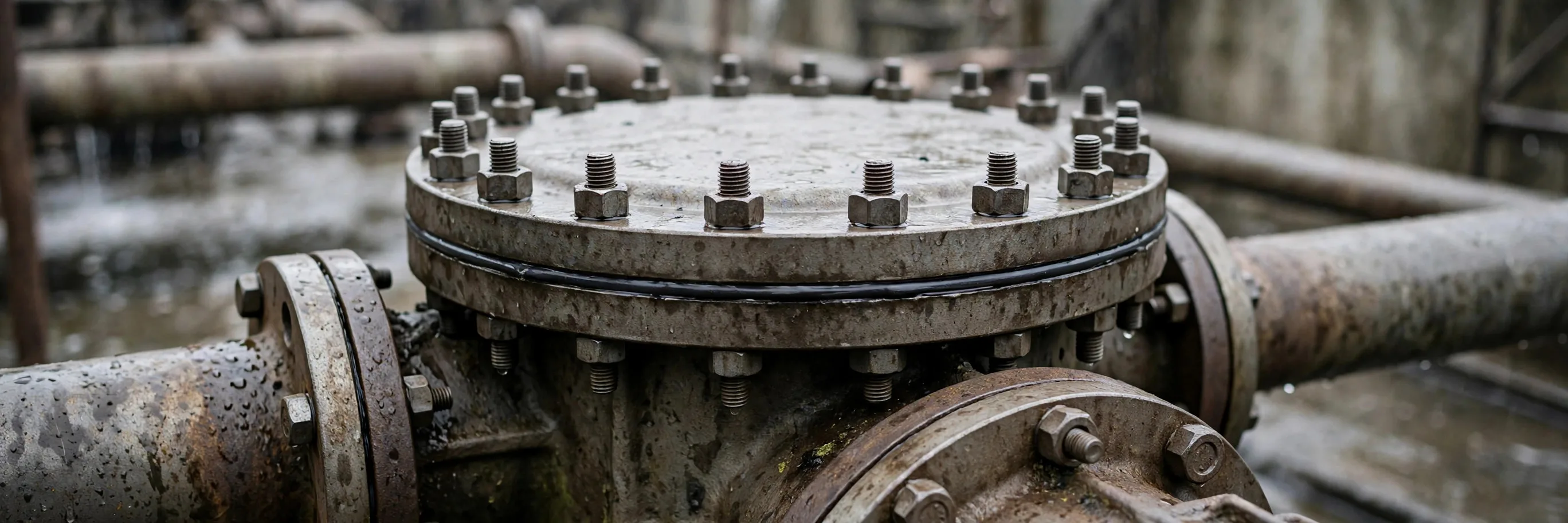
When a wet-end pump cover is opened after a long run, check under the nuts first. That is where crevice corrosion thins the studs, and where nuts seize into a crust of fibre and slime.
What white water carries
White water is the water that drains through the wire as the sheet forms. Most of it goes straight back to the headbox or to dilution, and only a small share leaves as effluent. As a mill closes its loops to save fresh water, dissolved salts, fines, fillers and organic material build up in that circuit. A study of paper-mill biofilms notes that closed white waters are rich in nutrients, and that temperatures of 30–50°C at a neutral pH favour bacterial growth.
Two pumps on the same machine can see very different water: a fan pump on short-circuit white water, a pump on clear filtrate after the save-all, a broke pump with heavy fibre. That is why the water analysis belongs to each pump rather than to the machine. Include sulfate and, if the mill measures it, thiosulfate alongside chloride and pH, and say whether the pump gets any fresh make-up water. A request for "studs for water service" gives the supplier nothing to check the grade against.
Deposits, cleaning and shutdown
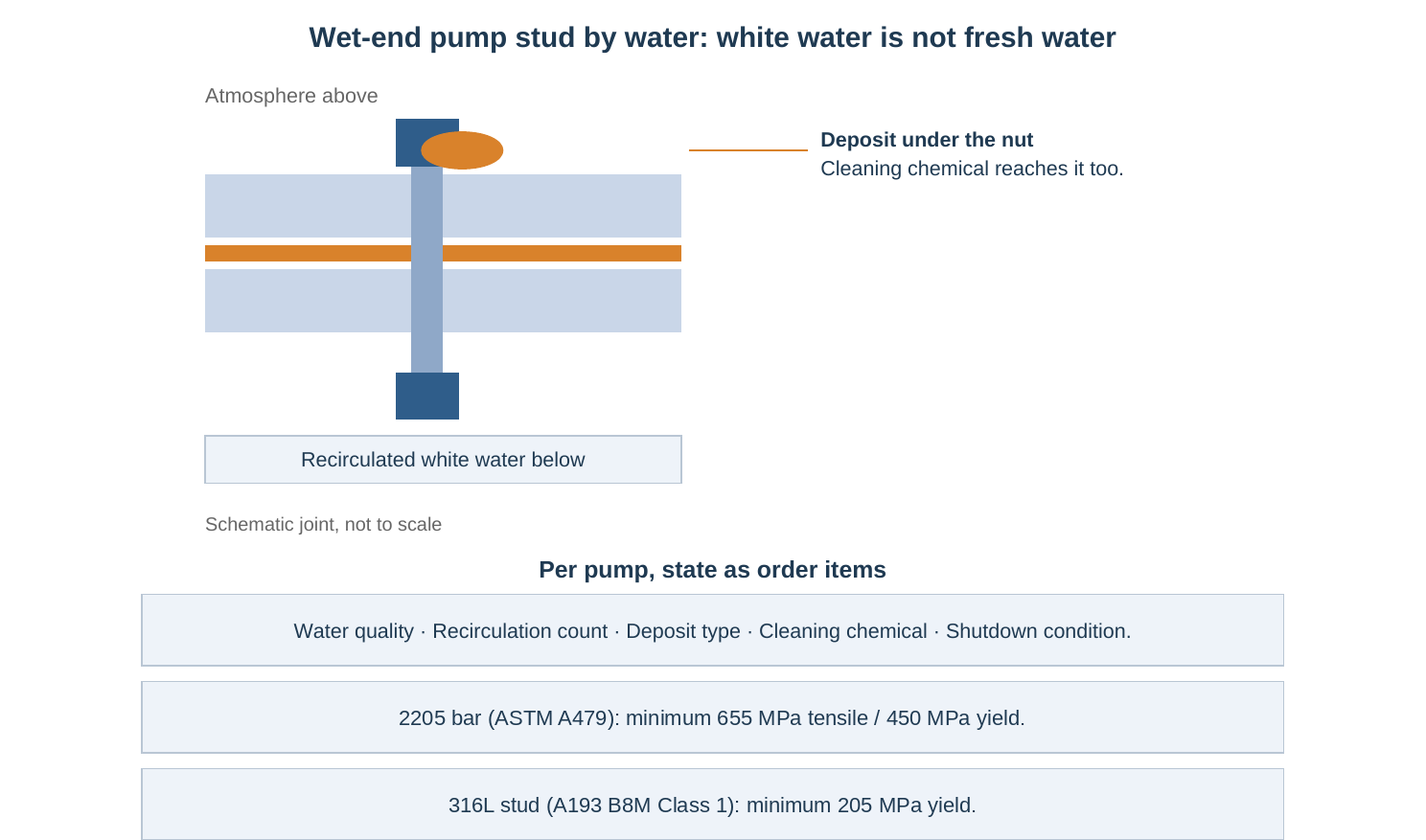
Deposits are what turn a moderate water into a crevice problem. Slime and fibre collect around the nuts and in the thread runout, and the water trapped under them goes stagnant. Oxygen is used up, chloride concentrates, and bacteria in the deposit change the chemistry further. The thread under the nut can then corrode while the visible shank still looks clean. Mills monitor this build-up for good reason; Klahre and Flemming measured deposit formation on line in a paper-machine white-water circuit to judge cleaning and biocide programmes.
Cleaning adds a second chemical duty. Boil-outs with caustic, acid washes for scale, and biocide or oxidizer programmes all reach the studs, and the bolting has to survive each of them. List the cleaning chemicals, concentrations, temperatures and frequency for each pump.
Then state what happens at shutdown. A pump drained and rinsed at every stop is a different case from one left full of white water for days, when deposits settle and dry on the studs and the residue concentrates as it dries.
Choosing the grade
| Candidate | UNS and form | Where it fits a wet-end pump | Limit to check |
|---|---|---|---|
| 316L | S31600/S31603, ASTM A193 B8M Class 1 (316/316L dual-certified) | Clean, cool fresh-water duty with no deposits | 205 MPa minimum yield; crevice attack under deposits in chloride |
| Duplex 2205 | S32205, bar to ASTM A479 or bolting to A1082 | Typical recirculated white water with deposits | Crevice temperature and chloride level; check against mill data |
| Super duplex 2507 | S32750, bar to ASTM A479 or bolting to A1082 | High chloride, warmer water, deposits that stay wet | Price; reserve for pumps where 2205 has pitted |
| Inconel 625 | N06625, bar to ASTM B446 | Rarely needed on the wet end; bleach-plant and acid duties | Cost; strength per stud size |
Duplex 2205 has a pitting resistance equivalent (PREN) of at least 34 in the S32205 composition, against about 24 for 316L. PREN is a ranking figure based on chromium, molybdenum and nitrogen content; it does not guarantee crevice performance in any particular water. ASTM A479 and A1082 both give S32205 a minimum of 655 MPa tensile and 450 MPa yield. The reverse swap is the one to watch: a 316L set fitted where the drawing says 2205 looks identical but carries less than half the yield. If the drawing calls for 2205, check that the certificate shows S32205 or a dual certification; our note on S31803 and S32205 dual certification explains the difference.
Super duplex 2507 adds chromium, molybdenum and nitrogen. Alleima's SAF 2507 bar datasheet gives a PRE of at least 41, a minimum 0.2% proof strength of 550 MPa and a ferrite content of 35–55% in the solution-annealed condition. Use it where the water analysis or the removal record shows 2205 pitting under the nuts.
Both duplex grades depend on correct solution annealing and quenching. Ask for the heat-treatment record and a ferrite check on the certificate; our guide to duplex heat treatment and inspection covers what to look for.
Nuts, tightening and the removal record
Pair duplex studs with duplex nuts, such as 2205 heavy hex nuts. A carbon-steel or 304 nut can become the weak link in a deposit that the duplex stud tolerates. Include the nut in the corrosion review rather than treating it as a generic spare. Assemble with a lubricant that tolerates the process water and the cleaning chemicals.
Tighten in a cross pattern in two or three passes, with the torque per pass and the target preload written in the procedure. When a cover is opened, record by pump:
- whether the nuts came off by hand, with a wrench or only by cutting
- any thread loss or pitting under the nut
- what the deposit looked like and where it was
- the cleaning done since the last opening
That record is what tells you whether the next set needs a better grade, a better cleaning practice, or both.
Requesting a quote
List the studs by pump, for example: "M20 × 140 2205 stud and nut sets, eight per cover, for the wire-pit fan pump and the broke pump on PM2; white water pH 6.5–7.5, chloride to be confirmed from the mill analysis, 45°C, slime deposits at the cover, caustic boil-out monthly; pump left full during short stops."
A photo of a removed stud, showing the deposit and any thread loss, is often more useful than a paragraph of description. We check the grade, dimensions and inspection plan pump by pump, then quote 2205 stud bolts or 2507 stud bolts with matching nuts. Other mill bolting is collected on our pulp and paper page.