On heated tooling, a bolt that held the plates tight when the tool was installed can be loose after the first production run. The bolt grew more than the plates it was clamping.
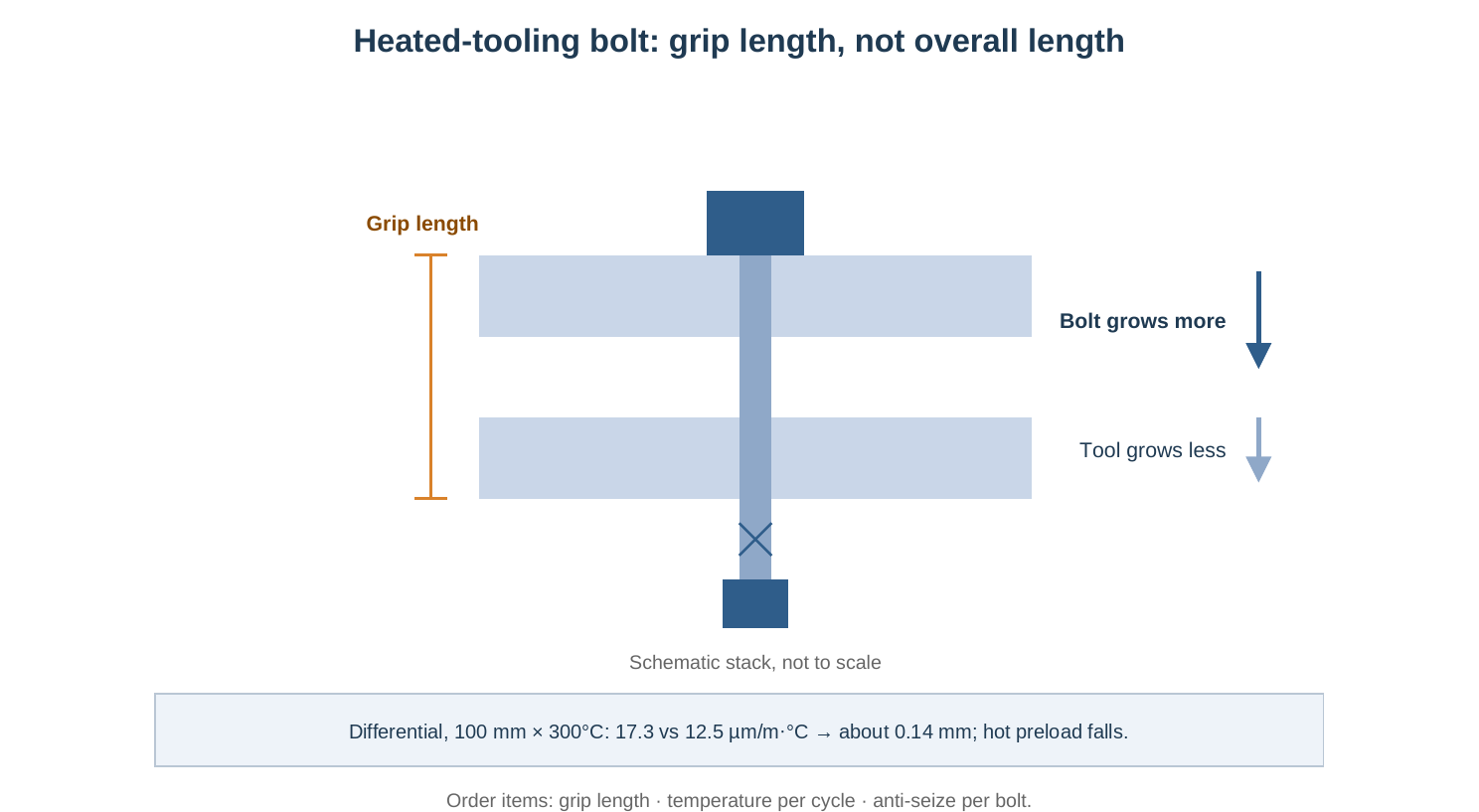
Grip length, not overall length
Grip length is the length of the clamped stack between the underside of the head and the face of the nut or the start of the tapped hole. Two bolts with the same overall length can have very different grips, depending on the thread length. For heated tooling, the grip sets how much differential expansion the joint has to absorb.
Put these on the drawing for each bolt:
- Grip length, measured across the clamped stack
- Shank-to-thread boundary: where the plain shank ends. The thread normally starts a little inside the grip, so the nut seats on full thread; keep the runout out of the nut and away from any shear plane between plates.
- The clamped stack: each plate, its thickness and its material, because each one expands at its own rate
- Nut seating: the nut must finish on full thread, not run onto the shank
Our note on grip length and thread runout explains how to measure it.
Differential expansion
The Rolled Alloys A-286 datasheet gives mean coefficients of thermal expansion from room temperature of 9.2 × 10⁻⁶ /°F to 200°F and 9.6 × 10⁻⁶ /°F to 800°F, about 16.6 and 17.3 µm/m·°C. Alloy tool steels and Cr-Mo steels used for heated tools typically run around 12–13 µm/m·°C over a similar range; take the actual figure from the tool material's datasheet.
A worked example, with 100 mm of grip, a 300°C temperature rise, A-286 at 17.3 µm/m·°C and a tool steel at 12.5 µm/m·°C:
100 mm × (17.3 − 12.5) × 10⁻⁶ /°C × 300°C ≈ 0.14 mm
Over a 100 mm length, that difference is a strain of about 0.0014. With a modulus of roughly 200 GPa, it corresponds to some 280 MPa of bolt stress in a perfectly stiff joint. Real joints have some flexibility and the modulus falls with temperature, but a large part of the preload can still be lost on heat-up. When the tool cools, the preload recovers only partly, because the bearing faces have embedded and some relaxation has taken place.
Where the tool itself is austenitic stainless, A-286 expands at nearly the same rate and the problem largely disappears.
Choosing the alloy
| Candidate | UNS and form | Where it fits heated tooling | Limit to check |
|---|---|---|---|
| A-286, A453 Grade 660 Class A, B or C | S66286 | Austenitic stainless tools; high strength to about 540°C long-term | Differential expansion in steel tools |
| A-286, A453 Grade 660 Class D | S66286, to 2-1/2 in | Higher yield where the preload must be higher | Hardness range; check class availability by size |
| Inconel 718 | N07718, bolting to ASTM A1014 | Steel tools where expansion matching and strength both matter | Cost |
| Alloy steel B7 | ASTM A193 B7 | Tools well below about 400°C | Relaxation and strength loss at higher temperature |
A-286 is usually bought to ASTM A453 Grade 660. Classes A, B and C have a minimum of 896 MPa tensile and 586 MPa yield at room temperature. Class D, up to 2-1/2 in, raises the minimum yield to 724 MPa. State the class on the order. Our guide to A453 Grade 660 Classes A to D explains the differences, and our note on A-286 yield strength at temperature covers how much strength remains when hot.
Inconel 718 bolting to ASTM A1014 is much stronger, with a minimum of 1275 MPa tensile and 1035 MPa yield. It also expands less than A-286, so it suits steel tooling better. Our comparison of A-286 and 718 fasteners sets out the trade-off.
Tightening, retightening and records
On critical joints, tighten to a stated preload, not just a torque. Within the heated grip, a longer bolt does not reduce the thermal load change, because the mismatch grows with length just as the bolt's stretch does; the load change is set by the expansion difference and the temperature rise. What does help is a bolt that is less stiff relative to the joint, such as a reduced shank, which turns the same mismatch into a smaller change in load, and enough length to make embedding losses small. Use an anti-seize rated for the tool temperature, because A-286 threads gall when dry.
After the first few heat cycles, check the preload and retighten if needed. Our note on preload loss at high temperature explains relaxation and embedding. At each tool service, record by position which bolts were loose, which had galled threads, and the tool temperature history.
Requesting a quote
List the bolts by tool, for example: "M16 A-286 long-shank hex bolts, A453 Grade 660 Class A, grip 120 mm, shank length 110 mm, 40 pieces; clamped stack of austenitic stainless plates; tool at 320°C; preload target stated on the drawing."
Once the class, dimensions and inspection plan are confirmed against the drawing, we quote A-286 hex bolts, long-shank hex head bolts or 718 bolts. Machine and tooling bolting in general is on the industrial machinery and automation page.