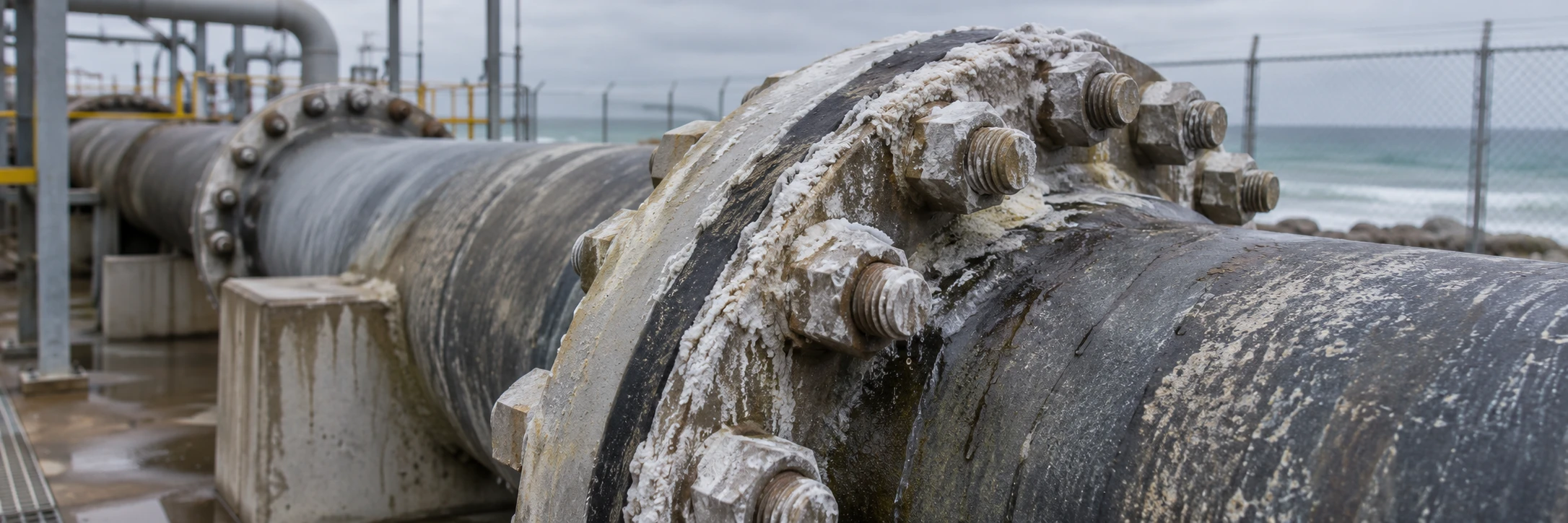
Brine-discharge flanges get less attention than the high-pressure end of the plant, but they carry the most concentrated water on site, often at low flow and sometimes with scale.
What the stud actually sits in
Seawater RO plants typically recover 40–55% of the feed as fresh water, according to a review of RO brine management, so the discharge carries roughly 60–80 g/L from a 35 g/L feed; an IntechOpen chapter on brine treatment puts typical discharge brine at 55–70 g/L. Thermal-plant blowdown is usually less concentrated but leaves warmer than the feed.
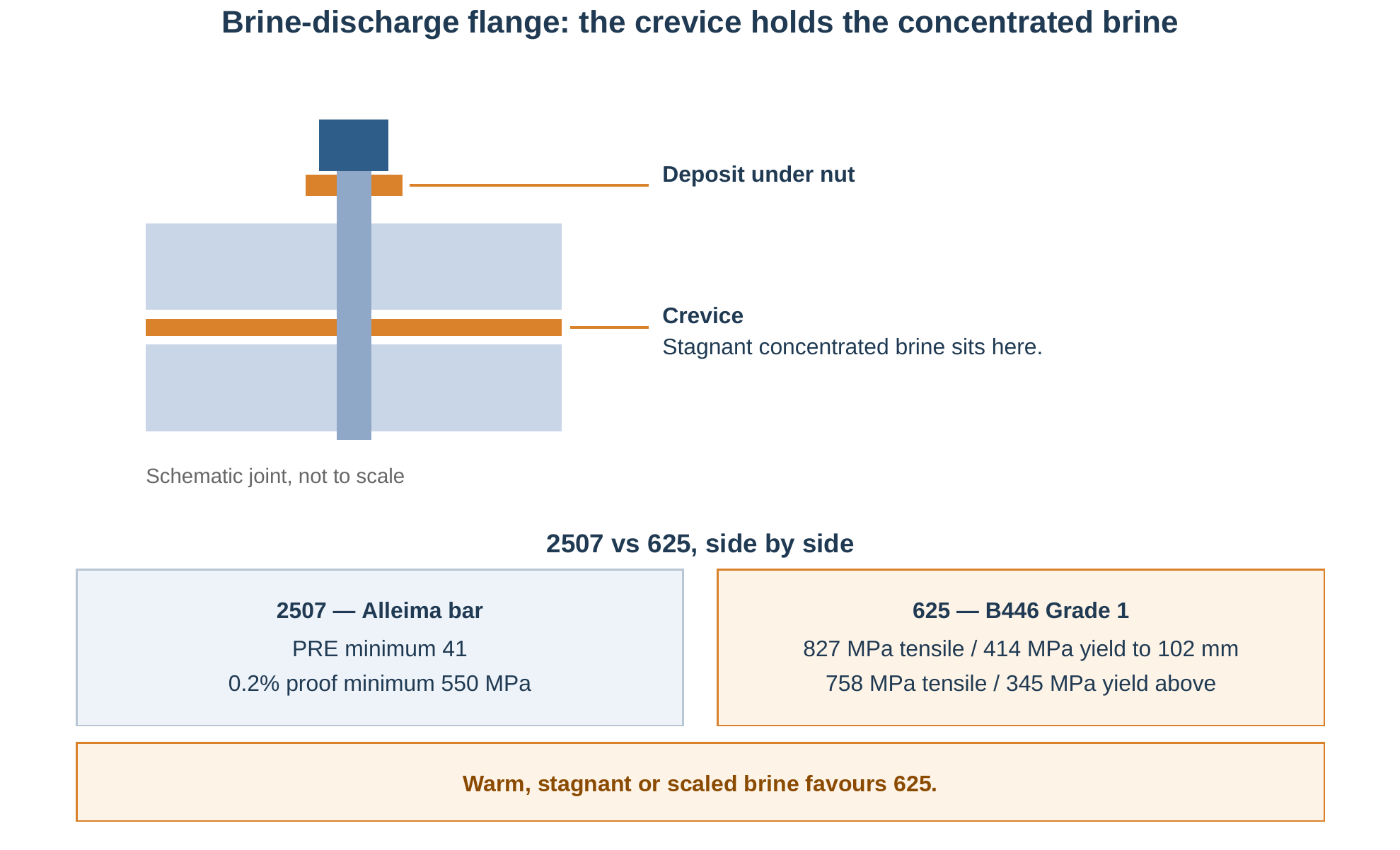
The stud doesn't see the open stream so much as the crevice under its nut and the gap at the gasket edge, where brine stands, oxygen runs out and chloride concentrates further. An intermittent discharge line makes this worse, because brine sits in those crevices between flows. Scale makes it worse again: calcium and magnesium salts that deposit on the flange and under the nuts create new crevices and make the nuts hard to remove.
The enquiry should therefore give the brine salinity from the process data sheet, its temperature range, whether the line flows continuously, and whether scale builds up on the flanges.
Where 2507 fits
Super duplex 2507 is the high-strength route: in Alleima's bar data its minimum proof strength is 550 MPa, a third more than 625's minimum yield, and its PRE is at least 41. That strength is useful at the pressurized end of the discharge, and on standard flanges where the stud size is fixed it gives more margin on gasket seating.
Its limit is crevices in warm water. According to TWI, super duplex shouldn't pit in seawater up to about 40°C, but crevice attack can start lower, which is why the conservative NORSOK M-001 rule stops at 20°C. Brine at nearly twice seawater salinity narrows that margin further. 2507 is therefore most at home on continuously flowing brine close to seawater temperature, with clean flanges.
Where 625 fits
Inconel 625 is the corrosion-margin route. The Special Metals 625 bulletin gives at least 58% nickel, 20–23% chromium and 8–10% molybdenum. That chemistry gives more resistance to crevice attack in warm, concentrated chloride water than 2507, though not immunity.
The price is strength. ASTM B446 Grade 1 bar has minimums of 827 MPa tensile and 414 MPa yield up to 102 mm. On a standard flange the stud size is fixed, so a 625 set gives less margin on gasket seating than 2507 and needs the joint load checked. Where the flange allows, a larger stud closes the gap.
| Condition at the flange | 2507 | 625 |
|---|---|---|
| Continuous flow, near seawater temperature, clean flange | Good fit | Works; more margin than needed |
| Warm brine (thermal plant or hot climate) | Check crevice margin | Preferred |
| Intermittent flow, brine standing under nuts | Risky | Preferred |
| Scale on flange and under nuts | Risky | Preferred, with a cleaning plan |
| High joint load on a standard flange | Preferred | Check gasket seating margin |
Our 625 vs 2507 seawater flange comparison goes through the same trade-off for ordinary seawater flanges.
Nuts, flange material and maintenance
Pair each stud grade with nuts of the same grade, or one the flange maker approves, so that the crevice under the nut doesn't become a galvanic cell. Look at the flange material as well: on GRP or rubber-lined steel pipe, the stud mostly meets brine at the gasket edge; on a super duplex or 6Mo flange, the stud and flange are both noble and the crevice is the issue.
Discharge flanges that scale need a cleaning plan. Say whether the studs are removed for cleaning or cleaned in place, and name a lubricant suitable for brine. Both 2507 and 625 threads can gall when run dry, and a scaled nut is the one most likely to seize.
At shutdowns, compare removed studs by position. Corrosion under the nuts on a few low-flow flanges points to stagnation at those flanges. Corrosion across the whole line points to a grade or temperature problem.
| Lock before ordering | Why it matters | Document to ask for |
|---|---|---|
| Brine salinity and temperature range | Decides 2507 or 625 | Process data sheet for the discharge line |
| Continuous or intermittent flow | Standing brine attacks crevices | Operating description |
| Scale and cleaning method | Deposits create crevices and seize nuts | Maintenance procedure |
| Flange standard, material and gasket | Sets stud size, length and crevice geometry | Line list or isometrics |
| Nut grade and lubricant | Galvanic cells and galling | Nut specification, lubricant |
| Traceability | Ties each set to its heat | EN 10204 3.1 certificates, PMI where specified |
Related references: EN 10204 3.1 certificates
Requesting a quote
An enquiry the team can work from: "M20 stud and nut sets for brine-discharge flanges, ASME B16.5 Class 150, SWRO brine about 65 g/L, 28–36°C, intermittent flow, scale on the flanges; please compare 2507 and 625." The engineering team will check joint load and crevice margin for both grades and recommend one.
They can then quote 625 stud and nut sets or 2507 stud and nut sets, packed per flange, with EN 10204 3.1 certificates. For intake, RO and post-treatment bolting, see water treatment and desalination.