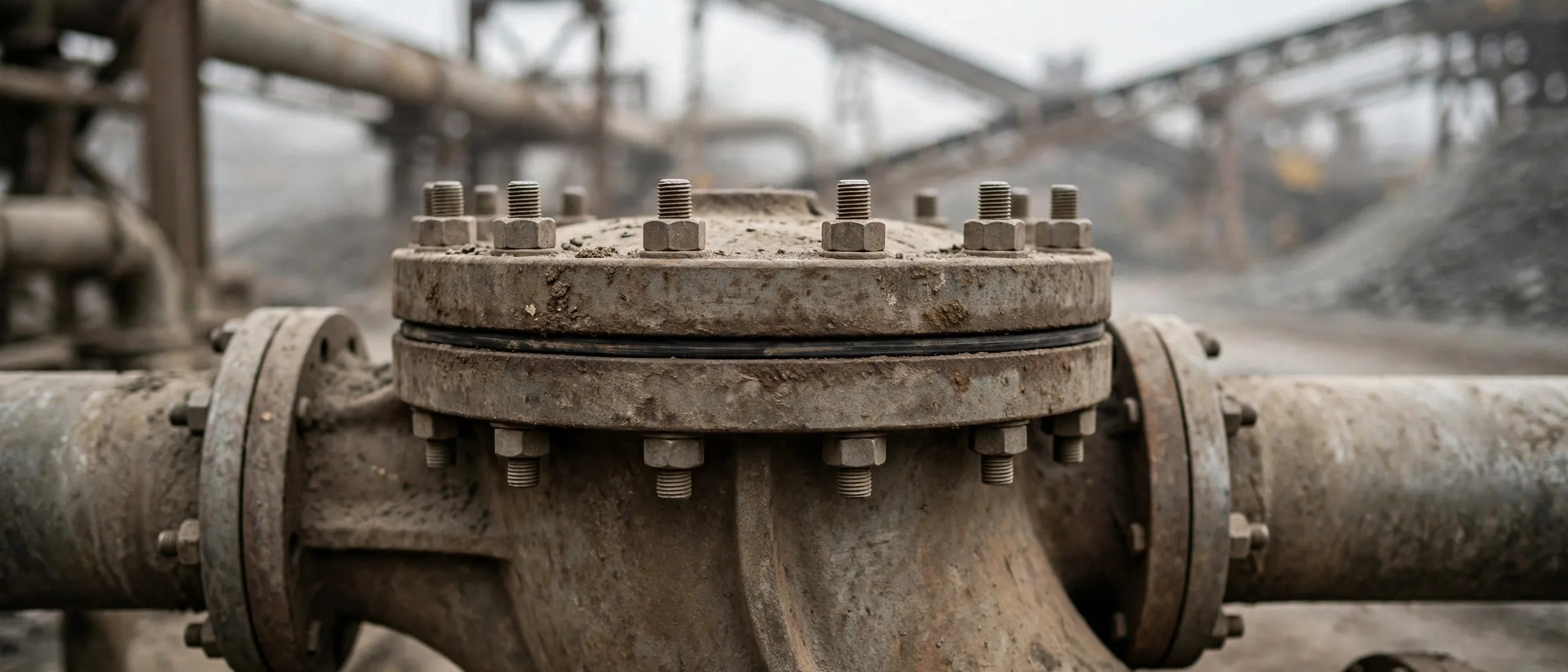
Slurry pumps come apart often, for liner and impeller changes, and the cover studs come out with them. Studs that corrode under the nut between changes end up cut off, and cutting studs off is how the next set of covers gets damaged.
What reaches the studs
Particles strip the passive film off stainless steel, and corrosion then attacks the bare metal. A 2024 failure analysis of a 2507 circulation pump impeller found the same sequence: solid particles abraded the surface and left small pits, and chloride and fluoride in the liquid then drove corrosion from those pits until the impeller failed. The studs sit outside the flow, but the same chemistry reaches them wherever slurry leaks or splashes and dries.
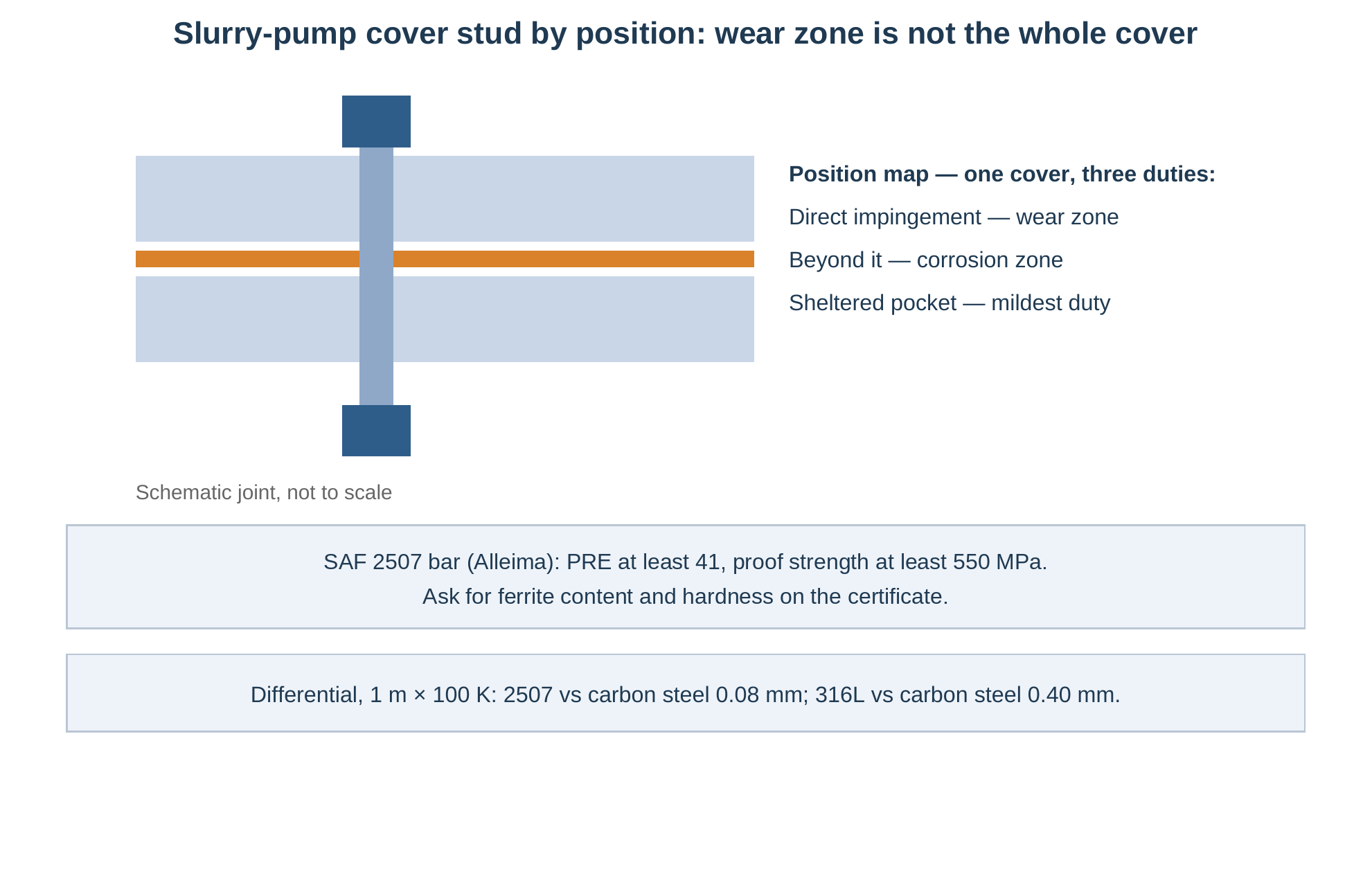
Mark each stud position on the pump drawing:
- In or next to the flow: liner bolts and studs whose ends are exposed behind worn liners. Treat these as wear-related and ask why the stud is in the flow.
- Splash and leakage zone: cover and casing studs near the gland, the suction cover joint and any weeping joint.
- Dry: frame and bearing housing bolts.
Then give the liquor: pH, chloride, temperature, and any oxidant or fluoride, and pick the grade from that analysis.
Choosing the grade by liquor
| Candidate | UNS and specification | Where it fits slurry pump studs | Limit to check |
|---|---|---|---|
| Super duplex 2507 | S32750, ASTM A479 bar / A1082 | Saline, near-neutral or mildly acidic liquor; splash and leakage zone; high cover load | Ferrite content and heat treatment on the certificate |
| Duplex 2205 | S32205, ASTM A479 | Neutral or mildly acidic liquor with moderate chloride | Less crevice margin than 2507 |
| 316L | S31603 | Fresh-water tailings, dry frame bolts | Pitting and cracking once chloride and heat rise |
| Inconel 625 / C-276 / C-22 | N06625 / N10276 / N06022 | Acidic chloride liquor with oxidizing ions (C-22 or titanium where strongly oxidizing) | Lower yield; may need a larger stud |
For the purchasing route, compare A1082 bolting and A479 bar with finished-part requirements.
Related references: Super duplex 2507 · Duplex 2205
Alleima's SAF 2507 bar data gives a proof strength of at least 550 MPa, tensile strength of 760–930 MPa and a PRE of at least 41. That strength suits the large covers of slurry pumps, which carry high gasket and pressure loads. It comes closer to carbon steel bolting than 316L, 625 or C-276 do, but A193 B7 (725 MPa minimum yield up to 64 mm) is about 30% stronger and property class 8.8 about 15–20%, so check the diameter against the original grade.
SAF 2205 has a PRE above 35 and costs less. In neutral liquor with moderate chloride it does the job; in seawater-strength or mildly acidic saline liquor, 2507's extra resistance is worth having.
Phase balance and heat treatment
A duplex stud's corrosion resistance depends on its microstructure. Alleima's bar data gives a ferrite content of 35–55% for correctly solution-annealed 2507. Too much ferrite, or sigma phase from slow cooling or poor annealing, lowers both toughness and corrosion resistance, and none of it shows on the outside of the stud.
Ask for these on the certificate for the finished studs:
- solution annealing temperature and quench
- ferrite content
- hardness
Our note on duplex and super duplex heat treatment and inspection explains how these checks are made and what to accept.
Liner changes and matched nuts
Use 2507 heavy hex nuts on 2507 studs. Covers opened at every liner change need anti-seize on every assembly, because dry super duplex threads gall.
Super duplex expands at about the same rate as the carbon steel or cast iron used for many pump casings, which reduces differential thermal movement in the joint. It does not by itself guarantee that preload holds; check the joint at its actual temperature, materials, stiffness and preload requirement. 316L expands noticeably more, so its differential movement against a carbon steel casing is larger.
At each liner change, note by position which studs show attack under the nut, which nuts seized, and which studs were cut off, and compare positions before reordering.
| Confirm before ordering | Why it matters | Document to ask for |
|---|---|---|
| Stud position: flow, splash/leakage or dry | Decides wear versus corrosion | Pump drawing |
| Liquor pH, chloride, temperature, fluoride | Decides 316L, 2205, 2507 or nickel alloy | Process datasheet |
| Cover load and stud size | Check diameter against the original grade | Pump drawing, gasket data |
| Liner-change frequency | Frequent removal needs anti-seize and matched nuts | Maintenance plan |
| Ferrite content and hardness on the certificate | Confirms the duplex structure | EN 10204 3.1 certificate |
Requesting a quote
Mark up the pump drawing and add one line of process data, for example: "M30 studs and heavy hex nuts for slurry pump suction and casing covers, tailings slurry made up with seawater, pH 8, 20 g/L chloride, 35°C, covers off every liner change (about eight weeks), 12 studs per cover, original bolting B7."
We'll mark the grade on each position and quote 2507 stud bolts with matching nuts, plus 2205 or 316L where the drawing allows. Related concentrator bolting is under mining and mineral processing.