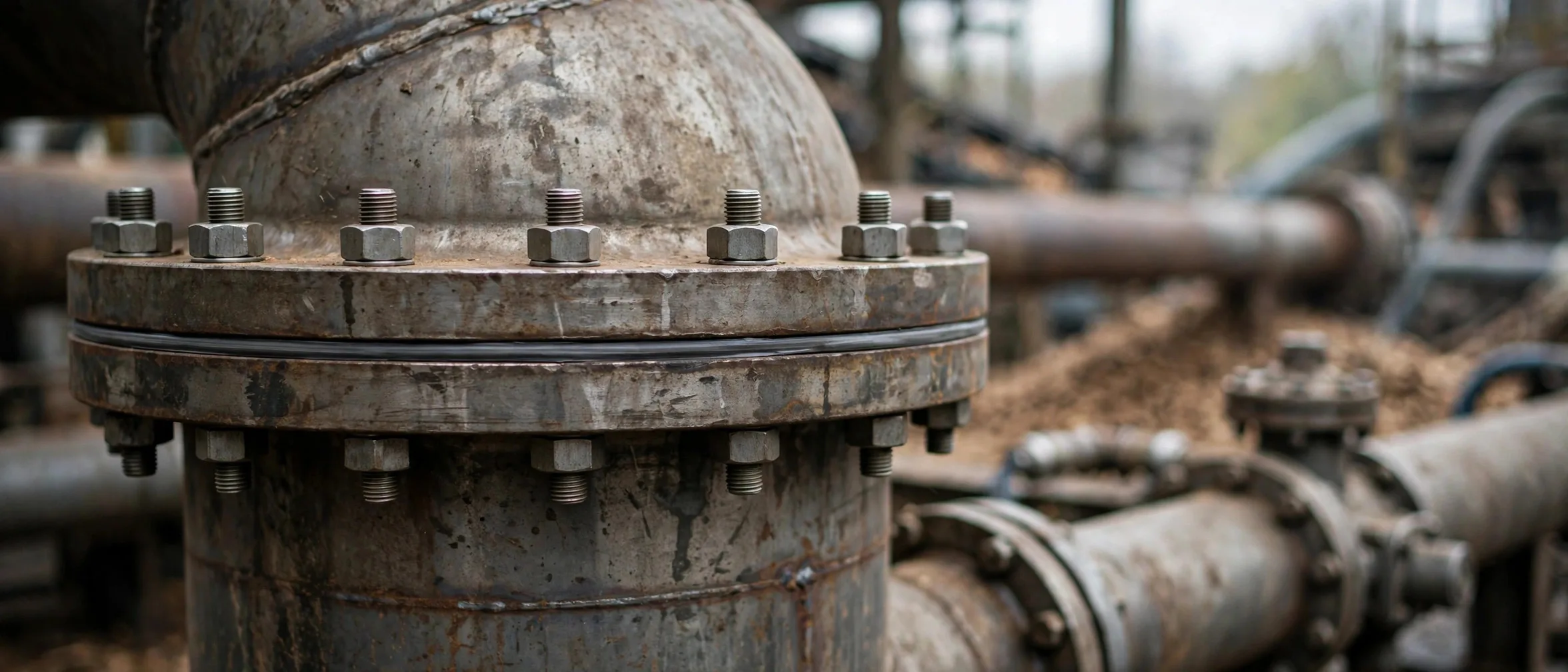
Digester bolting problems can start on the purchase order rather than in the metal: cover studs bought on a bracket-bolt specification, or a corroded cover stud replaced from the outage spares box.
What the cover studs see
The cooking conditions above are typical of kraft mills; this kraft process overview gives the same pH and temperature range. Sulfite mills use an acidic liquor instead, which calls for different alloys, so state the process first.
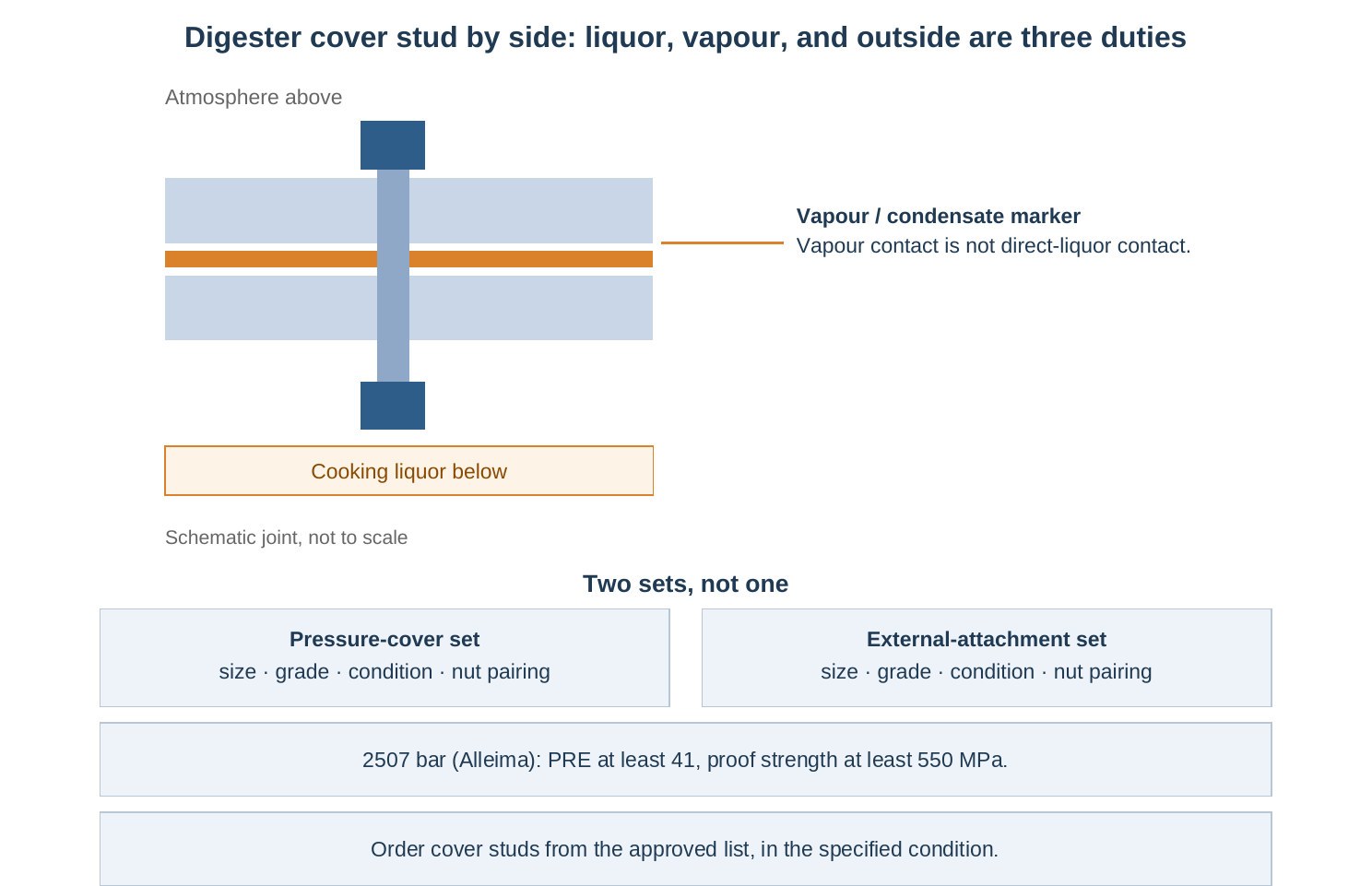
The cover studs sit outside the gasket. In normal running they see heat and some vapour, not liquor. The trouble comes from leaks and from condensate. A gasket that weeps puts hot liquor onto the stud and nut, the water evaporates, and the caustic concentrates in the threads, which is exactly the condition for caustic cracking. A nut packed with dried liquor will also seize.
The cover data the supplier needs:
- operating temperature and pressure, and the temperature at shutdown
- whether the studs can be wetted by liquor or condensate, or see only vapour
- the liquor concentration at that position, from the digester datasheet
- how often the cover is opened, and whether leaks have occurred before
Cover studs and external bolting are two sets
The pressure-cover set is a pressure part. Its size, grade, condition and nut pairing follow the cover drawing and the vessel's design code, and the grade must be on the mill's approved material list. A bar specification is not automatically an accepted bolting material: check that the exact specification, grade and condition are listed as bolting under the vessel code (for ASME vessels, the Section II-D bolting tables), and that the bolt-load calculation still holds with that material's allowable stress. State the required heat-treated condition and the hardness report with the order. A stud in the right grade but the wrong condition will not carry the load it was sized for.
External attachments are a different job. Platforms, guards, ladder brackets and instrument mounts see humid air, wash water and occasional spills, and what matters most is that they can be reached, cleaned and removed. State which external bolts must come off for cleaning or inspection, and which can be permanent. A bracket bolt hidden behind insulation or a guard is rarely inspected, and corrosion there goes unnoticed until the bolt fails.
Choosing the grade
| Candidate | UNS and form | Where it fits a digester | Limit to check |
|---|---|---|---|
| Super duplex 2507 | S32750, bar to ASTM A479 | Cover studs that may be wetted by hot liquor | Approval for pressure bolting under the vessel code; heat-treatment record |
| Duplex 2205 | S32205, bar to ASTM A479 | Cover studs with occasional wetting; external bolting in wash-down areas | Concentrated caustic under deposits on hot studs |
| 316L | S31603, ISO 3506-1 A4-70 or A4-80 | External brackets, guards and mounts | Not a substitute for cover studs |
| Carbon or low-alloy steel | e.g. ASTM A193 B7 | Dry external bolting away from leaks | Caustic cracking if hot liquor reaches it |
Duplex steels are widely used in kraft mills for digesters and liquor tanks because they resist alkaline sulfide liquor and chloride stress corrosion cracking better than standard austenitic grades. Duplex 2205 bar to ASTM A479 has a minimum of 655 MPa tensile and 450 MPa yield.
Super duplex 2507 has a PRE of at least 41 and a minimum 0.2% proof strength of 550 MPa, according to Alleima's SAF 2507 bar datasheet. The same datasheet warns that prolonged exposure above 250°C changes the microstructure and lowers impact strength. A digester at around 170°C is below that, but check the actual metal temperature at the cover.
Both duplex grades depend on proper solution annealing and quenching. Ask for the heat-treatment record and a ferrite check; our note on duplex heat treatment and inspection explains what the certificate should show.
Nuts, leaks and outage records
Pair duplex cover studs with nuts of the same grade, such as 2507 heavy hex nuts, and use an anti-seize rated for the cover temperature and for alkaline service. Duplex threads assembled dry can gall; our note on galling covers prevention.
At each outage, record by cover:
- which studs were wet or crusted with liquor, and where the leak came from
- thread loss, pitting or cracking at the first engaged thread
- which nuts seized and how they were removed
A cover with repeated leaks needs a gasket or flange fix as much as a different stud grade.
Requesting a quote
Send two lists. For the cover set, for example: "1-1/8 in 2507 studs, 2 heavy hex nuts each, 24 per manway, top manway and two side covers of the continuous digester; white liquor service at about 170°C; must be on the mill's approved material list; heat-treatment record and hardness report required." For the external set, list the bolt sizes by location and wash-down duty.
Each list is checked and priced on its own: 2507 stud bolts for the covers, and 2205 hex bolts or 316L for the external bolting, all sized to the drawings. Evaporator and bleach-plant bolting are covered on our pulp and paper page.