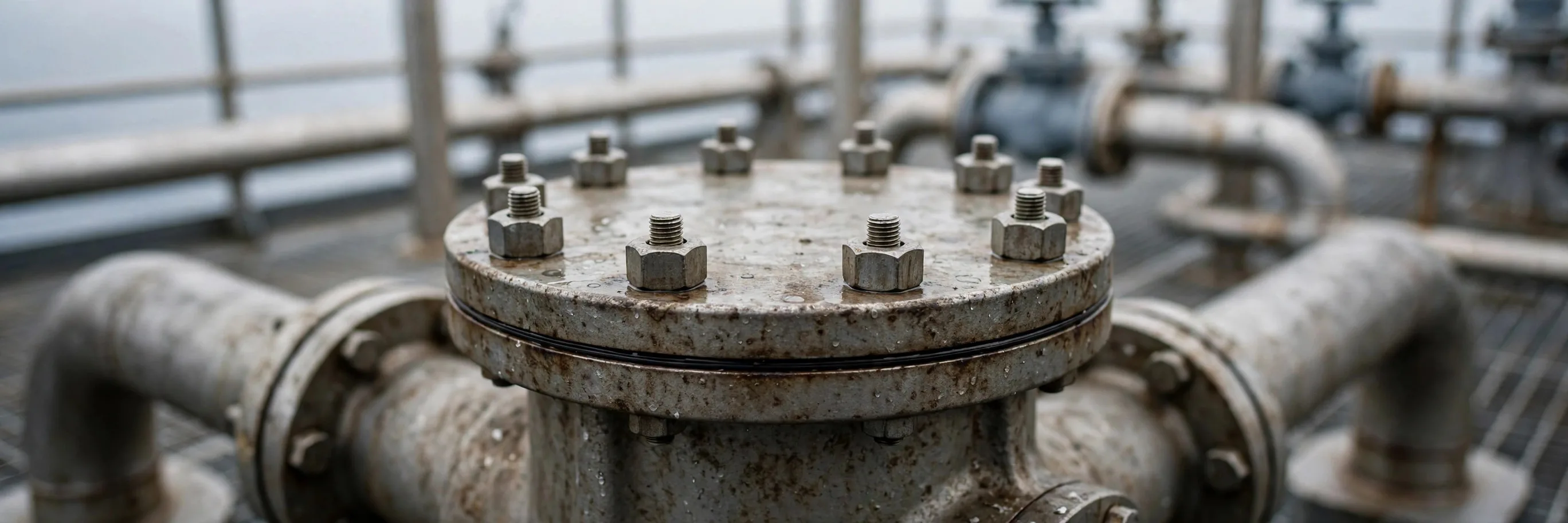
A seawater pump cover is opened at every seal change and refitted in a wet, salty bay, and its studs spend their service life in a crevice next to seawater and inside a CP field. A stud that meets its strength on paper can still fail there, which is why the condition and the surroundings go on the order along with the size.
Order the aged condition
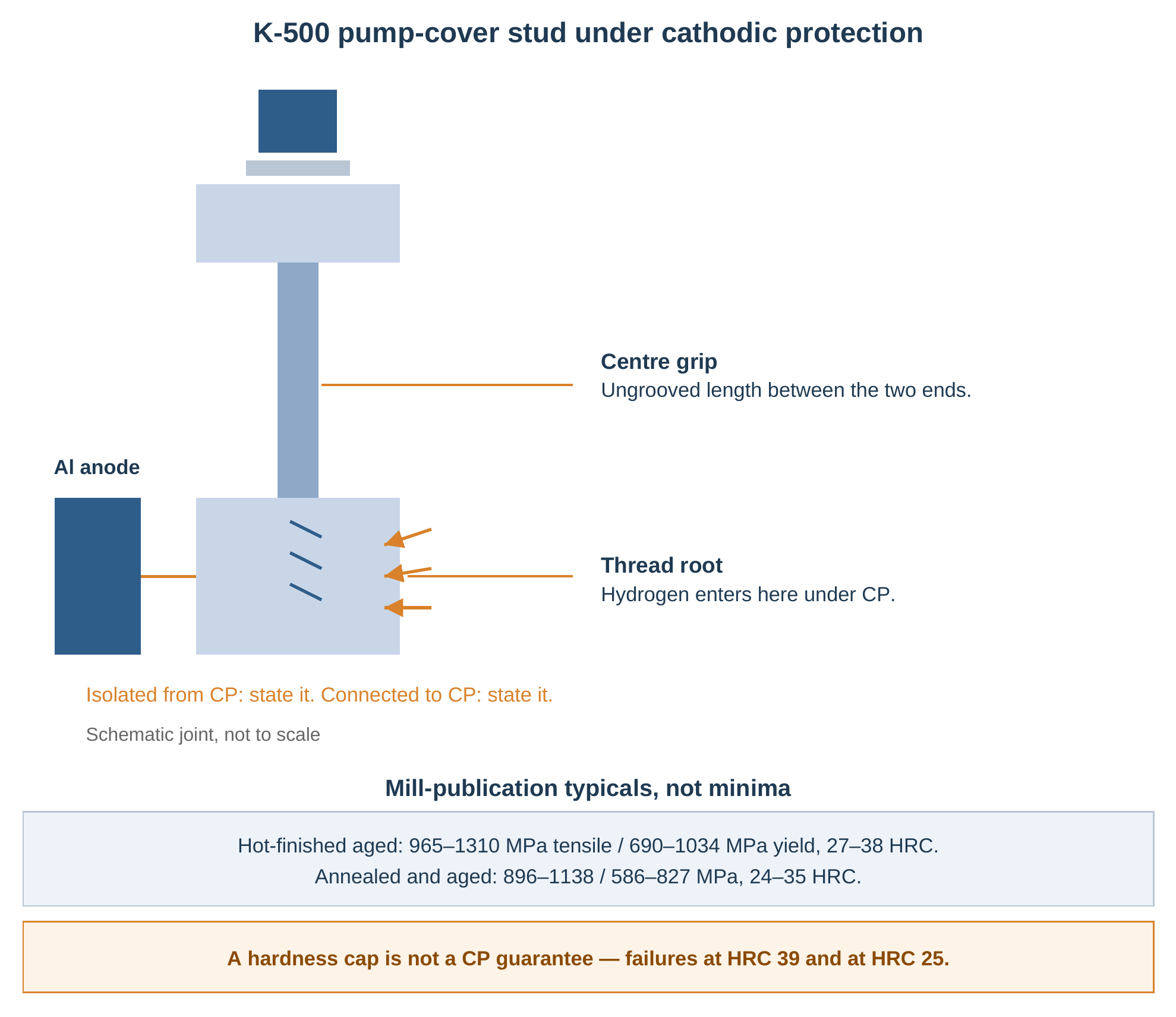
Monel K-500 is solution treated and then aged to precipitate the particles that give it its strength. The Special Metals K-500 bulletin gives typical rod and bar properties for different routes, for example 690–1034 MPa yield at 27–38 HRC for hot-finished and aged material, and 586–827 MPa yield at 24–35 HRC for hot-finished, annealed and aged material. These are typical ranges, not minimums, and they show how much the condition changes the result.
The order should therefore name the condition, the minimum yield the joint was designed on and a maximum hardness, and the certificate should show hardness measured on the finished studs. Our K-500 specification guide covers how to write those requirements.
Cathodic protection and hydrogen
CP protects steel by driving its potential negative, and the same current generates hydrogen at the metal surface. Metals with high strength and a susceptible microstructure absorb that hydrogen and can crack under sustained load, usually at stress raisers such as thread roots.
Appendix K of the National Academies report on offshore bolting records K-500 failures under aluminium-anode CP: an early case at 39 HRC at the thread root, and later failures of roll-threaded bolts at 25 HRC, loaded to about 59% of yield, after about a year in service, with no single root cause pinned down. That is why a hardness cap alone isn't enough here. TWI makes the same point about duplex steels: susceptibility depends on the material and the potential together.
For the enquiry, state:
- whether the pump is inside a CP system, and whether it uses sacrificial anodes or impressed current
- the design potential and the reference electrode it is measured against, since a voltage without its reference scale can't be checked
- whether the pump casing is electrically connected to the protected structure or isolated from it, for example by an insulating flange kit. The studs take the casing's potential either way.
Our CP enquiry checklist lists what a bolting supplier needs from the CP designer.
Nuts, galling and the crevice
Monel 400 heavy hex nuts are the usual partner for K-500 studs. Because they belong to the same nickel-copper family, they avoid a galvanic couple in the crevice where nut and stud meet. The nut condition still matters: the Special Metals Monel 400 bulletin gives typical yields of 172–345 MPa annealed and 379–690 MPa cold drawn and stress relieved, so state which one the joint needs.
Nickel-copper threads gall and seize when they are run together dry, and seized nuts usually have to be split off. Name the lubricant in the order and use one approved for seawater service. Seawater also stands in the gap under the nut and washer, and that is where attack begins; a stud that has corroded only under the nut on a few positions points to a crevice or seating problem at those positions rather than the wrong alloy.
K-500 against 400, 625 and 2507
| Candidate | UNS and bar specification | Where it fits a marine pump cover | What to watch |
|---|---|---|---|
| Monel K-500 | N05500, ASTM B865, aged | Covers that need more strength than 400 | Aged condition and hardness; hydrogen under CP |
| Monel 400 | N04400, ASTM B164 | Lightly loaded covers | Much lower strength; low hydrogen risk |
| Inconel 625 | N06625, ASTM B446 Grade 1 | Covers inside CP where hydrogen risk must be low | 414 MPa minimum yield to 102 mm; may need a larger stud |
| Super duplex 2507 | S32750, ASTM A479 | High-strength alternative in cool seawater without CP | Also prone to hydrogen cracking under CP; DNV-RP-F112 stress and potential limits apply |
Related references: Monel 400 · Inconel 625 · Super duplex 2507
The choice usually turns on CP and load together. Without CP, aged K-500 has served well on seawater pumps for decades. Inside a CP system, 625 at a larger size, or K-500 with tight hardness control on a casing isolated from the CP circuit, are the safer options. Our 400 vs K-500 comparison goes through the trade-off for valve connections.
| Lock before ordering | Why it matters | Document to ask for |
|---|---|---|
| Aged condition, minimum yield, maximum hardness | Strength depends on the ageing; hardness affects hydrogen risk | Ageing record, hardness on finished studs |
| CP type, design potential and reference electrode | Hydrogen risk depends on the potential | CP design data |
| Casing connected to or isolated from CP | The studs take the casing's potential | Assembly drawing or CP designer's note |
| Nut grade and condition, lubricant | Mixed metals and dry threads seize in seawater | Nut specification, approved lubricant |
| Traceability | Ties each stud to its heat and ageing lot | EN 10204 3.1 certificates, PMI where specified |
Related references: EN 10204 3.1 certificates
Requesting a quote
Give the pump and its CP situation along with the size. For example: "M16 Monel K-500 studs for a seawater pump cover, aged, hardness range per drawing, ship hull CP with aluminium anodes at about -1.05 V vs Ag/AgCl, casing not isolated, Monel 400 nuts." A photo of a removed stud showing where cracking or corrosion started helps the team tell hydrogen cracking from crevice attack.
The engineering team will confirm the condition, hardness and nut pairing with you and quote K-500 stud bolts with matching nuts and EN 10204 3.1 certificates. Other seawater and offshore bolting is covered under offshore and marine.