
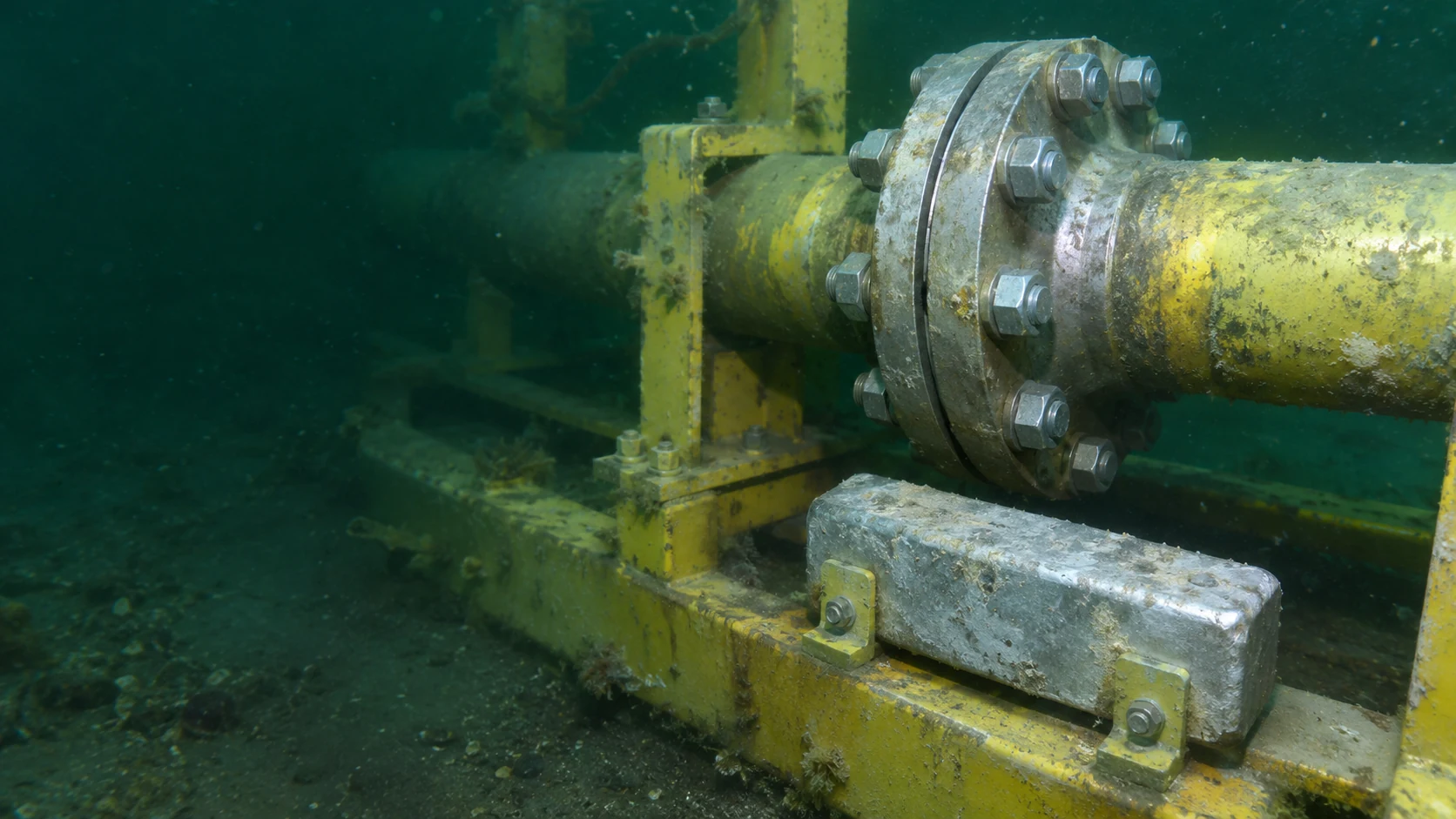
This guide is about writing a marine bolting enquiry that states the cathodic protection system, the stud condition, and the stress level together. Leave any one of those out, and a supplier cannot judge whether the stud on the order is safe under that protection system.
Start with the joint, not the alloy name. A stud set ordered by grade and size alone leaves the three variables that decide a hydrogen failure unstated: potential, hardness, and load.
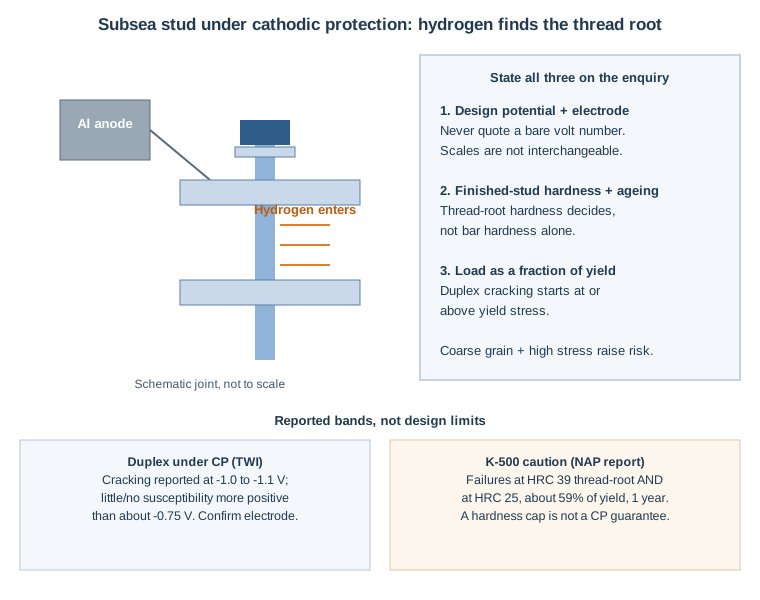
Figure: Subsea stud under cathodic protection — hydrogen enters at the thread root; the enquiry must state design potential with its reference electrode, finished-stud hardness with the ageing sequence, and load as a fraction of yield.
01 A bolt that is protected and still cracks
Cathodic protection, known as CP, protects a subsea structure by making it the cathode in an electrochemical cell, using sacrificial anodes or an impressed current. The system pushes electrons into the steel so the steel does not give up its own metal to corrosion. That push has a side effect: at the metal surface, water splits and hydrogen atoms enter the metal.
Hydrogen atoms are tiny, so they move into the metal and collect at grain boundaries, at hard particles, and at stress concentrators such as thread roots. There they make the metal less able to stretch before cracking. A crack then grows slowly under a steady load, even though the part has not been overloaded, and the remaining sound metal eventually cannot carry the load.
That is why CP is not a separate line item from bolting. The design potential, the anode type, the stud hardness, and the load on the stud all belong in the same enquiry. A related assembly effect belongs in the same document: preload can also fall over time with no rotation of the fastener, whether by stress relaxation at temperature, as described in Bolt Science's stress-relaxation technical page, or by gasket creep and surface embedment.
02 Which studs are most at risk under CP
Risk rises with strength, hardness, stress, and the fraction of ferrite in the metal. Ferrite is one of the two phases in duplex stainless steel, and it is the phase most open to hydrogen. TWI's cathodic protection FAQ for duplex steels explains that duplex and super duplex steels contain about 50% ferrite, that cracking under CP has been reported at potentials around -1.0 to -1.1 V, and that there is little or no susceptibility at potentials more positive than about -0.75 V. A more negative potential means more hydrogen drive into the metal. Treat these potentials as reported values, not as design limits: confirm the reference electrode with the CP designer, since the scales are not interchangeable.
The same FAQ notes that coarse material, high stress, and local stress at a concentrator all encourage cracking, while fine-grained material shows substantially greater resistance. Rolled Alloys' HISC resistance paper puts the reported failure band around -1 V SCE, with susceptibility below about -700 mV SCE, and cracking initiating only at stresses at or above yield.
For super duplex 2507, UNS S32750, the microstructure requirement follows from the same mechanism. Hydrogen diffuses much faster in ferrite than in austenite, so susceptibility rises with austenite spacing, and Alleima's SAF 2507 bar datasheet lists a solution-annealed and quenched structure with 35–55% ferrite. An austenite-spacing requirement and a strain assessment under DNV-RP-F112 (now DNVGL-RP-F112), current edition at the project date, are therefore order items for a 2507 stud set under CP, not optional extras. DNV-RP-F112 is a design recommended practice whose key criterion is austenite spacing, not a single pass or fail test for a stud set.
Aged Monel K-500, UNS N05500, carries a different, well-reported risk. National Academies' offshore bolting technology report records nickel-copper bolt failures under normal cathodic polarization coupled to aluminium anodes in seawater, first attributed to high thread-root hardness of HRC 39 from age hardening after threading. The same report records that later failures occurred in roll-threaded K-500 bolts at only HRC 25, annealed at 980–1050°C, water quenched, and aged at 500–600°C for 16 hours, under load to about 59% of yield and cathodically protected with anode-grade aluminium, after about one year, with the root cause still elusive. A hardness cap alone does not guarantee aged K-500 safety under CP. The HRC 35 figure in that report is a recommended limit in sour systems, not a CP guarantee.
High-strength carbon and low-alloy bolting, such as ASTM A193 Grade B7, sits in the same risk group when heavily loaded under CP. Nickel alloys without ferrite, such as Inconel 625, UNS N06625, are generally less exposed to the duplex hydrogen-cracking mechanism, but that does not make a 625 stud automatically safe under any CP potential. Monel 400, UNS N04400, carries lower aged-particle risk than aged K-500, since it hardens only by cold work. State the CP system for every alloy, and let the designer confirm the combination.
| Stud material | Main CP risk | What to state on the enquiry |
|---|---|---|
| Super duplex 2507, UNS S32750 | Hydrogen-induced stress cracking in ferrite, especially coarse grain, high stress, and potentials near -1.0 V or more negative | CP type and design potential with its reference electrode, austenite-spacing requirement, stress level, and strain assessment under current DNV-RP-F112 where the project requires it |
| Monel K-500, UNS N05500, aged | Hydrogen embrittlement at thread roots, reported in subsea bolts under aluminium-anode CP at HRC 39 and at HRC 25 | Final aged condition, hardness limit on the finished stud, thread-machining and ageing sequence, CP potential and anode type |
| High-strength carbon / low-alloy steel, ASTM A193 Grade B7 | Hydrogen embrittlement at high load and high hardness | Hardness limit, load as a fraction of yield, CP potential and anode type |
| Inconel 625, UNS N06625 | Lower ferrite-related CP risk, but not a blanket exemption | CP system and potential, so the designer can confirm the combination rather than assume it |
| Monel 400, UNS N04400 | Lower strength and lower aged-particle trapping than aged K-500 | Condition (annealed or cold-worked), CP system, and whether the joint load fits its lower strength |
03 State the CP system, not just the word "subsea"
An enquiry that says only "subsea" or "CP protected" does not give a supplier enough to check:
- Identify the CP type and anode metal: sacrificial aluminium or zinc anodes, or impressed current. Name the anode metal, since the failure reports for K-500 involve aluminium anodes specifically.
- Map the design potential and its reference electrode: state the design potential range, the electrode it is quoted against, and whether the system can drive the joint more negative than about -0.75 V, where reported duplex susceptibility rises.
- Verify the electrical path: state whether the studs are coated, isolated, or electrically connected to the protected structure, and whether a coating is allowed to break that connection. An isolated stud is not CP-protected, so it is a different corrosion case, not just a different CP case.
- Account for load, thread form, and finish together: give the preload or the tightening method, the thread form, and whether the stud will see cyclic load, vibration, or a bending load from misalignment. A hydrogen crack starts at a concentrator, so thread-root finish and freedom from nicks at assembly matter as much as the alloy name.
- Record the K-500 sequence and the 2507 microstructure requirement: state whether threads are cut or rolled before or after ageing, and what hardness limit applies to the finished stud, not just to the bar. Ageing after threading is often specified to keep thread-root hardness under control, but the exact sequence must come from the project specification. For 2507, state whether an austenite-spacing requirement and a hydrogen-cracking assessment are required.
Thread seizure is a separate assembly risk. Bossard's galling technical note describes how a broken oxide layer lets stainless thread surfaces lock together, which is why lubricant and thread finish belong in the same enquiry. That note covers stainless threads only.
Remember that a bar specification, such as ASTM B865 for K-500 bar or ASTM A479 for 2507 bar, is not by itself a finished-stud specification. State the finished-stud dimensions per ASME B16.5, the thread form and class, the nut pairing, and the finished-part testing separately, and for precipitation-hardened grades state whether threads are rolled before or after final ageing, using a rounded-root form such as UNR or UNJ.
04 Condition, batch tests and the set that arrives
A CP enquiry must end in a testable order. For each stud set, state the alloy, the UNS number, the final condition, the hardness limit and test location, and the bar or material specification. The number the stud is sized from must be the finished-stud strength and hardness, not a bar typical range.
Send the CP details, the flange or joint drawing, and the load case to the BYBOLT engineering team for a check before ordering. That check is where a 2507 stud is caught at a potential that needs a different alloy, a K-500 stud is caught with a hardness or ageing sequence that does not fit the CP system, or a nut pairing is caught that changes the joint picture.
At receipt, the BYBOLT documentation package should tie each stud set to its heat, its heat-treatment record, and its hardness report for the finished condition. Ask for EN 10204 3.1 certificates, a dimensional report for the actual studs, and a PMI report where the project requires it.
| What to lock before ordering | Why it changes the joint | Document to ask for |
|---|---|---|
| CP type, anode type, design potential and reference electrode | Decides whether hydrogen risk is low, marginal, or needs a different alloy or qualification | CP design datasheet, potential range and electrode stated |
| Stud alloy, UNS, final condition | Aged, annealed and cold-worked conditions have different hydrogen risks | Material specification, condition stated on the certificate |
| Hardness limit and test location | Thread-root hardness, not bar hardness alone, decides the risk at the concentrator | Finished-stud hardness report, test location stated |
| Load, preload and thread finish | High stress and sharp roots encourage cracking under CP | Joint load calculation, thread form and finish, tightening method |
| Microstructure and qualification for 2507 | Coarse grain and high stress encourage hydrogen cracking | Microstructure requirement, austenite-spacing and strain assessment under current DNV-RP-F112 where required |
| Nut, washer and coating or isolation | A mismatched nut or a broken coating changes the electrical and galvanic picture | Set list by joint, nut and washer standards, coating approval |
05 Ask for a quote with the CP system attached
If a subsea joint is being re-specified, or if a 2507 or K-500 set is being considered under CP, send the protection system with the size. A note like "M24 super duplex 2507 stud set for a subsea flange, aluminium-anode CP, design potential and reference electrode to be confirmed from the CP datasheet, high load, thread finish to be stated" gives the BYBOLT engineering team enough to check the alloy, the hardness limit, and the qualification before quoting. Even a photo of a removed stud, showing where a crack started, helps show whether the last failure was a hydrogen, crevice, or load problem.
That note, plus the drawing if you have it, is enough to start. The team will fill in the missing details with you, and quote a small batch or a full set with EN 10204 3.1 traceability.