

This guide compares the two grades for the same job: a marine valve bonnet stud set in seawater service, where the bonnet load, the seawater flow, and the final heat-treatment condition must be stated together.
Order by condition, not by grade name alone. A K-500 stud without a stated aged condition has not yet gained the strength it was bought for, and a 400 set sized from aged K-500 numbers will not hold the bonnet.
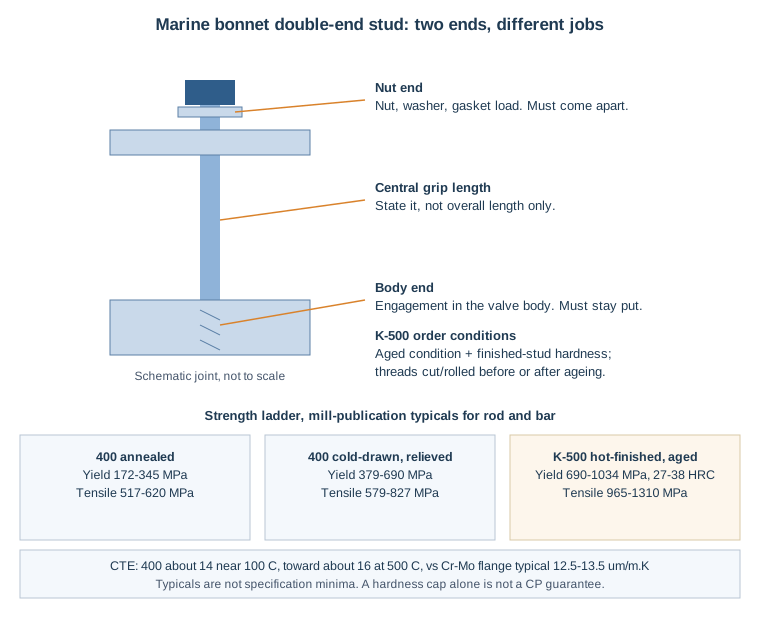
Figure: Marine bonnet double-end stud — nut end, central grip, and body end are different jobs; K-500 strength comes only with its stated aged condition.
01 Same base, different strength
Monel 400, UNS N04400, and K-500, UNS N05500, both list nickel plus cobalt at 63% minimum, but their copper ranges differ: 400 is 28–34% copper and K-500 is 27–33% copper. Both resist seawater and chloride stress corrosion cracking in most marine service. The difference is aluminium and titanium in K-500, at 2.3–3.15% aluminium and 0.35–0.85% titanium, which allow K-500 to be age-hardened. Ageing forms tiny nickel-aluminium-titanium particles in the metal that pin its structure in place, so the stud can carry far more load without stretching.
Special Metals' MONEL alloy 400 publication gives rod and bar annealed typicals of 517–620 MPa tensile and 172–345 MPa yield, and cold-drawn, stress-relieved typicals of 579–827 MPa tensile and 379–690 MPa yield. Special Metals' MONEL alloy K-500 bulletin gives hot-finished, aged rod and bar typicals of 965–1310 MPa tensile and 690–1034 MPa yield at 27–38 HRC, and hot-finished, annealed and aged typicals of 896–1138 MPa tensile and 586–827 MPa yield at 24–35 HRC. The 400 publication states that its ranges are composites for various product sizes and are not suitable for specification purposes. Treat the K-500 ranges the same way: they are mill-publication typicals for rod and bar, not specification minima. The exact yield depends on form, cold work, and the ageing cycle. Monel 400 strengthens only by cold work. Without ageing, K-500 is close to 400 in strength.
For a bonnet, that strength gap decides the set size. A 400 set can seal a low-pressure, low-load bonnet with room to spare. A high-pressure bonnet, a large gasket seating load, or a bolt circle that cannot grow needs the aged K-500 load, or a larger 400 set that may not fit the valve.
02 Flowing seawater, stagnant spots and the bonnet thread
Both grades do well in flowing seawater. The K-500 bulletin notes very low corrosion rates in high-velocity seawater, which is why Monel remains a valve and pump choice after decades of service. That is not unlimited: state the design velocity on the order.
Stagnant spots are the exception for both grades. Under a bonnet nut, under a washer, in a packing gland, or under marine fouling, seawater can sit still, concentrate chloride, and start a pit. The K-500 bulletin notes that in stagnant or slow-moving seawater, fouling may occur followed by pitting. State whether the bonnet joint sees flowing seawater, stagnant seawater, washdown, or a packing leak path, since a grade chosen for flowing service alone will not predict a crevice failure.
Galling is the second bonnet-specific risk, handled here as an assembly control, not as a proved Monel property. Bossard's galling technical note describes how a broken oxide layer lets stainless thread surfaces lock together, which is a useful guide to why lubricant matters here, though it does not itself prove Monel galling. Check nut pairing and any anti-galling treatment on the order, and do not assume a same-alloy nut will run free on a Monel stud. The nut pairing, the lubricant, and the tightening method must be approved for the actual valve and process area.
03 Aged K-500: strength with conditions attached
Aged K-500 brings two conditions that must be written on the order. First, the ageing cycle and the final hardness. Ageing raises strength by raising hardness, and harder parts are more susceptible to stress corrosion cracking and to hydrogen embrittlement under cathodic protection or in sour service. Hydrogen collects at the ageing particles and at thread roots, and a crack can grow slowly under steady load.
National Academies' offshore bolting technology report records nickel-copper bolt failures under normal cathodic polarization coupled to aluminium anodes in seawater, first attributed to high thread-root hardness of HRC 39 from age hardening after threading. The same report records later failures in roll-threaded K-500 bolts at only HRC 25, under load to about 59% of yield and cathodically protected with anode-grade aluminium, after about one year, with the root cause still elusive. A hardness cap alone does not guarantee aged K-500 safety under CP, and the HRC 35 figure in that report is a recommended limit in sour systems, not a CP guarantee. A K-500 bonnet stud under CP, or in a sour-adjacent service, therefore needs a stated hardness limit, a stated CP potential where CP applies, and a check of the aged condition against the project specification and the NACE MR0175 / ISO 15156-3 tables.
Second, the machining sequence. Threads cut after ageing can leave a hard thread root, while ageing after threading can keep that root hardness under control. Thread rolling also cold-works the root, and the sequence plus a hardness cap together still do not guarantee CP safety. State whether threads are cut or rolled before or after ageing, and what hardness limit applies to the finished stud, not just to the bar.
Monel 400, by contrast, is the lower-risk, lower-strength choice. It is more ductile, it does not carry the same aged-particle hydrogen and cracking conditions, and it is easier to rework at overhaul. Where the bonnet load fits 400, and where repeated opening and re-seating matter more than maximum load, 400 is often the better bonnet stud.
| Property | Monel 400, UNS N04400 | Monel K-500, UNS N05500 |
|---|---|---|
| Strengthening | Solid solution, cold work only | Precipitation hardening by ageing, aluminium and titanium particles |
| Yield, mill publication typical bar range | Annealed rod and bar 172–345 MPa; cold-drawn, stress-relieved rod and bar 379–690 MPa | Hot-finished, aged rod and bar 690–1034 MPa; hot-finished, annealed and aged rod and bar 586–827 MPa |
| Ductility | Higher, easier to rework at overhaul | Lower than annealed 400, higher load for the same size |
| Flowing seawater | Strong resistance, long valve and pump service | Very low corrosion rates in high-velocity seawater per the mill bulletin |
| Stagnant and crevice spots | Pits in stagnant seawater, fouling, and crevices | Pits in stagnant seawater, fouling, and crevices; aged condition adds cracking conditions to check |
| Cathodic protection and sour service | Lower aged-particle risk than aged K-500 | Check hardness, CP potential, and project specification for aged K-500; do not rely on a hardness cap alone |
| Magnetism | Variable by heat: some heats are magnetic at room temperature and others are not, per the mill publication | Virtually non-magnetic, though a magnetic surface film can form during processing; state the requirement on the order where instruments require it |
| Escalation where Monel load or temperature does not fit | — | Inconel 625, UNS N06625, bar to ASTM B446, sized for annealed yield per the B446 Grade 1 standard figures, not for aged K-500 strength |
04 Double-end studs: the two ends are different jobs
A marine valve bonnet often uses double-end studs, and the two ends do different work. The body end screws into the valve body, often into a tapped hole in a dissimilar or softer material, and must stay put during bonnet removal. The nut end carries the nut, the washer, and the gasket seating load, and must be removable. A stud with the right overall length but the wrong body-end engagement will feel right at assembly and fail to clamp evenly, or pull out of the body when the bonnet is removed.
State both ends on the drawing: the body-end thread form, class, and usable engagement, the nut-end thread form and usable length, the central unthreaded or grip length, and the nut standard, alloy, and condition. State whether the nut is the same grade as the stud or a compatible grade approved for the valve, and whether a washer is required under the nut. A softer nut can yield under the stud load, and a gall-prone pairing can seize at overhaul, turning a routine opening into a cut-off job.
A bar specification alone does not define a finished stud. State the finished-stud dimensions per ASME B16.5, the thread form and class, and whether threads are rolled before or after final ageing, using a rounded-root form such as UNR or UNJ. Thermal expansion belongs in the same pairing check: the 400 publication gives mean linear expansion for annealed material of about 14 µm/m·K near 100°C, rising toward about 16 µm/m·K at 500°C, against a typical Cr-Mo steel flange value of about 12.5–13.5 µm/m·K. State the body material and the temperature on the order so differential expansion at the bonnet joint is checked.
Send the valve drawing, the bonnet load, the seawater condition, and the CP or sour details where they apply to the BYBOLT engineering team for a check before ordering. That check is where a 400 set is caught undersized, a K-500 set is caught with a hardness or ageing sequence that does not fit the CP system, or a double-end stud is caught with a body-end engagement that cannot hold the bonnet.
At receipt, the BYBOLT documentation package should tie each stud set to its heat, its heat-treatment record, and its finished-condition hardness report. Ask for EN 10204 3.1 certificates, a dimensional report for the actual studs with both ends dimensioned, and a PMI report where the project requires it.
| What to lock before ordering | Why it changes the joint | Document to ask for |
|---|---|---|
| Bonnet load and bolt circle | Decides 400 versus aged K-500, and whether the set fits the valve | Valve datasheet, bonnet load calculation |
| Alloy, UNS and final condition | Aged K-500 without a stated ageing cycle has not gained its strength | Material specification, condition stated on the certificate |
| Hardness limit and machining sequence | Thread-root hardness decides galling, cracking and CP risk | Finished-stud hardness report, sequence stated |
| Seawater condition per location | Flowing, stagnant and packing-leak spots are different services | Joint exposure datasheet, per location |
| Body-end and nut-end engagement | A short body-end engagement can pull out at bonnet removal | Drawing with both ends dimensioned, dimensional report |
| Nut, washer and lubricant | A mismatched nut or unapproved lubricant can seize the bonnet | Nut and washer standards, approved lubricant list |
05 Ask for a quote with the bonnet, not just the grade
If a marine valve bonnet is being re-specified, or if a K-500 set is being considered to replace a 400 set, send the bonnet details with the size. A note like "M20 Monel K-500 double-end stud set for a marine valve bonnet, flowing seawater, high bonnet load, body-end engagement to be confirmed from the drawing" gives the BYBOLT engineering team enough to check load, condition, and both ends before quoting. Even a photo of a removed stud, showing galling at the nut end or pitting under the washer, helps show whether the last failure was load, galling, or crevice.
That note and the drawing, if you have it, are enough to start; the team will fill in the rest with you and quote a small batch or a full set with EN 10204 3.1 traceability.