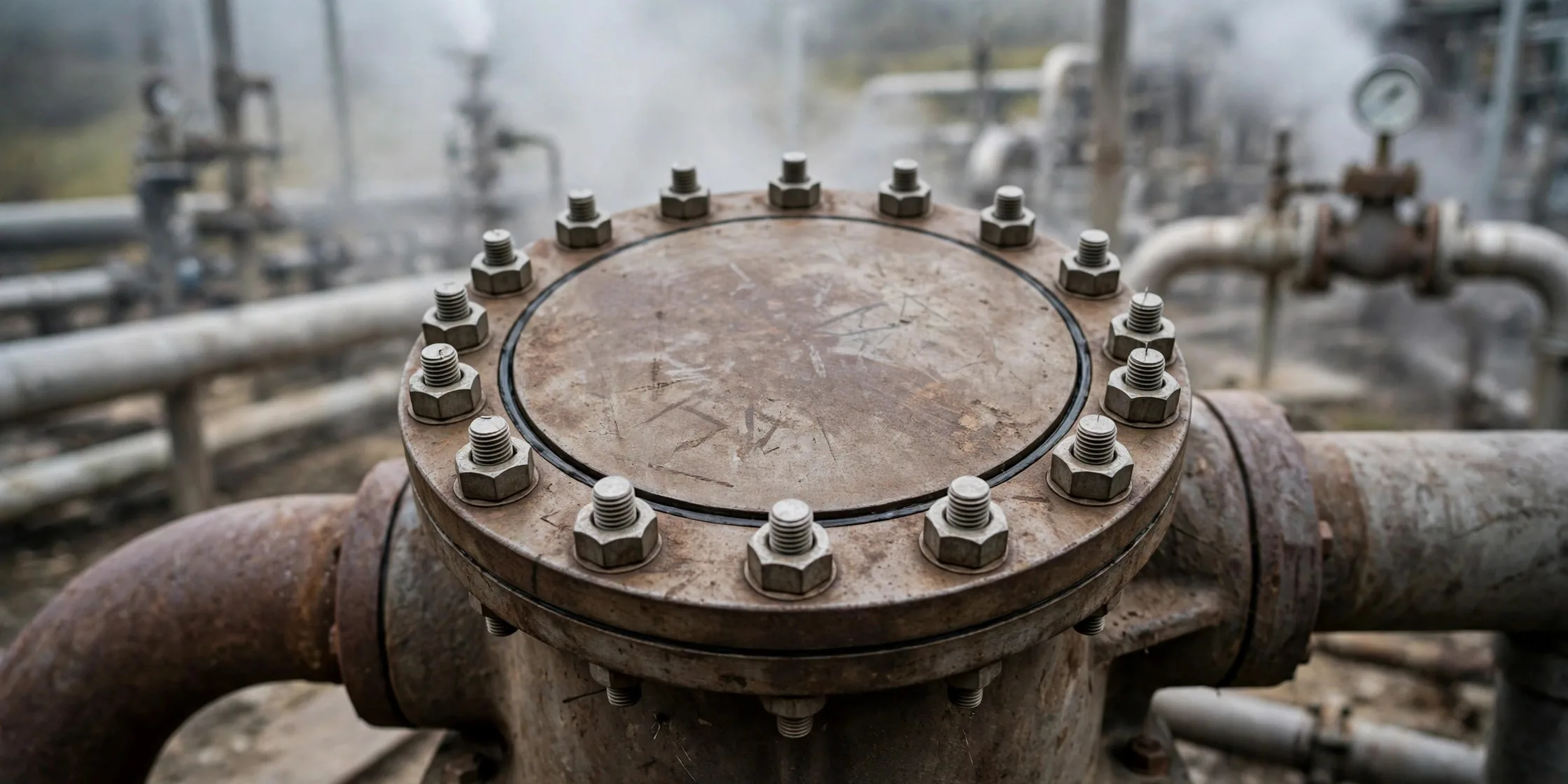
A pump cover is opened far more often than a pipe flange. Every opening tests the studs twice: the nut has to come off a thread that has sat in brine and scale, and the tap end has to stay put in the casing while that happens.
Which cover, and what reaches it
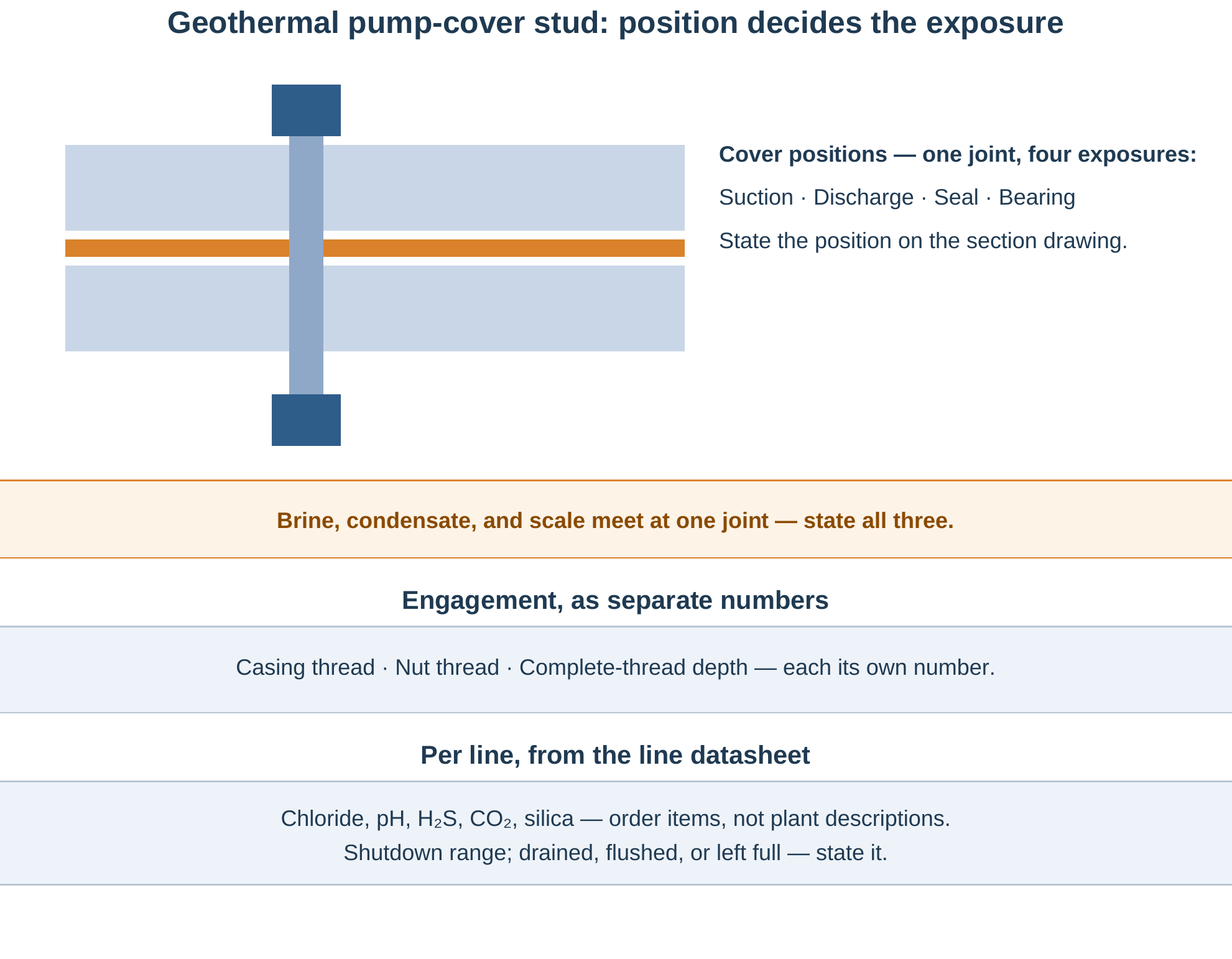
A geothermal pump has several bolted covers, and each sees a different exposure:
- Suction and discharge covers carry the full pressure and temperature, with brine behind the gasket.
- Seal covers see leakage past the mechanical seal, often hot brine flashing to steam and leaving salt and silica on the studs.
- Bearing covers are normally dry, but they collect condensate and washdown water.
Mark the position on the pump section drawing and state, for each, whether the studs are wetted by brine, condensate, leakage, or nothing in normal running. A single stud list for "the pump" can hide the different exposure and fit requirements of each cover.
Fluid chemistry varies between wells and lines; in one two-site field study, 625 kept a clean surface in both fluids but developed subsurface cracks along inclusions, so take nothing for granted from one site's experience. Take chloride, pH, H₂S, CO₂ and silica from the pump's line datasheet, together with the running and shutdown temperatures and whether the pump is drained when it stops.
The tap end and the casing
The tap end lives in the casing for the life of the pump, or should. It corrodes in the casing thread if brine reaches it, and it can gall or seize as the nut is broken loose. Then the stud turns out with the nut, or snaps, and the hole has to be drilled out.
Give the engagement as separate numbers:
- casing material and its strength, since a soft casing thread strips before the stud yields
- tapped-hole thread and depth
- complete-thread length in the casing (the runout doesn't carry load)
- nut-end thread and nut height
On a duplex or nickel alloy casing, the stud and casing have to be checked for galling as well as for corrosion. Seat the tap end with a suitable compound and to a defined torque, so it stays in place when the nut comes off. Our guide to stud length measurement shows how to give the overall length, tap-end length and nut-end length so the replacement matches.
Choosing the alloy
For the material routes, see Alloy 625 and Alloy 925. Compare the cover with geothermal brine-flange bolting.
| Candidate | UNS and specification | Where it fits a geothermal pump cover | Limit to check |
|---|---|---|---|
| Inconel 625 | N06625, ASTM B446 Grade 1 | Brine, condensate and scale at the cover; frequent removal | 414 MPa minimum yield; may need a larger stud |
| Incoloy 925 | N09925, ASTM B805, solution-annealed and aged | Sour lines needing higher strength | 38 HRC maximum and ISO 15156-3 environmental limits |
| Super duplex 2507 | S32750, ASTM A479 | Cooler, low-oxygen pumps with high cover loads | Crevice margin in hot, aerated brine; H₂S limits if sour |
| 316L | S31603 | Dry bearing covers only | Pitting and cracking in hot chloride |
Inconel 625 suits most wetted covers. Size 625 double-end studs from the ASTM B446 Grade 1 minimums; the Special Metals 625 bulletin gives typical values and the corrosion data behind the choice.
On sour lines covered by NACE MR0175/ISO 15156, Incoloy 925 double-end studs give more strength within a 38 HRC limit; the Special Metals 925 bulletin lists its aged properties. Alleima's SAF 2507 bar data gives a 550 MPa minimum proof strength, useful on heavily loaded covers where the fluid is cool and oxygen-free.
Removal, scale and records
Silica and salt deposits lock the nut end, and seal covers are the worst for it because leakage evaporates there. Pair the studs with nuts of the same alloy, use an anti-seize suited to hot brine, and state whether studs are replaced at each opening or reused. Dry nickel alloy threads under scale gall easily.
When covers come off, record by position which nuts seized, which tap ends moved, and where the threads show attack. Problems concentrated on the seal covers point to leakage; problems on every cover point to the fluid or the shutdown practice.
| Confirm before ordering | Why it matters | Document to ask for |
|---|---|---|
| Cover position and what wets the studs | Seal, casing and bearing covers differ | Pump section drawing |
| Line chemistry and shutdown practice | Grade and sour-service rules follow the fluid | Line datasheet, shutdown procedure |
| Casing material, tapped thread and depth | Decides galling risk and engagement | Casing drawing |
| Complete-thread length at each end | Runout carries no load | Stud drawing |
| Removal frequency and reuse policy | Repeated removal favours a galling-resistant set | Maintenance plan |
Requesting a quote
Send the pump, not the plant: "M24 double-end studs for geothermal brine pump casing and seal covers, duplex casing, 30 mm complete thread in casing, 165°C brine, 4,000 ppm chloride, no H₂S, silica scale, covers opened yearly, 16 studs per cover."
That is enough for us to review the specified alloy, dimensions and inspection requirements, and to quote studs, matching nuts and spares with EN 10204 3.1 certificates. More geothermal bolting is listed under renewable energy.