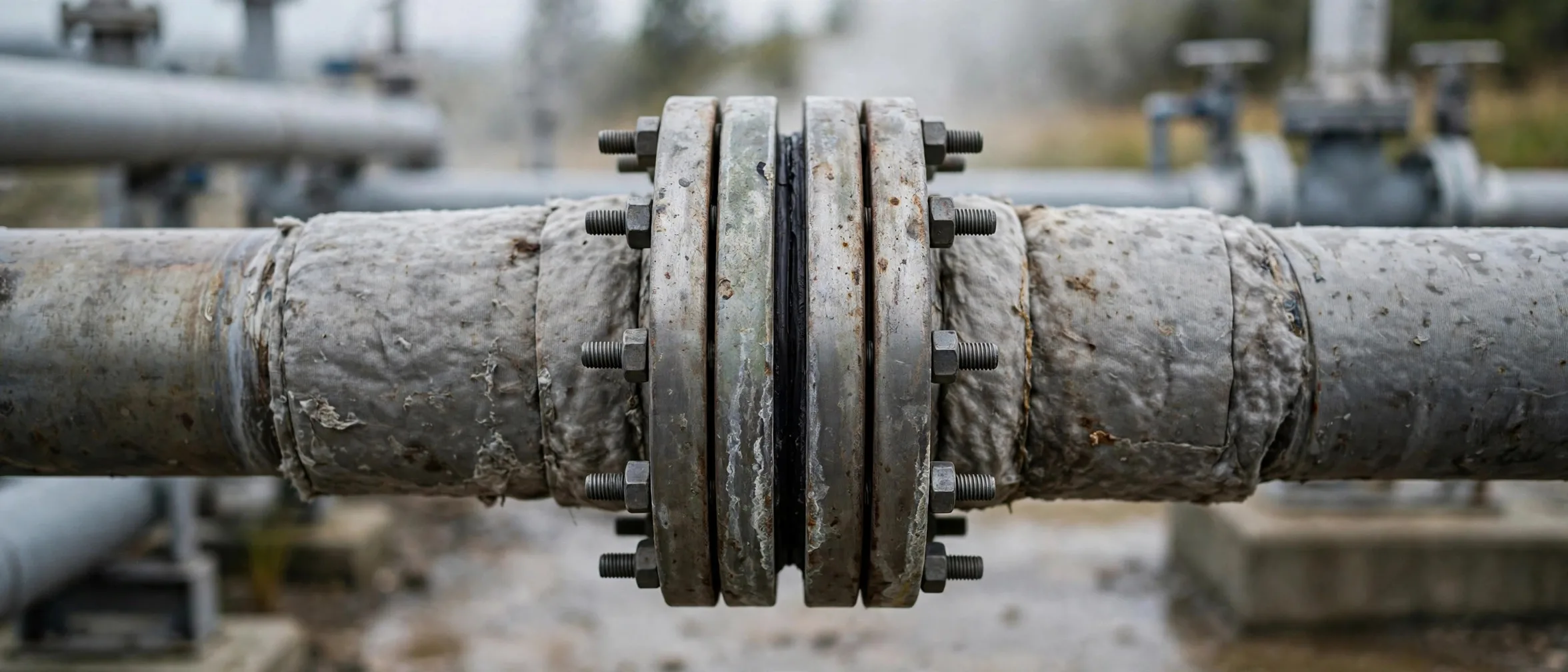
Much of the damage to geothermal flange studs happens at shutdown, and the studs that suffer most are the ones ordered against the running analysis alone.
See also geothermal pump-cover studs and thread engagement and the renewable-energy applications.
One plant, several fluids
A geothermal plant has production lines, separator outlets, brine reinjection lines and steam lines, each with its own temperature and chemistry. A field study of heat-exchanger alloys in the journal Geosciences exposed 316L, 254 SMO, titanium Grade 2 and Inconel 625 at the Reykjanes power plant in Iceland and the Chaunoy oil field in France. 625 showed no surface corrosion at either site, yet cracks running along inclusions below the surface appeared after both exposures. A clean surface after a trial is not the whole answer, and fluids differ between lines at one plant as much as between plants.
For each line, send:
- chloride, pH, hydrogen sulfide, carbon dioxide and silica from the line's fluid analysis
- the running temperature and pressure, and the temperature the flange falls to at shutdown
- the scale that forms on that line: silica, calcium carbonate or metal sulfides
What the studs see at shutdown
Running geothermal fluid usually carries little oxygen. Shutdown changes that. The line cools, steam condenses in the crevices under the nuts, residual brine stays wherever the line is not drained, and air can enter through vents and open flanges. For stainless steel, warm chloride with oxygen present is the classic trigger for pitting and stress corrosion cracking.
Steam lines have a problem of their own. At the Larderello steam field, Cabrini and co-workers measured the first condensate at the dew point at about pH 3.4–3.9 with roughly 6,500 ppm chloride. In their tests, austenitic and nickel alloys with PREN above 38 did not pit, and stress corrosion cracking appeared only in alloys with intermediate nickel content and low PREN.
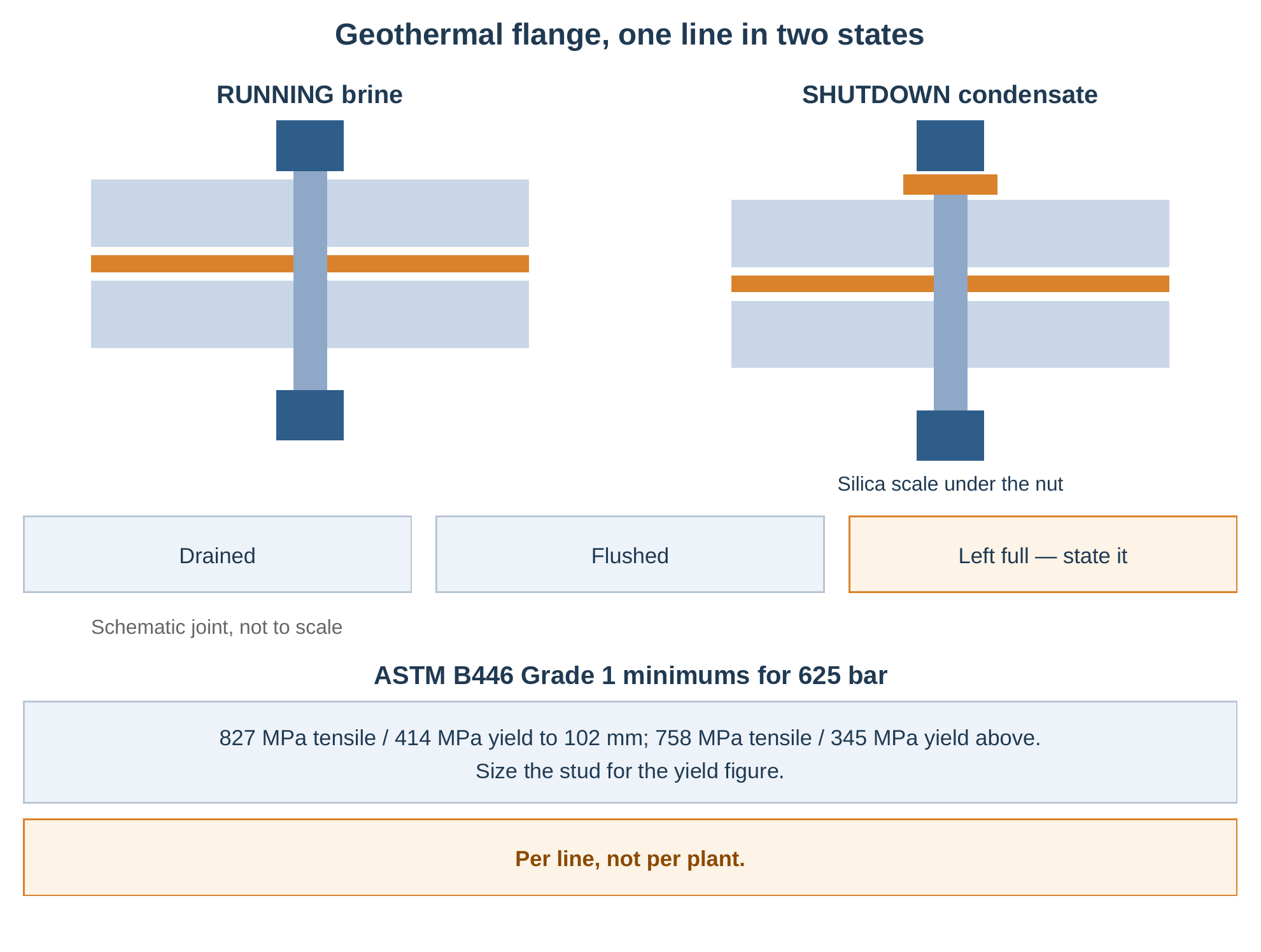
For each line, state whether it is drained, flushed or left full at shutdown, how long it stands, and whether air can get in. A flange left full of brine with air in the line is the worst case, and studs sized for the running duty may never have been checked against it.
Choosing the alloy by line
Inconel 625 suits lines where chloride, condensate and shutdown residue all reach the joint. Its 8–10% molybdenum, per the Special Metals 625 bulletin, is what keeps it passive in acidic chloride condensate; the cost is strength, with ASTM B446 Grade 1 bar at 414 MPa minimum yield up to 102 mm and 345 MPa above.
Sour service is a separate decision. Where the project applies NACE MR0175/ISO 15156, assess the exposed bolting against the material-condition and environmental requirements of ISO 15156-3, which limits hardness and also sets environmental limits on temperature, H₂S partial pressure, chloride and elemental sulfur for each alloy group. Do not use 0.3 kPa (0.05 psi) H₂S partial pressure as a universal exemption threshold for corrosion-resistant alloys: the ISO 15156 maintenance panel has stated that Part 3 has no defined "non-sour" limit. Bolting that the produced fluid cannot reach may be exempt, depending on the specification. Where strength is also needed, Incoloy 925 (UNS N09925, ASTM B805) is limited to 38 HRC in the solution-annealed and aged condition, and Inconel 718 to 40 HRC; the Special Metals 925 bulletin gives the aged properties.
| Candidate | UNS and specification | Where it fits a geothermal flange | Limit to check |
|---|---|---|---|
| Inconel 625 | N06625, ASTM B446 Grade 1 | Chloride brine, acidic condensate, shutdown residue | 414 MPa minimum yield; may need a larger stud |
| Incoloy 925 | N09925, ASTM B805, solution-annealed and aged | Sour lines needing higher strength | 38 HRC maximum and ISO 15156-3 environmental limits |
| Inconel 718 | N07718, ASTM B637 | Sour lines with high flange load | 40 HRC maximum and ISO 15156-3 environmental limits |
| Super duplex 2507 | S32750, ASTM A479 bar / A1082 | Cooler, low-oxygen lines with high load | Corrosion limits in hot chloride brine; H₂S limits if sour |
| 316L | S31603 | Low-chloride, low-temperature lines only | Pitting and cracking in hot chloride condensate |
Related references: Super duplex 2507
Alleima's SAF 2507 bar data gives a PRE of at least 41 and warns that long exposure above 250°C reduces impact toughness. That 250°C figure is a toughness limit; in hot chloride brine, and especially with H₂S, 2507's corrosion limits come well below it. It fits cooler reinjection lines better than hot production lines.
Silica, nuts and tightening
Silica precipitates as the fluid cools and loses pressure, and it fills the threads under the nut. A nut locked by silica on a flange that also stood in condensate usually comes off with a grinder. State the nut material and standard with the stud, and pair 625 studs with 625 heavy hex nuts where the nut sits in the same crevice. Choose an anti-seize compound that tolerates the line's chloride and temperature, because nickel alloy threads gall when assembled dry and galling under scale makes removal worse.
On hot flanges the gasket creeps after the first heat-up, so plan a retightening check if the gasket supplier or the site's bolting procedure (typically based on ASME PCC-1) calls for one; Bolt Science explains why joints relax after the first heat-up.
At each turnaround, record by line and flange position which studs carried silica under the nut, which showed attack at the thread root, and which had to be cut off. That record shows whether the trouble came from the alloy, the shutdown practice or the scale.
| Confirm before ordering | Why it matters | Document to ask for |
|---|---|---|
| Fluid analysis per line | Each line can need a different grade | Line datasheet |
| H₂S partial pressure and the governing specification | Decides whether ISO 15156 applies | Fluid analysis, project material specification |
| Temperature range including shutdown | Studs see both ends | Temperature log |
| Shutdown procedure and air ingress | Residual brine with oxygen does the most damage | Shutdown procedure |
| Scale type and descaling method | Silica locks nuts | Scale report, maintenance procedure |
| Nut material, anti-seize and retightening plan | Seized nuts are cut off | Nut specification, tightening procedure |
Requesting a quote
A useful enquiry carries the line data with it, for example: "7/8"-9 UNC Inconel 625 stud and nut sets for brine reinjection flanges, ASME B16.5 Class 300, 160°C running, 5,000 ppm chloride, no H₂S, silica scale, drained at shutdown, plus spares." A photo of a removed stud with scale under the nut also helps show what failed last time.
We'll check alloy and stud size line by line and come back with a price for 625 stud and nut sets or complete flange stud bolt kits, each with EN 10204 3.1 certificates.