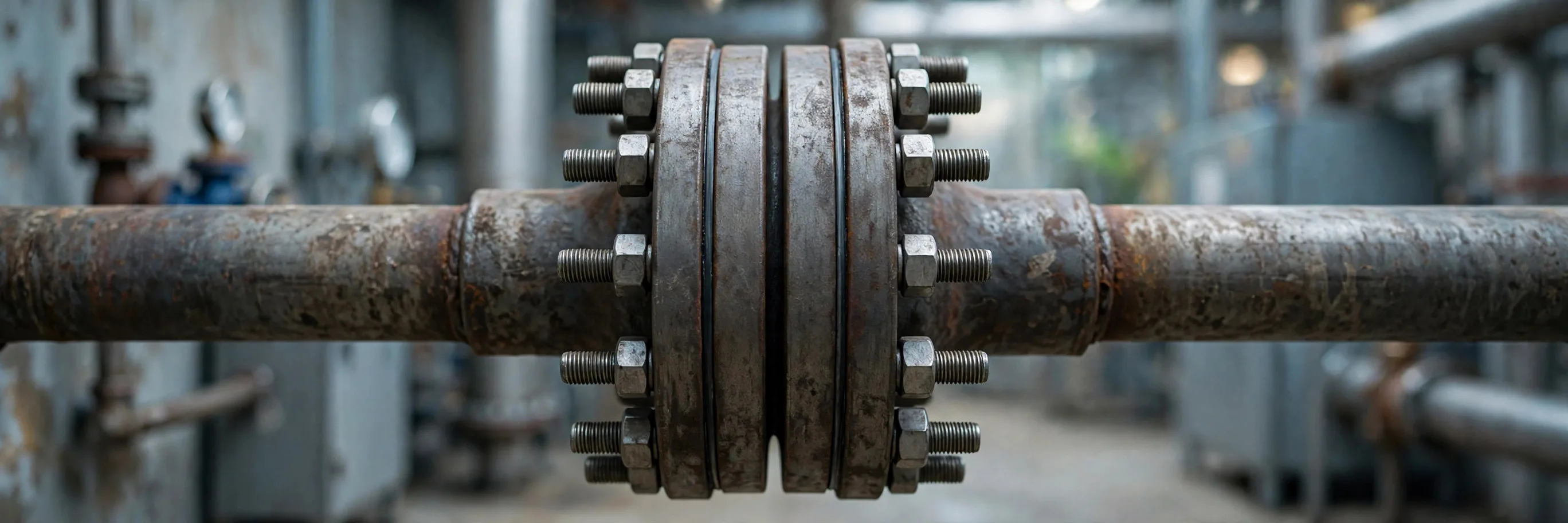
On a utility exchanger, the process side gets the design review. The water-side studs deserve the same attention, because that is where chloride, drips and warm flanges meet.
Chloride, temperature and pH together
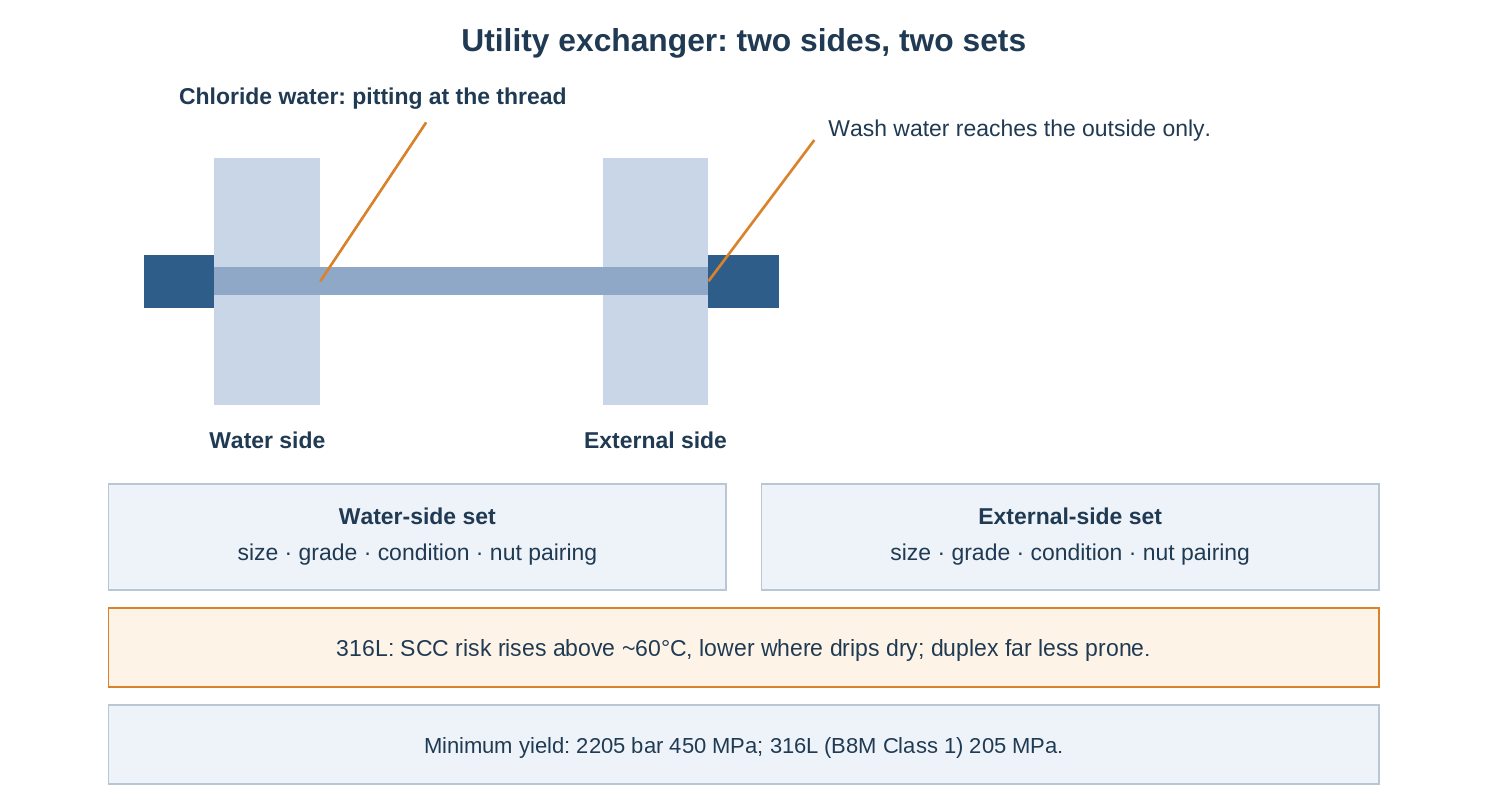
Chloride attack on stainless steel depends on chloride, temperature and pH together. The Alleima SAF 2205 datasheet puts the risk for 304L and 316L at temperatures above 60°C in chloride-bearing solutions, and notes that duplex grades are far less prone to this cracking. Treat 60°C as a warning level, not a safe limit: where a drip evaporates on a hot flange and concentrates chloride, cracking can start at lower temperatures. A 316L stud that serves well on the external frame can therefore be the wrong stud on a hot water-side joint.
Where the studs sit matters too. A stud in a dry, insulated flange is barely exposed. A stud below a joint that drips, or on a flange that sweats from condensation and dries again, sees chloride concentrated far above the bulk water level.
Include steam-out and summer peaks in the maximum temperature, and say whether the studs stay dry, are wetted by drips or condensation, or are washed down.
Joint strength and the gasket
A heat-exchanger flange has to seat its gasket and hold design pressure at design temperature, and the stud yield strength sets how much preload the joint can carry. Spiral-wound and kammprofile gaskets need substantial seating stress, and low-strength studs often can't reach it without being tightened close to their limit.
| Stud material | Specification | Minimum yield |
|---|---|---|
| 316 / 316L, Class 1 | ASTM A193 B8M Class 1 | 205 MPa, all diameters |
| 316, Class 2 (strain-hardened) | ASTM A193 B8M Class 2 | 655 MPa to 3/4 in, 550 MPa 7/8–1 in, 450 MPa 1-1/8–1-1/4 in, 345 MPa 1-3/8–1-1/2 in |
| Duplex 2205 | ASTM A479 bar, S32205 | 450 MPa, all sizes |
| Super duplex 2507 | ASTM A1082, S32750 | 550 MPa (sizes to 2 in) |
B8M Class 2 is strong in small sizes but loses strength as the diameter grows, and its corrosion resistance is still that of 316. 2205 keeps 450 MPa at every size.
A stronger stud only helps if the flange and gasket can take the extra preload. Thin flanges on food-plant exchangers can rotate, and some gaskets crush, so the exchanger designer should confirm the bolt load before it is raised. For pressure joints, also confirm that the stud material and condition are accepted as bolting under the exchanger's design code (for ASME equipment, the Section II-D bolting tables).
State the design pressure and temperature, gasket type and seating load for each joint. Also state how often it is opened: a joint opened for cleaning several times a year is tightened again each time, and needs nuts that won't seize.
Choosing the grade
| Candidate | UNS and form | Where it fits a utility exchanger | Limit to check |
|---|---|---|---|
| 316L | S31600/S31603, ASTM A193 B8M Class 1 (316/316L dual-certified) | Cool, dry joints with low seating loads; external frame bolts | 205 MPa yield; chloride cracking risk, rising above about 60°C |
| Duplex 2205 | S32205, bar to ASTM A479 | Water-side joints with warm chlorinated water, drips or condensation | Check chloride and temperature against the water data |
| Super duplex 2507 | S32750, bar to ASTM A479 or A1082 | High chloride, brackish or recycled water, or joints where 2205 has pitted | Cost; usually only for specific joints |
Duplex 2205 is the usual answer for water-side studs. Check that the certificate shows S32205, or dual certification to S31803 and S32205; our note on 2205 dual certification explains why it matters. For water with high chloride, such as brackish make-up or recycled water, super duplex 2507 has a PRE of at least 41 according to Alleima's SAF 2507 bar datasheet.
316L remains a good choice for the external frame, supports and dry joints, where it matches the stainless equipment and is easy to source.
Nuts, tightening and records
Pair 2205 studs with 2205 nuts, such as 2205 heavy hex nuts. A 304 nut can become the weak link in a chloride exposure that the duplex stud tolerates; include the nut in the corrosion review. Tighten in a cross pattern in several passes to the procedure torque, with a food-safe anti-seize where the exchanger is near product areas.
Each time a joint is opened, record:
- pitting or cracking under the nuts, especially on the lower studs
- any drip path or wet insulation above the joint
- which nuts seized
If the studs below a drip keep corroding, fixing the leak may matter as much as upgrading the grade.
Requesting a quote
List the joints by exchanger tag, for example: "M20 2205 stud and nut sets for the cooling-water channel covers of HX-104 and HX-105; chlorinated tower water, chloride about 400 mg/L, 45°C normal, 70°C during summer peaks; spiral-wound gaskets; opened twice a year."
Quotes for 2205 stud bolts with matching nuts follow a check of the grade, dimensions and inspection plan against that data. Process-side bolting on chemical exchangers is covered in our guide to heat exchanger head stud bolts, and other food-plant equipment on the food and beverage equipment page.