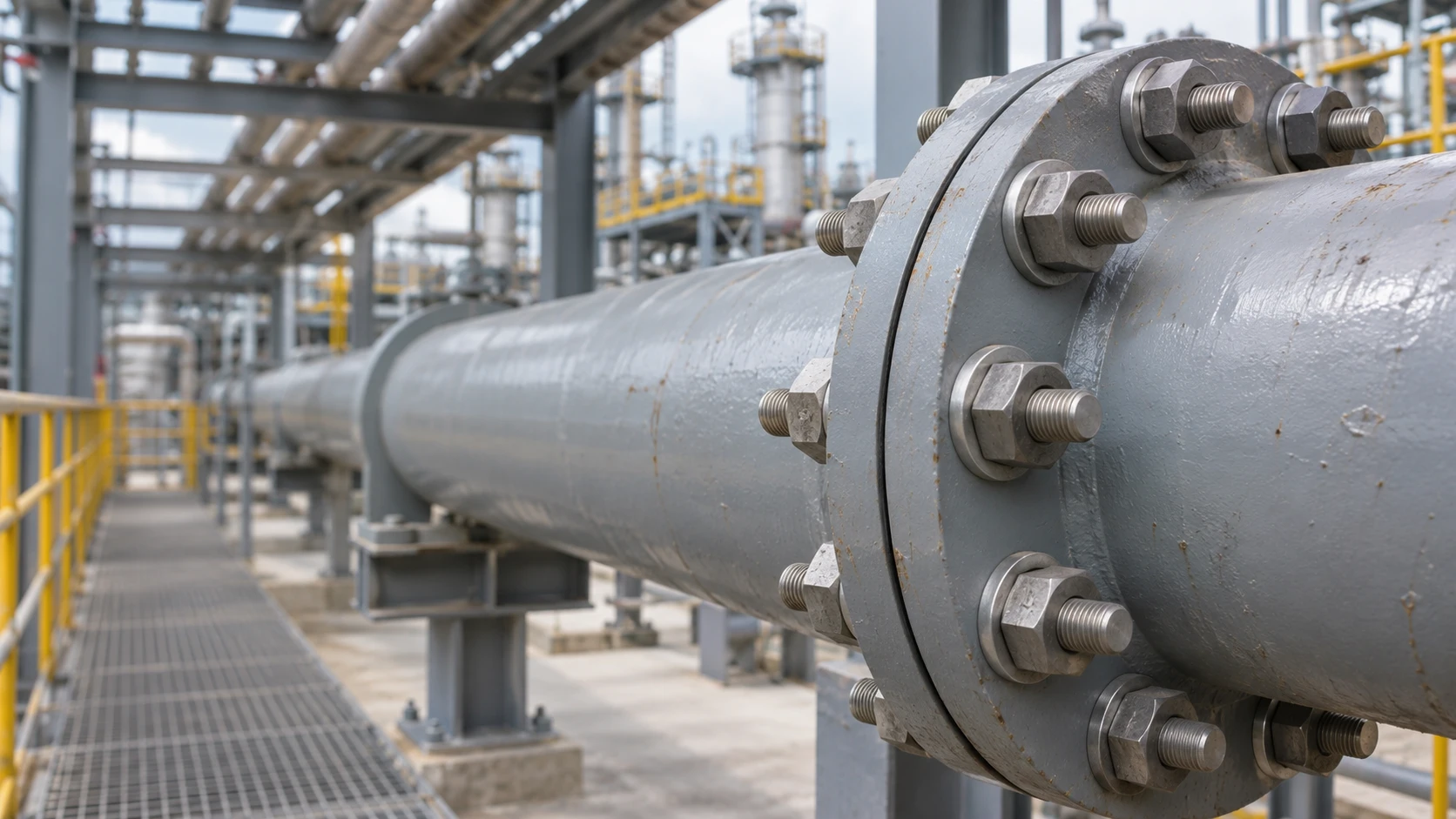
The short answer
8UN is the Unified 8-thread series: eight threads per inch (TPI) at every diameter it covers. On flange stud bolts the convention is:
- Up to and including 1 in.: coarse series (UNC). A 1 in. UNC thread already has 8 TPI, so a 1 in. stud is written 1-8 UNC.
- Over 1 in. (1-1/8 in. and larger): the 8-thread series. A 1-1/2 in. stud is 1-1/2-8 UN rather than 1-1/2-6 UNC, and a 2 in. stud is 2-8 UN rather than 2-4.5 UNC.
- Class 2A on the stud, 2B on the nut, under ASME B1.1.
ASME B16.5 sets this out for alloy-steel flange bolting, and ASTM A193 and A320 bolting follows it. In our experience, nickel-alloy, duplex and A-286 flange studs are ordered the same way, because they replace or sit alongside that bolting.
For nuts over 1 in., ASTM A194 permits UNC or 8UN and specifies 8UN unless otherwise ordered. Write the series on both the stud and the nut lines so the bolting schedule states the intended pairing explicitly.
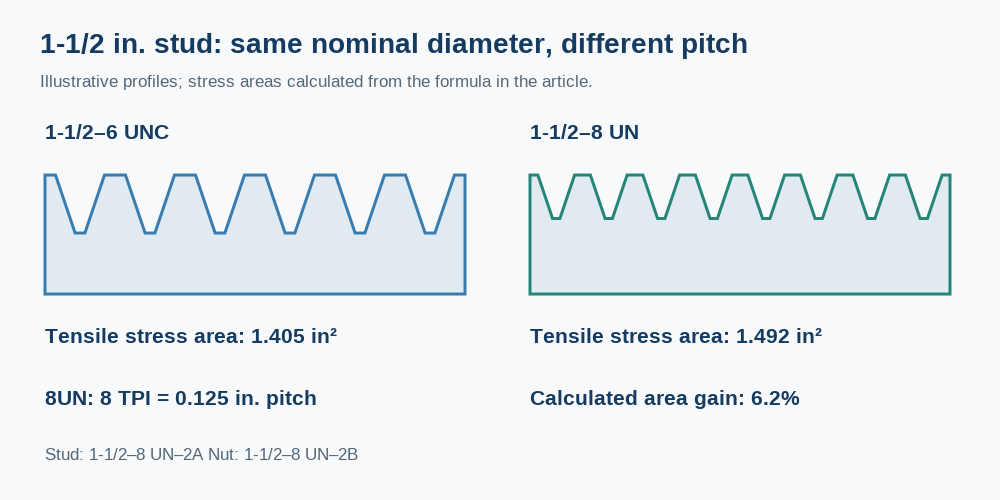
Compare UNC and 8UN stress area
UNC (6 TPI): 1.405 in². 8UN (8 TPI): 1.492 in².
Aₜ = 0.7854 × (D − 0.9743/n)². This reproduces the article's comparison, not a design load or torque. Use the applicable ASME B1.1 formula and project requirements for design.
Where the rule comes from
- ASME B16.5 gives dimensional recommendations for flange bolting. For alloy-steel bolting, external and internal threads are coarse series through 1 in. and the 8-thread series for larger bolts, Class 2A/2B. ASTM F704, the practice for selecting bolting lengths for flanged joints, states the same: alloy-steel bolting above 1 in. nominal diameter has threads of the 8UN series.
- ASTM A193 and A320 studs (B7, B8, B8M and others) are listed in distributor thread tables, such as Portland Bolt's, as 8UN from 1 in. upward. At 1 in. that is the same pitch as UNC, so it agrees with B16.5.
- ASTM A194 nuts: up to and including 1 in. nominal, UNC Class 2B. Over 1 in., either UNC Class 2B or 8UN Class 2B, with 8UN supplied unless otherwise specified. State the intended series explicitly on the purchase order.
None of this is a material rule. It is a thread convention for inch-series flange bolting. Metric flanges, for example to EN 1092-1, are bolted with metric threads and the 8UN question does not arise.
Why 8 TPI instead of coarse threads
Above 1 in., UNC gets steadily coarser: 7 TPI at 1-1/8 in., 6 at 1-1/2 in., 4.5 at 2 in., and 4 from 2-1/2 in. to 4 in. The 8-thread series holds the pitch constant. That gives the flange stud two practical advantages.
1. More tensile stress area at the same diameter. A finer thread cuts less deeply into the stud, so more cross-section carries the load. Using the standard tensile stress area formula, At = 0.7854 × (D − 0.9743/n)²:
| Nominal diameter | UNC (TPI) | At UNC (in²) | At 8UN (in²) | Gain with 8UN |
|---|---|---|---|---|
| 1-1/8 in. | 7 | 0.763 | 0.790 | 3.6% |
| 1-1/4 in. | 7 | 0.969 | 1.000 | 3.2% |
| 1-1/2 in. | 6 | 1.405 | 1.492 | 6.2% |
| 2 in. | 4.5 | 2.498 | 2.771 | 10.9% |
| 2-1/2 in. | 4 | 3.999 | 4.442 | 11.1% |
| 3 in. | 4 | 5.967 | 6.506 | 9.0% |
| 4 in. | 4 | 11.083 | 11.813 | 6.6% |
Calculated from the formula above. The 1-1/2 in. and 2 in. values agree with published thread tables. ASME B1.1 gives a modified formula for bolting above 100 ksi tensile strength, which covers these alloys; it gives slightly different areas, but the comparison between series holds. Use ASME B1.1 for design.
For a high-strength alloy stud, that extra 6–11% of stress area at the common 1-1/2 to 3 in. sizes is useful preload capacity. No change of material is needed to get it.
2. One pitch across the joint list. A plant with 1-1/8 in. to 3 in. studs works with one pitch. Nuts and thread gauges are all 8 TPI, whatever the diameter.
The trade-off: a finer thread has a shallower thread depth, so engagement length matters more. Portland Bolt notes that fine threads need longer engagement than coarse threads to prevent stripping. A heavy hex nut provides the engagement on a flange stud. Shallow threads also damage more easily, so keep them clean and protected in the field.
Common mistakes on 8UN orders
- "1-1/2 in. stud" with no pitch. The supplier has to guess between 6 UNC and 8UN, and the nuts may come from a different supplier who guesses differently. Write 1-1/2-8 UN-2A.
- Nut line that does not match the stud. Under A194 both series are allowed above 1 in., with 8UN as the default unless otherwise specified. Write 1-1/2-8 UN-2B on the nut line, or reference the stud, especially when departing from that default.
- Mixing 1 in. callouts. 1-8 UNC and 1-8 UN describe the same pitch, so this is a paperwork difference, not a fit problem. Keep one form throughout the bolting list so the documents match.
- Replacing an 8UN stud with a UNC one "of the same size". It will not take the existing nuts, it has a smaller stress area, and torque values calculated for the 8UN stud no longer give the same preload.
- Assuming 8UN for metric or non-B16.5 equipment. Pressure-vessel heads, valves and machinery may have their own thread callouts. Follow the drawing, not the flange convention.
Ordering 8UN nickel-alloy and duplex flange studs
A complete line item names the stud and both nuts. For example:
Stud bolt, 1-1/2-8 UN-2A × length per the flange bolting table, fully threaded, Inconel 718 to ASTM A1014, threads rolled; two heavy hex nuts 1-1/2-8 UN-2B, dimensions to ASME B18.2.2, machined from ASTM B637 bar, solution treated and aged, hardness range stated; thread gauging to ASME B1.3 System 21; EN 10204 3.1 certificate; PMI by sampling.
For super duplex 2507, order the studs to ASTM A1082 and state the nut standard and condition. For A-286, use ASTM A453 Grade 660 with the class and thread type stated.
State also:
- Quantity per flange: studs plus two nuts each, and washers if required.
- Thread class, if anything other than 2A/2B is required (see Class 2A vs 3A threads).
- Gauging and inspection: for example ASME B1.3 System 21 by sampling. See our thread gauging guide.
- Documents: EN 10204 3.1 certificate, and PMI scope.
What BYBOLT supplies
- Default series: Studs and nuts over 1 in. are threaded to the 8-thread series by default, as the standards set out (at 1 in., UNC is already 8 TPI). If your drawing needs a different pitch, we can make it to your requirement. A non-standard pitch needs its own thread gauges, which are made for the order and charged separately.
- Thread production: External threads are rolled up to 4 in. diameter (see rolled vs cut threads). Classes 2A/2B and 3A/3B are both available.
- Sets: Studs, heavy hex nuts and washers are supplied in matching material and condition, as flange stud bolt kits for ASME Class 150–2500 or as stud, nut and washer sets.
- Inspection and documents: GO/NOT GO thread gauging on a sampling basis. Routine PMI by sampling; 100% PMI or third-party inspection on request. EN 10204 3.1 certificate with every lot. Tensile and hardness tests are done in our own laboratory.
- Commercial terms: MOQ 100 pcs per size and grade. Lead time is 7–15 working days for standard fasteners from stock bar and 15–25 working days for custom forged or special aging batches.
See stud bolts and heavy hex nuts for the product ranges. For specific alloys, see Inconel 718 stud bolts, Inconel 625 stud bolts, Super Duplex 2507 stud bolts and A-286 stud bolts.
Common questions
What does 8UN mean? It is the Unified 8-thread series: a constant pitch of 8 threads per inch (0.125 in.) at every diameter in the series, with the standard 60° Unified profile. "8UN" always needs a diameter, as in 2-8 UN.
Is 8UN the same as UNC? Only at 1 in., where UNC also has 8 TPI. Above 1 in. UNC is coarser, and 8UN and UNC parts of the same diameter do not mate.
Why do flange studs use 8UN above 1 in.? ASME B16.5's dimensional recommendations for alloy-steel bolting call for the 8-thread series above 1 in. The finer constant pitch gives more stress area than UNC and keeps one pitch across all large sizes.
Can I order a 2 in. alloy stud in UNC? Yes, if the drawing and mating nuts call for it. Make sure the nuts are ordered in the same series. For BYBOLT, a non-default pitch on a stud over 1 in. means custom gauges, charged separately.
Send the bolting list
Send the flange list or bolting schedule with diameter, thread series, length, material and quantity of studs and nuts per flange. We will confirm threads, any custom gauges and sets before the order is confirmed. Request a quote.