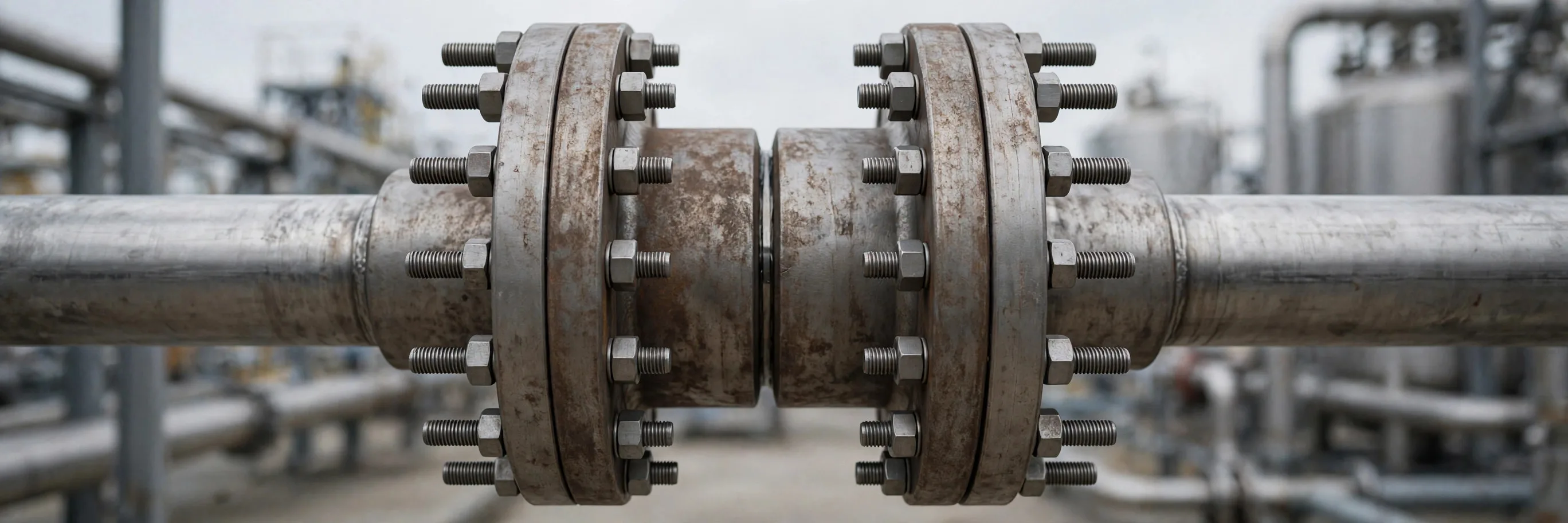
A polysilicon plant runs one family of chemicals through very different equipment. The fluidized-bed reactor, the distillation columns and the deposition reactors each put a different temperature on their flanges, and the studs only see the process chemistry when something goes wrong at the joint.
Where the temperatures come from
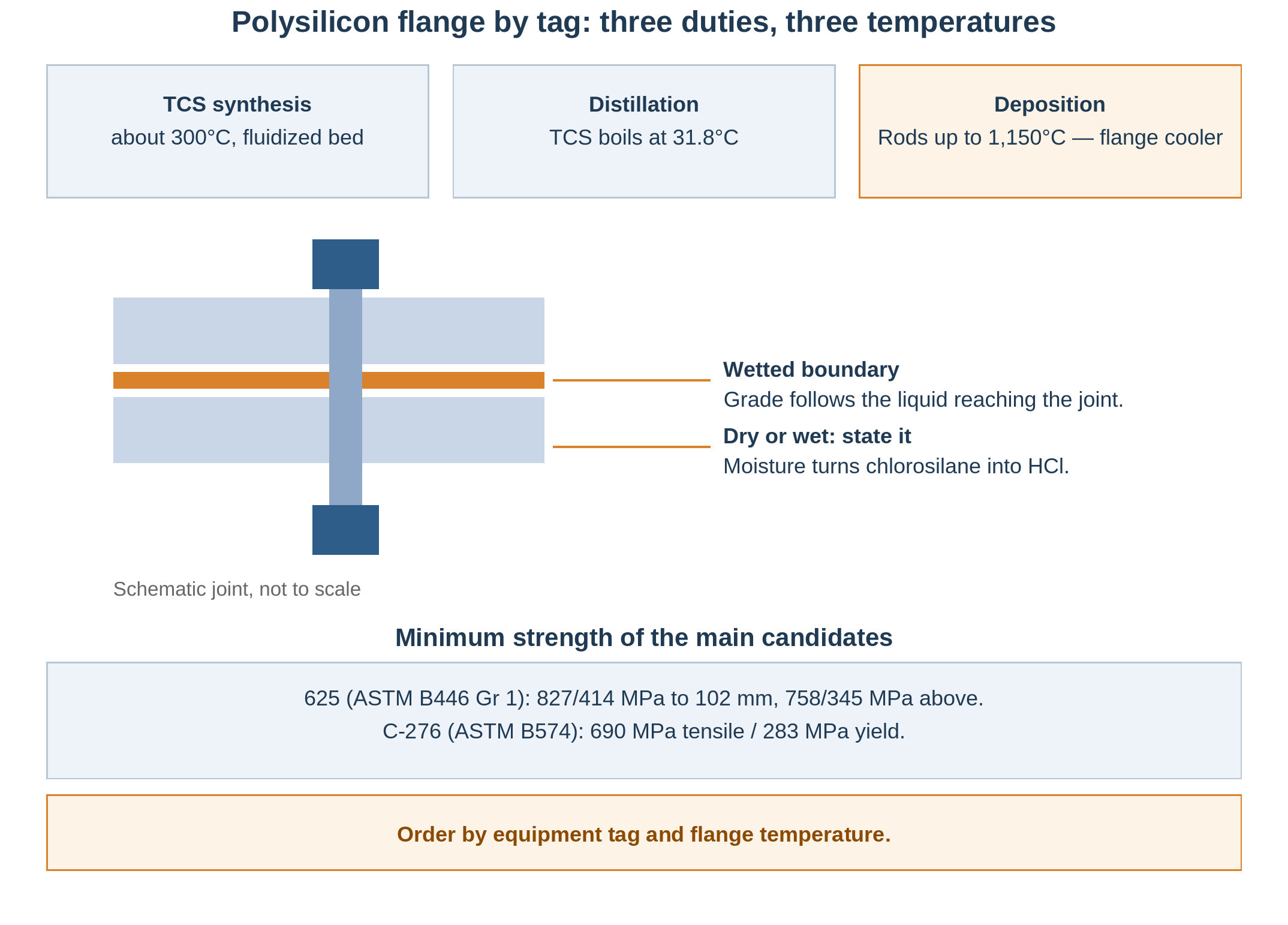
Bernreuter Research's overview of the Siemens process describes the chain: metallurgical silicon reacts with hydrogen chloride to form TCS, the TCS is purified in tall distillation columns (it boils at 31.8°C), and silicon is deposited from it onto slim rods heated to up to 1,150°C. A Fraunhofer ISE report on polysilicon energy use puts TCS synthesis at about 300°C in a fluidized bed and distillation at 30–60°C.
Most of these are not flange temperatures. A deposition reactor's base plate and feed connections are cooled, and a distillation column flange sits close to ambient. The exception is the hot, pressurized equipment: hydrochlorination reactors and silicon tetrachloride converters run far hotter and under pressure, and their flanges need a strength-at-temperature check as well as a corrosion check. Put the flange metal temperature on the order, not the process temperature, and give for each tag:
- equipment tag and process step
- medium at the flange: TCS, silicon tetrachloride, HCl, hydrogen, or a mixture
- flange metal temperature and pressure in operation and during start-up
- whether the line is dry in normal service, and how it is purged before opening
Moisture is what attacks the studs
Where wet HCl reaches the threads, compare the conditions in the hydrochloric-acid fastener guide. Polysilicon production is covered under chemical processing.
Chlorosilanes react with water to form hydrochloric acid and silica. In a tight, dry system that reaction never reaches the bolting. At a flange it can: a slow weep past the gasket meets humid air, and the acid and white deposit form on the flange rim, in the threads and under the nuts. The studs then sit in wet HCl that the process datasheet never mentions.
Openings make it worse. A flange broken for maintenance is purged first, but residual chlorosilane in the gasket area and threads hydrolyses as soon as air reaches it, and any moisture left in the line before reassembly does the same on restart. Hydrolysis of TCS also releases hydrogen and can leave reactive silicon-hydrogen solids around a weeping flange, so treat those deposits under the plant's own procedure before anyone cleans or cuts a seized nut.
For each flange, state whether it has a leak or deposit history, how often it is opened, and the purge and drying procedure. Pick the grade from those answers.
316L, 625 and C-276
| Candidate | UNS and specification | Where it fits polysilicon flanges | Limit to check |
|---|---|---|---|
| 316L | S31603 | Dry service, low temperature, no leak or deposit history | Pitting and cracking once wet HCl reaches the threads |
| Inconel 625 | N06625, ASTM B446 Grade 1 | Occasionally damp chloride with no acid build-up; hot flanges near reactors | Loses resistance quickly as HCl strength and temperature rise |
| Hastelloy C-276 | N10276, ASTM B574 | Weeping flanges, hydrolysis deposits, vents and scrubbers | 283 MPa minimum yield; limits in hot, concentrated HCl |
Inconel 625 carries 20–23% chromium and 8–10% molybdenum, per the Special Metals 625 bulletin, and handles intermittent wet chloride at moderate temperature, but it is not a hydrochloric acid alloy. Its value here is at the hotter flanges, where it keeps its strength and resists hot chloride gas.
Hastelloy C-276 is the better choice where the studs face hydrochloric acid itself. Haynes International gives it a nominal 16% molybdenum and 4% tungsten and notes its resistance to both oxidizing and reducing acids. Its weakness in a stud is yield strength: 283 MPa minimum in the annealed condition, so the stud may need to go up a size. Our comparison of Hastelloy and Inconel fasteners covers the trade-off in more detail.
Matched nuts and reassembly
Order the nuts in the same alloy as the studs. A carbon steel or 300-series nut on a 625 or C-276 stud is the first part to corrode in a wet-HCl crevice, and once it seizes the stud is cut off with it. Pair 625 studs with 625 heavy hex nuts and C-276 studs with C-276 heavy hex nuts.
Nickel alloy threads assembled dry can gall, and in high-purity chlorosilane service the plant's purity rules usually dictate the lubricant, so put its name on the order. Tighten in a cross pattern in several passes, and check the stud length against the actual gasket.
| Confirm before ordering | Why it matters | Document to ask for |
|---|---|---|
| Equipment tag, process step and medium | Each tag can need a different grade | Equipment datasheet |
| Flange metal temperature | Rod and reactor temperatures are not flange temperatures | Equipment datasheet, thermal design note |
| Leak or deposit history and opening frequency | Wet HCl at the threads decides the grade | Maintenance records |
| Purge and drying procedure | Residual chlorosilane hydrolyses when the joint opens | Operating procedure |
| Stud size against gasket load | 625 and C-276 have lower yield than B7 | Flange drawing, gasket data |
| Nut alloy and lubricant | Mismatched nuts seize in the crevice | Nut specification, plant lubricant list |
Requesting a quote
Group the enquiry by tag, for example: "M20 stud and nut sets for TCS distillation column flanges, tags C-101 to C-104, 40–60°C flange temperature, dry service but two flanges with deposit history, opened annually, nitrogen purge before opening."
The reply comes back tag by tag, with a grade, a stud size and a price for 625 stud and nut sets or C-276 stud and nut sets, each with EN 10204 3.1 certificates.