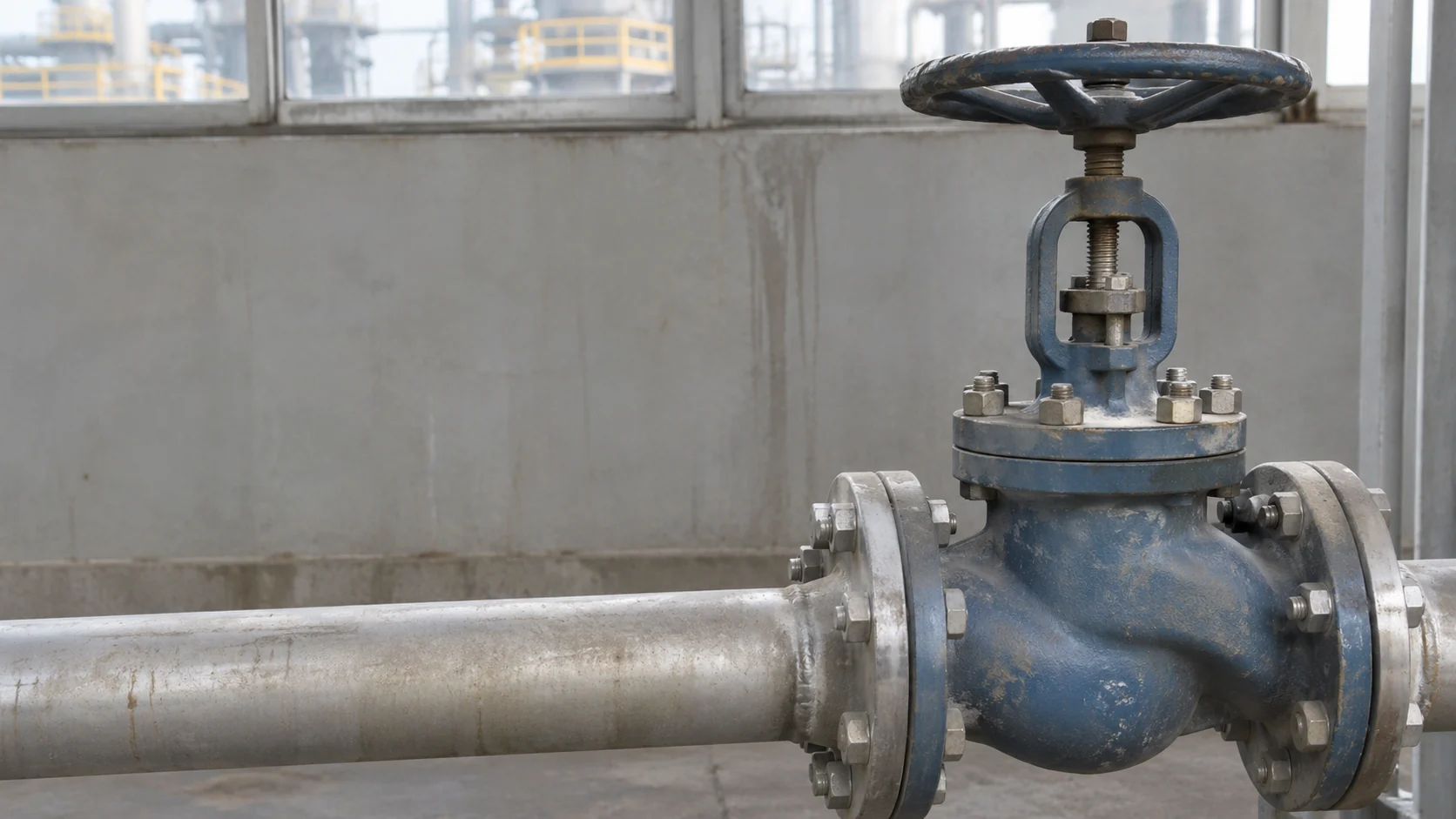
The stud choice decides both. In oxidizing service, the alloy's passive film decides whether the stud survives long enough to be opened at all.
Put the body end, the nut end, the oxidizing stream, and the opening procedure on one order. A stud long enough overall but short at one end feels right at assembly and fails to clamp evenly, so the order must dimension both ends instead of giving a single total length and leaving the rest to the shop.
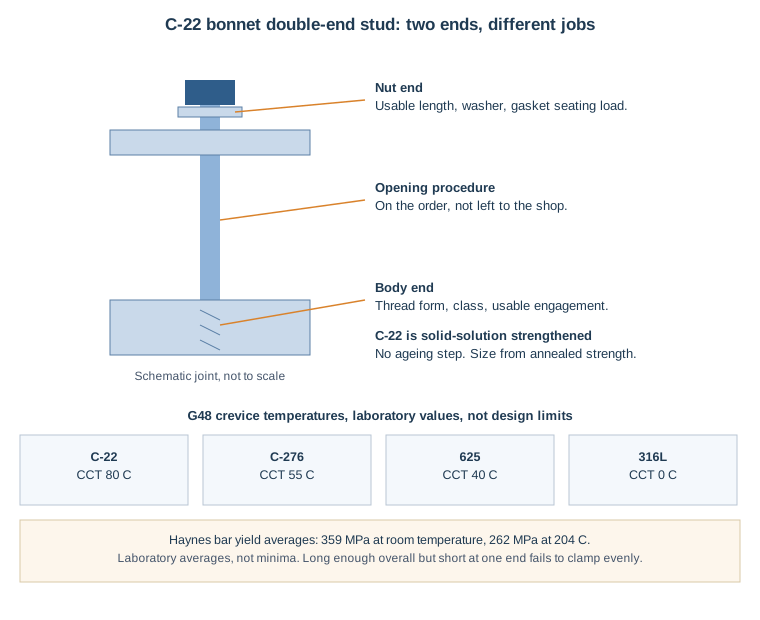
Figure: C-22 bonnet double-end stud — body end and nut end are different jobs; G48 crevice temperatures are laboratory values, and bar yield averages are not minima.
01 Oxidizing service, and what it does to a passive film
Oxidizing service means the stream carries species that drive the metal toward its passive state: nitric acid, ferric chloride, cupric chloride, hypochlorite, wet chlorine, or chlorinated oxidizers. Where the passive film stays intact, attack stays slow. Where chloride, a crevice, or a change in stream character breaks it, attack concentrates at that spot, especially under a nut, under a washer, or in a thread root where liquid sits still.
C-22 earns its place here through chromium. Haynes International's HASTELLOY C-22 alloy page gives its nominal chemistry as nickel 56% as balance, chromium 22%, molybdenum 13%, iron 3%, and tungsten 3%, and states that its high chromium content provides much higher resistance to oxidizing media than the family standard, C-276 alloy, with exceptional resistance to chloride-induced pitting. C-22 is a solid-solution alloy, not an age-hardened alloy: its strength comes from molybdenum and tungsten dissolved in the nickel-chromium matrix, so there is no ageing cycle to get wrong on a C-22 stud, and no aged condition to state in the way an aged precipitation-hardened stud requires. Any cold-worked condition must be stated separately on the order.
Its strength is modest for a bonnet stud, so size the joint for solution-annealed strength: about 283–310 MPa yield depending on product form and specification edition, with 690 MPa tensile, and name the specification on the order rather than sizing from "modest" alone. Confirm the figures against the governing ASTM B574 edition. Temperature derating is real and quantified on the same page: Haynes bar averages fall from 359 MPa yield at room temperature to 262 MPa at 204°C, with tensile falling from 765 MPa to 662 MPa. Those are laboratory averages, not minima, and they show why the stud temperature belongs on the order next to the stream temperature.
The same page reports a sharper comparison in acidified 6% ferric chloride under ASTM G48: a critical pitting temperature above 150°C and a critical crevice temperature of 80°C for C-22, against 55°C crevice for C-276, 40°C for 625, and 0°C for 316L. Those are laboratory test values in one aggressive solution, not design limits, and they show why a crevice temperature, not a general corrosion rate, often sets the bonnet decision.
02 The candidate alloys, and where each one stops
C-22 is the starting point where oxidizing species govern. C-276, UNS N10276, is the choice where the stream swings reducing: its higher molybdenum, 16% nominal, and tungsten, 4% nominal, carry hydrochloric and reducing acids better, while its lower chromium, 16% nominal, gives it less oxidizing headroom than C-22. Inconel 625, UNS N06625, is a solid-solution alternative where oxidizing service dominates, but its chloride-pitting and reducing-acid limits sit below the C-family grades. Its ASTM B446 Grade 1 bar minima run 827 MPa tensile and 414 MPa yield to 102 mm diameter, and 758 MPa tensile and 345 MPa yield above that diameter, to be confirmed against the governing B446 edition. Alloy 20, UNS N08020, is the boundary to test, not assume: it fits dilute sulfuric duty, but an oxidizing chloride stream, ferric chloride, or nitric ingress takes it outside the envelope it was designed for. Carpenter Technology's CarTech 20Cb-3 datasheet places Alloy 20 in scrubber service where acid content matters more than high-halogen content, which marks the halogen side as its limit.
| Candidate | UNS and form | Where it fits an oxidizing bonnet | Boundary to watch |
|---|---|---|---|
| Hastelloy C-22 | UNS N06022, bar to ASTM B574 | Oxidizing chemical service, ferric and cupric chloride, nitric ingress | Modest solution-annealed strength, about 283–310 MPa yield; state stud temperature |
| Hastelloy C-276 | UNS N10276, bar to ASTM B574 | Stream that swings reducing, hydrochloric-bearing mixed acid | Less oxidizing headroom than C-22 where oxidizers govern |
| Inconel 625 | UNS N06625, bar to ASTM B446 Grade 1 | Oxidizing service, higher annealed yield for seating | Reducing-acid and chloride-pitting limits below C-22; confirm Grade 1 minima against the governing B446 edition |
| Alloy 20 | UNS N08020, bar to ASTM B473 | Dilute sulfuric, no oxidizing chloride | Ferric chloride, nitric ingress, or hot chloride beyond its qualified envelope |
Thermal expansion deserves one quantified check where a C-22 stud meets a different body metal. Haynes International's HASTELLOY C-22 alloy page gives a mean coefficient of 12.4 µm/m·K over 24–100°C, rising to 13.1 µm/m·K over 24–400°C. Haynes International's HASTELLOY C-276 alloy page gives 11.2 µm/m·K over 24–100°C, rising to 13.1 µm/m·K over 24–400°C. Over a 100 mm grip and a 100°C rise, either grade grows about 0.11–0.13 mm, so a C-22 stud and a C-276 body thread expand together and the joint keeps its preload better than a mixed set with a high-expansion bolt. State the body metal with the stud alloy, since the body-end thread and the pull-out strength depend on the body, not just on the stud.
ASTM B574, B446, and B473 are bar and material specifications, not finished-stud specifications. State the finished-stud dimensions for flange bolting per ASME B16.5, the thread form, and the thread rolling sequence relative to final heat treatment on the order. For these solution-annealed grades there is no ageing step, so the order names the annealed condition and the thread form, such as UNR or UNJ rolled threads, rather than leaving either to the shop.
03 Double-end studs: the two ends are different jobs
A process-valve bonnet often uses double-end studs, and the two ends do different work. The body end screws into the valve body, often into a tapped hole in a dissimilar or softer material, and must stay put during bonnet removal. The nut end carries the nut, the washer, and the gasket seating load, and must be removable. A stud with the right overall length but the wrong engagement at the body end feels right at assembly and fails to clamp evenly, or pulls out of the body when the bonnet is removed.
State both ends on the drawing:
- Dimension the body end: give the body-end thread form, class, and usable engagement. A short body-end engagement pulls out at bonnet removal, whatever the nut end does.
- Dimension the nut end: give the nut-end thread form and usable length, the central grip length, and the nut standard, alloy, and condition. A softer nut can yield under the stud load.
- State the body material: give the body alloy with the stud alloy, since the body-end thread, the galvanic picture, and the pull-out strength all depend on the body.
- Fix the lubricant and tightening method: name the approved lubricant, check it against any copper, graphite, or halide ban in the process area, and state whether torque or torque-angle is used. Torque-angle, tightening to a stated torque and then turning the nut a further stated angle, gives a more repeatable stretch than torque alone where friction varies.
Galling is the bonnet-specific assembly risk. Nickel-alloy threads can cold-weld and tear when the same alloy turns against itself under load, so the thread surfaces lock and the torque reading stops telling the truth about preload. Bossard's technical note on galling describes the oxide-breakdown sequence for stainless threads; apply the same lubricant discipline to C-22 threads, and confirm the lubricant against the process area's bans before relying on it. A gall-prone nut pairing can seize at overhaul, turning a routine bonnet opening into a cut-off job.
04 Bonnet load, temperature, and the set that arrives
A bonnet stud set must be sized for load first, then checked for corrosion, not the other way around. Give the bonnet load, the gasket seating load, the bolt circle, and the number of studs, since a C-22 set that fits the corrosion envelope but is undersized for the bonnet load will not seal, and a larger set that seals may not fit the valve. Give the stud temperature separately from the stream temperature, since the stud at the bonnet flange can run cooler than the process fluid, or hotter where insulation or a heating jacket changes the picture. State whether the bonnet sees thermal cycling, washdown, or condensate, since a joint that cycles loses preload differently from a joint that stays at one temperature.
Send the valve drawing, the bonnet load, the stream description, and the temperature range to the BYBOLT engineering team for a check before ordering. That check is where a C-22 set is caught undersized for the bonnet load, a double-end stud is caught with a body-end engagement that cannot hold the bonnet, or a nut pairing is caught that changes the crevice or galvanic picture at the joint.
At receipt, the BYBOLT quality pack ties each stud set to its heat, its solution-annealing record, and its hardness report for the finished condition. Ask for EN 10204 3.1 certificates, a dimensional report for the actual studs with both ends dimensioned, and a PMI report where the project requires it. A bar certificate alone does not prove the finished, threaded stud meets the condition the bonnet was sized on.
| What to lock before ordering | Why it changes the joint | Document to ask for |
|---|---|---|
| Oxidizing stream: species, chloride, temperature | Decides C-22 versus C-276, 625, or Alloy 20 | Stream datasheet, stud temperature stated separately |
| Bonnet load, bolt circle, and stud count | An undersized set will not seal, whatever the alloy | Valve datasheet, bonnet load calculation |
| Body-end and nut-end engagement | A short body-end engagement can pull out at bonnet removal | Drawing with both ends dimensioned, dimensional report |
| Body material and nut alloy, UNS, condition | An unstated body or nut changes pull-out, galvanic, and galling risk | Body and nut standards, conditions on the certificate |
| Lubricant, tightening method, and opening interval | Galling and uneven seating ruin a sound alloy choice | Approved lubricant list, tightening procedure |
| Set list and records | Mixed sets on a valve leave no auditable trail after a leak | Set list by valve position, EN 10204 3.1 certificates, PMI where specified |
05 Ask for a quote with the bonnet, not just the grade
If a process-valve bonnet is being re-specified, or if a C-22 set is being considered to replace a corroded stainless set, send the bonnet with the size. A note like "M20 Hastelloy C-22 double-end stud set for a process-valve bonnet, oxidizing chloride service with ferric chloride, 90°C stud temperature, body-end engagement to be confirmed from the drawing" gives the BYBOLT engineering team enough to check alloy, both ends, load, and temperature before quoting. Even a photo of a removed stud, showing galling at the nut end or pitting under the washer, helps show whether the last failure was a load, galling, or crevice problem.
That note, with the drawing when one exists, is enough for the team to start from: they will close the remaining load, temperature, and engagement gaps with you, then quote a small batch or a full set with EN 10204 3.1 traceability.