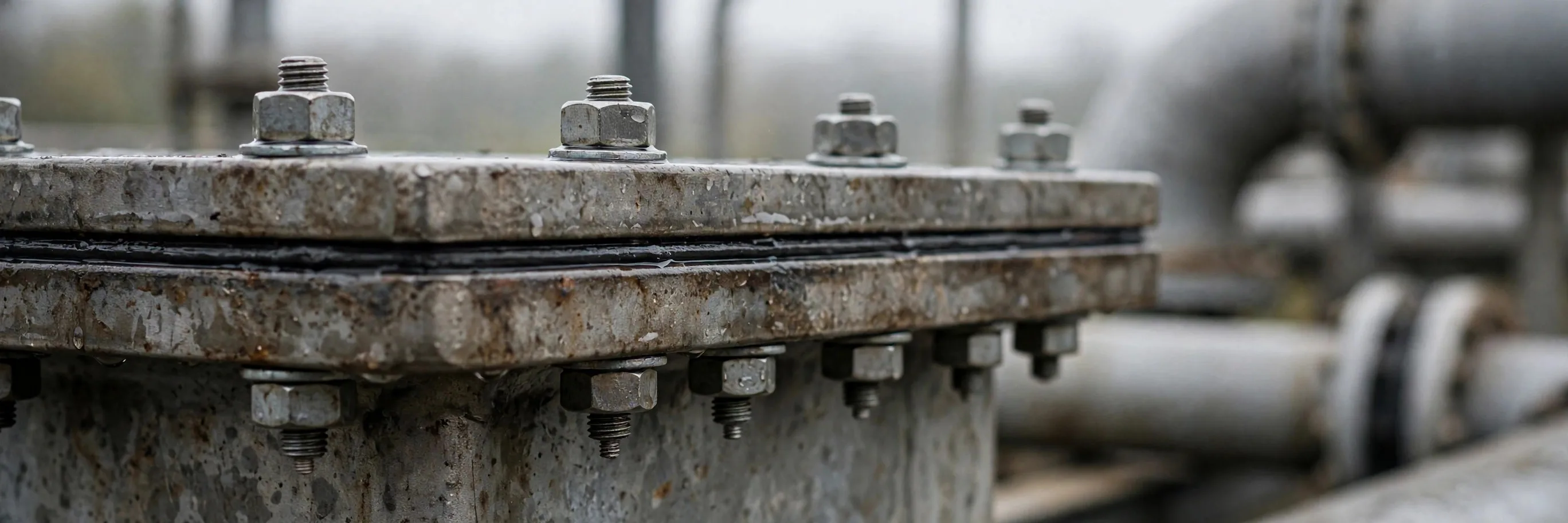
Wet abatement units are opened for nozzle cleaning, packing changes and deposit removal, and the service-cover bolts are handled each time. After a service, the first cover to check for leaks is the one whose bolts have sat in wet residue for months.
What reaches the bolts
A wet scrubber removes gaseous pollutants by absorbing them into a liquid, which is usually water, sometimes with reagents added, as the US EPA's wet scrubber monitoring page describes. The liquid reaching a cover may be condensate or scrubbing liquid, whose chemistry depends on the gases absorbed and any reagents added; gas or vapour can also reach the joint, depending on its position and seal condition.
The exposure differs by position. Covers on the inlet or quench section can see hot acid gas, vapour and condensate. Covers on the packed section and sump see splash of recirculated scrubbing liquid, which carries dissolved salts and particles. Outlet covers may see mostly entrained mist. A cover that drains dry between runs collects deposits, and a cover that stays wet has a permanently wet crevice under the nut.
Name the treated gases on the order (for example HCl, HF, Cl₂ and NF₃ by-products), any oxidizer or caustic added to the water, and the cover's position and temperature.
What liquid does at the joint
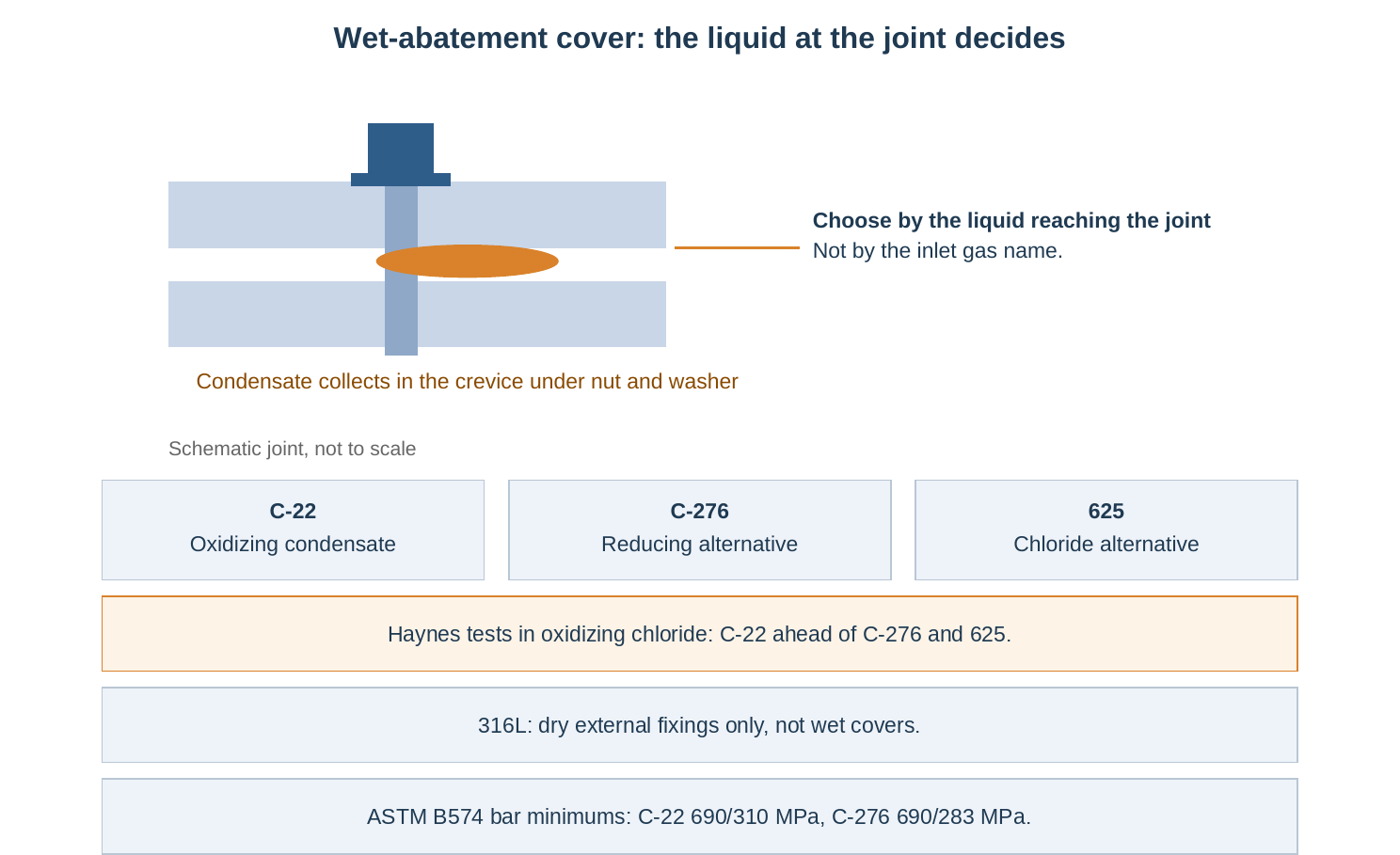
Condensate, mist and splash all end up where liquid can stay: under the nut, under the washer and in the thread. In that crevice the liquid goes stagnant, acid and chloride concentrate, and oxygen is used up, which is the setting for crevice corrosion. If the cover dries between runs, a salt deposit is left behind and re-wetted on the next run.
The result is rarely a broken bolt. More often the nut seizes, the bearing face under the nut corrodes so the preload is uneven, or the gasket face develops a leak path. Each service then makes it worse, because the deposit changes the friction and the torque no longer gives the intended preload.
Clean the seating face and threads at each service, and write the cleaning step into the same maintenance instruction as the tightening procedure.
Choosing the alloy
| Alloy | UNS and form | Use at the cover | Limit to check |
|---|---|---|---|
| Hastelloy C-22 | N06022, bar to ASTM B574 | Oxidizing condensate: chlorine, hypochlorite, mixed acids with oxidizers | 690 MPa tensile / 310 MPa yield minimum |
| Hastelloy C-276 | N10276, bar to ASTM B574 | Reducing acid condensate: HCl without oxidizers | 690 MPa tensile / 283 MPa yield minimum; less suited to strong oxidizers |
| Inconel 625 | N06625, bar to ASTM B446 | Milder chloride condensate; higher strength needed | Lower localized corrosion resistance than C-22 and C-276 |
| 316L | S31603, ISO 3506-1 A4-70 or A4-80 | Dry external fixings only | Pitting and cracking in acidic chloride condensate |
Hastelloy C-22 and C-276 are both nickel-chromium-molybdenum alloys with tungsten. Haynes International gives C-276 a nominal 16% chromium and 16% molybdenum, while C-22 carries about 22% chromium and 13% molybdenum. The extra chromium makes C-22 the better choice in oxidizing conditions, and in Haynes' comparisons of pitting and crevice resistance in oxidizing chloride solutions, C-22 ranks above both C-276 and 625. These are ranking tests, not design limits for a particular scrubber liquid.
Fluoride is worth checking separately. Where the abatement unit treats fluorine compounds, dilute HF is present in the condensate, and it should be named on the order so the grade is checked against it. Titanium, which is often used in chlorinated water, is attacked by fluoride and is not a candidate here.
If a higher-strength alternative is needed, Inconel 625 in ASTM B446 Grade 1 bar has 827 MPa tensile and 414 MPa yield up to 102 mm, but it gives up localized corrosion resistance. Where the bolt size is fixed by the cover design, check the preload and torque against the chosen alloy's yield before changing grade.
Tightening and the set at each service
Tighten cover bolts in a cross pattern in two or three passes to the written torque, with the threads and bearing faces clean. Nickel alloys gall readily if assembled dry; use an anti-seize compatible with the process. Our note on galling in nickel alloy fasteners covers prevention.
Use nuts of the same alloy, such as C-22 heavy hex nuts, and washers that won't create a galvanic couple with the cover. Keep each cover's set together through service, so a C-276 bolt is not mixed with a C-22 nut or a 316L washer from the spares box.
At each service, record by cover:
- deposit or corrosion under nuts and washers
- thread damage or galling
- leaks at the gasket face
Requesting a quote
List the covers by unit and position, for example: "M10 × 30 C-22 hex bolts with nuts and washers, 12 per cover, quench-section service covers on four abatement units treating HCl and Cl₂, condensate at about 60°C, covers stay wet; opened monthly."
With that list we check grade, dimensions and inspection requirements cover by cover, then quote C-22 hex bolts or C-276 hex bolts with matching nuts. Covers on chemical cabinets and other wet-process auxiliaries are covered in our guide to C-22 wet process cover bolts, and further tool bolting on the semiconductor manufacturing equipment page.