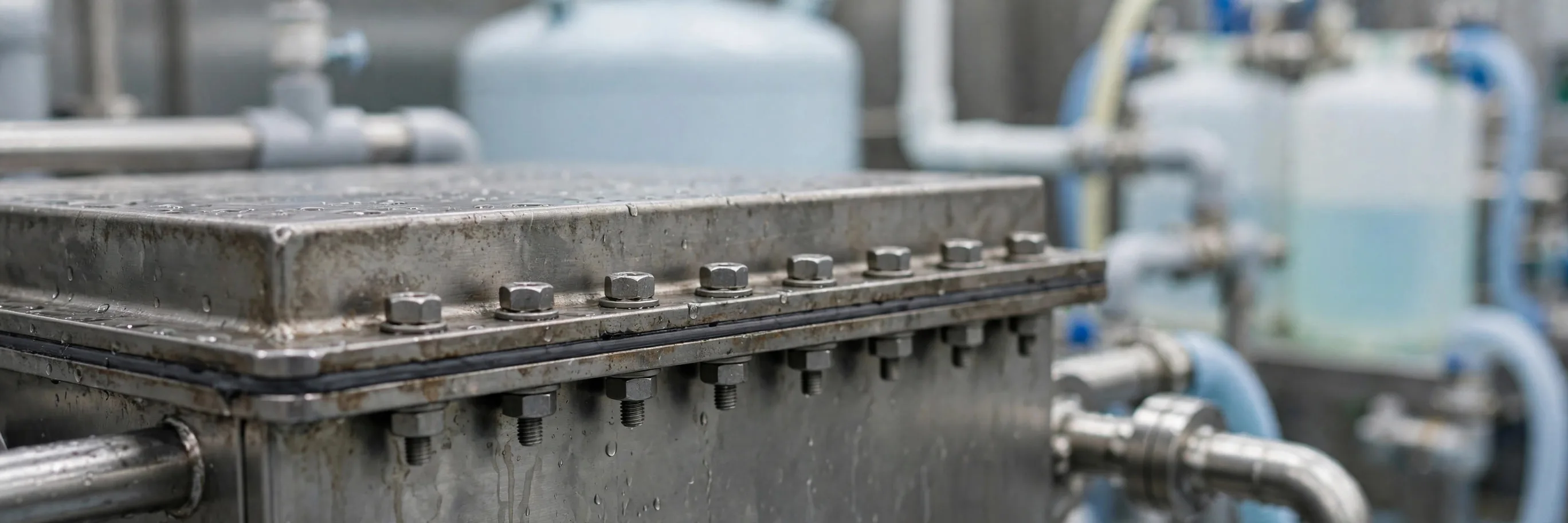
On wet-process auxiliaries, a cover bolt can look sound from the head while its first engaged thread is being eaten away, because that is where splashed liquid lingers after the rinse.
The chemical sequence
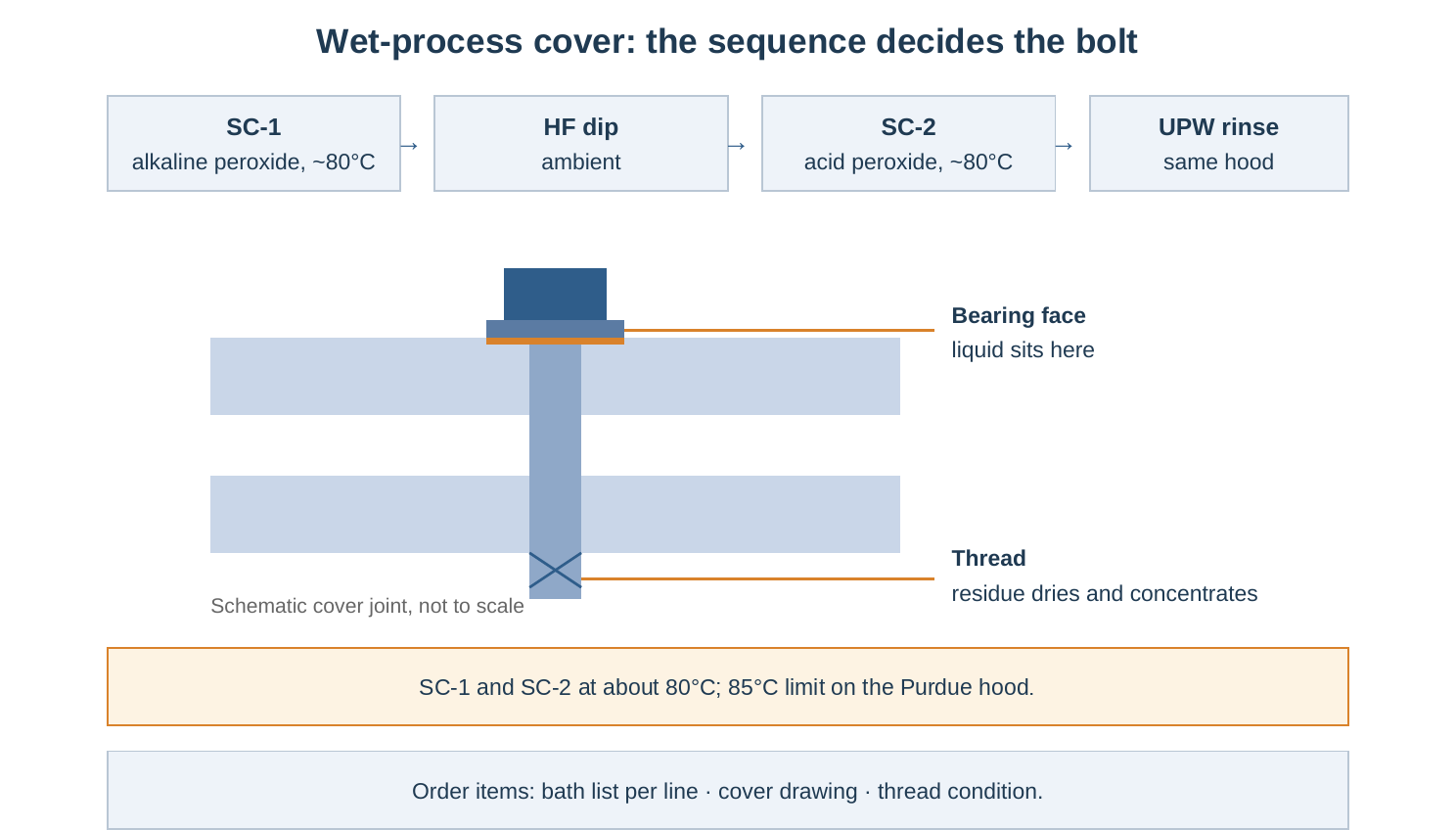
The classic front-end clean is a good example of what cover bolts see. Purdue University's RCA cleaning procedure uses:
- SC-1: ammonium hydroxide and hydrogen peroxide in ultrapure water, at about 80°C, for particles and organics
- HF dip: dilute hydrofluoric acid, at room temperature, to remove oxide
- SC-2: hydrochloric acid and hydrogen peroxide in ultrapure water, at about 80°C, for metal contamination
The SC-1 and SC-2 baths on that hood are limited to 85°C. So in one shift a cover bolt can see an alkaline oxidizer, a fluoride acid and a chloride acid with oxidizer, each at its own temperature. Other lines add sulfuric acid and peroxide mixtures, phosphoric acid etches or solvent steps.
Take the concentrations, temperatures and any condensate chemistry from the line data rather than from memory of the recipe.
Threads and bearing faces
The thread is where the damage happens. Capillary action holds splashed liquid in the thread long after the surface looks dry. As it dries, the liquid concentrates at the thread root, which is also where the stress is highest.
The bearing face is the second spot. Liquid under the head or nut dries into a deposit. The next time the bolt is tightened onto that deposit, the friction changes and the preload is no longer what the torque value assumed. The cover may then seal unevenly.
Mark on the cover drawing:
- whether the thread is immersed, splashed or in vapour only
- whether splash reaches the bearing face
- how often the cover is opened: every shift, weekly or once a quarter
Opening frequency does not establish whether the threads are rinsed. State the actual rinse and drying step, including any residue left between openings.
Choosing the alloy
| Alloy | UNS and form | Use on wet-process covers | Limit to check |
|---|---|---|---|
| Hastelloy C-22 | N06022, bar to ASTM B574 | Mixed acid and chloride splash, such as SC-2 and HF | Check HF and SC-1 exposure against data; 310 MPa minimum yield |
| Hastelloy C-276 | N10276, bar to ASTM B574 | Reducing acid duty without strong oxidizers | Peroxide and other oxidizers; 283 MPa minimum yield |
| Inconel 625 | N06625, bar to ASTM B446 | Milder chloride duty where higher strength is needed | Lower localized corrosion resistance |
| 316L | S31603, ISO 3506-1 A4-70 or A4-80 | Dry external parts of the cabinet | Chloride residue in threads; HF |
Hastelloy C-22 has a nominal composition of about 56% nickel, 22% chromium, 13% molybdenum, 3% iron and 3% tungsten. In Haynes' pitting and crevice comparisons it ranks above C-276 and 625. Those are laboratory ranking tests, not limits for a particular bath.
Strength is moderate. ASTM B574 bar of C-22 has a minimum of 690 MPa tensile and 310 MPa yield. Most cover joints carry light loads, but check the torque if C-22 is replacing a stronger bolt of the same size.
Assembly, rinsing and inspection
Use C-22 nuts and washers with C-22 bolts, such as C-22 heavy hex nuts, so every part in the residue has the same resistance. C-22 threads gall easily; assemble clean, use a thread lubricant only if the process allows one, and tighten in a cross pattern to the written torque. Our note on galling in nickel alloy fasteners covers prevention.
Rinse and dry covers before they are refitted, and clean the bearing faces. At each opening, record by cover:
- residue or discoloration in the threads and under heads
- pitting at the first engaged thread
- galled or seized threads
Requesting a quote
List the covers by tool and chemical sequence, for example: "M8 × 25 C-22 hex bolts with nuts and washers, 40 pieces, chemical cabinet access panels and drain box covers on an RCA clean line; SC-2 and HF splash, SC-1 vapour; splash does not return to any bath; covers opened weekly."
We check the grade against that sequence, confirm dimensions and inspection, and quote C-22 hex bolts with matching nuts. Scrubber and abatement covers are covered in our guide to C-22 and C-276 wet abatement fasteners, and more tool bolting on the semiconductor manufacturing equipment page.