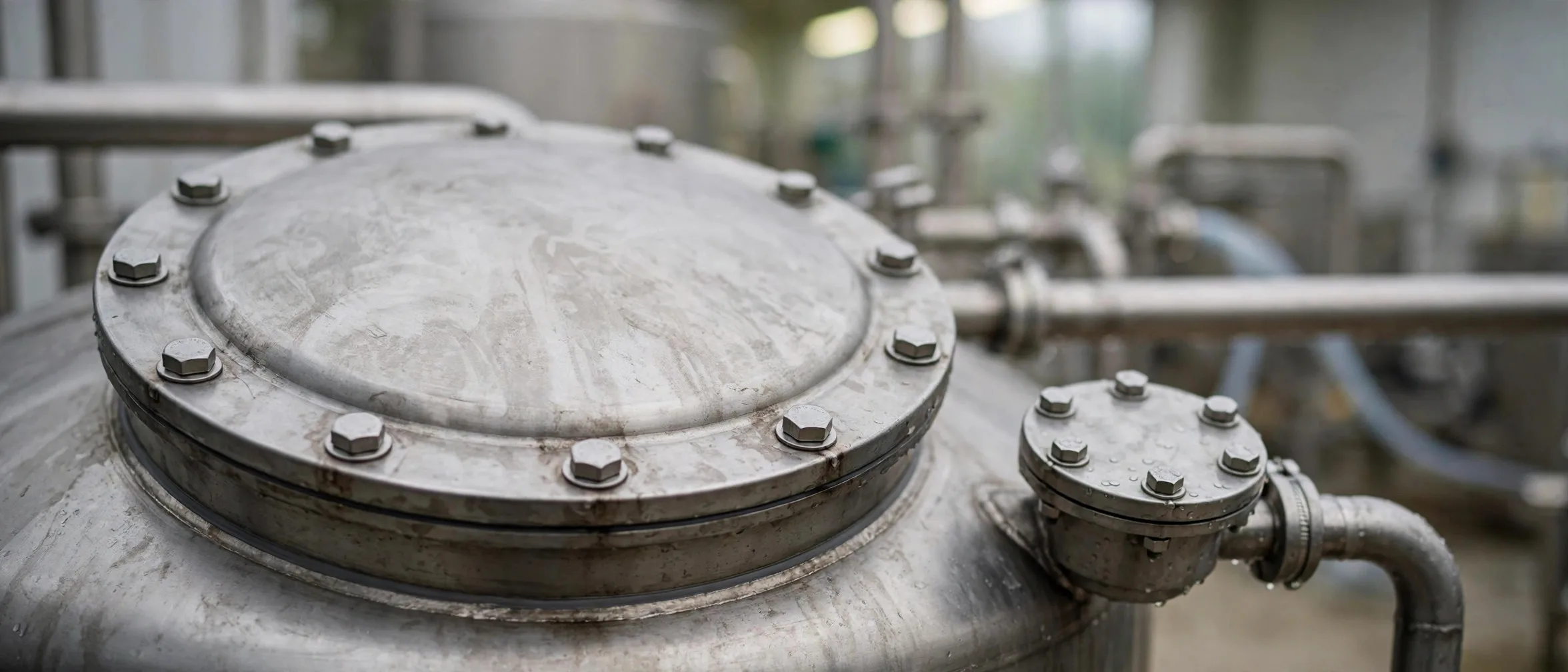
Tank and pump-cover fasteners are judged at the hygiene audit, long before any of them comes near its load limit. The trouble-makers are the bolt with a pocket under its head and the loose nut an operator drops into the product.
Covers that are opened often
Pump covers and manways on hygienic equipment may be opened every shift or every day. Loose nuts and washers are a foreign-body risk every time.
- Swing bolts on manways and covers stay attached to the equipment when opened. Our eye-end and swing bolts can be made in 316L or duplex to the hinge and cover drawing.
- Captive bolts or retained nuts keep parts with the cover.
- Wing nuts or hand knobs speed up opening, but they need a design that can be cleaned and doesn't trap product under the wings.
Repeated opening also wears threads, and a dry 316L thread spun on fast by an operator can seize halfway. A food-grade lubricant helps; so does replacing a bolt with damaged threads instead of forcing it. Our note on galling explains the mechanism.
Pressure and vacuum covers also need a joint calculation for bolt size and class; the cleaning and opening details do not replace that check.
Contact zones on tanks and pump covers
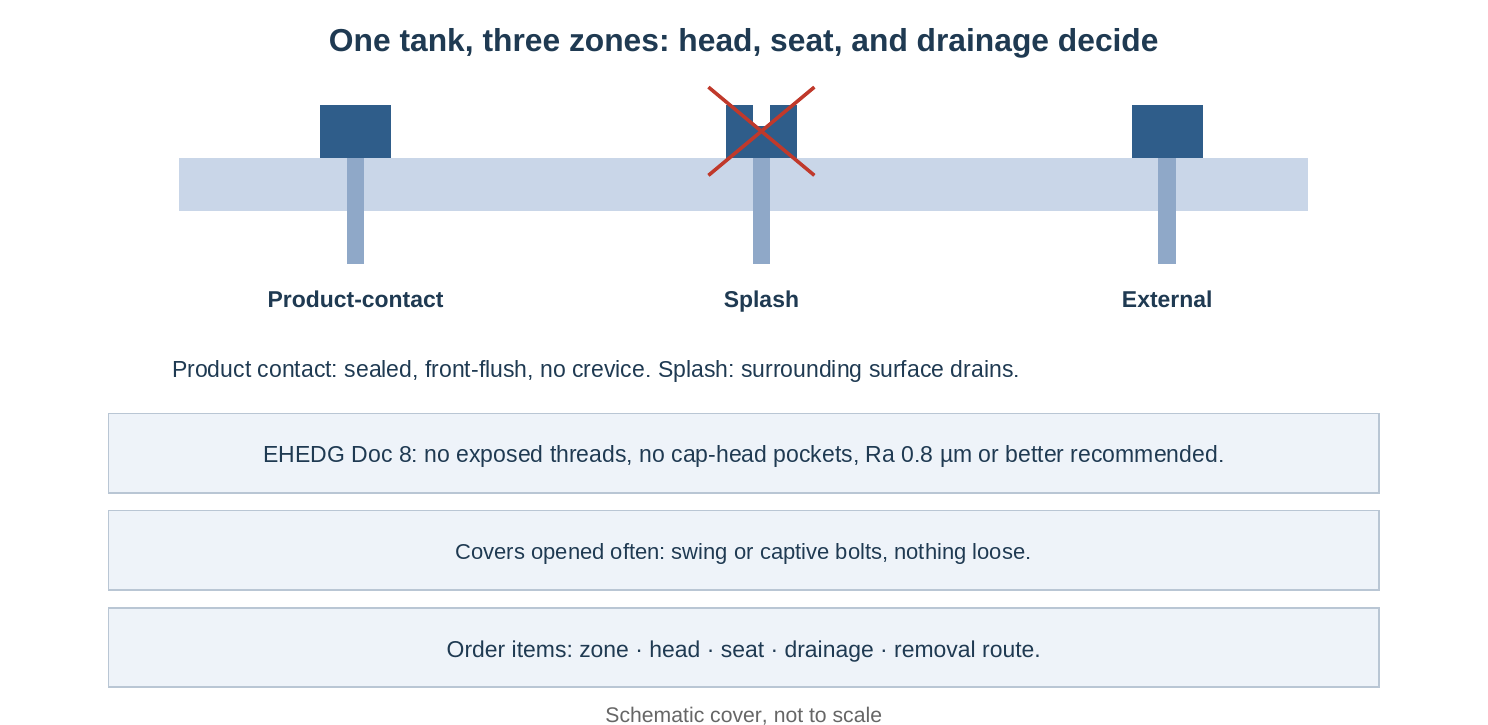
Start by marking each fastener's zone. On a mixing tank, the bolts holding an agitator mount inside the vessel are product-contact. Manway clamp bolts on the top dish may be in a splash zone, depending on the arrangement. The leg and platform bolts are external. On a hygienic centrifugal pump, the cover fasteners may be outside the product, but the cover is removed for inspection and the nuts are handled every time.
For each zone, state the product type, because it changes the duty:
- acidic products such as juices, sauces and dressings
- salty products and brines
- fatty and sugary products, which leave soil that is hard to clean
- neutral products such as water or raw milk
Then state how the equipment is cleaned: closed CIP, wash-down, or opened for manual cleaning, and how often.
Sealing, seats and drainage
EHEDG Document 8 sets out the principles most food-equipment buyers check against:
- no exposed screw threads, metal-to-metal fastener joints or pockets such as those in cap-head screws
- static seals front-flush in the installed condition, so no crevice is left for soil
- horizontal surfaces avoided, or sloped at least 3° so they drain
- stainless surfaces at Ra 0.8 µm or better, by polishing or machining, with higher values accepted where justified
- fasteners that could loosen and fall into product designed out
For fasteners, that turns into specific choices. In product-contact zones, use sealed fasteners, where a seal under the head fills the gap and sits flush with the surface, or avoid fasteners there entirely. In splash zones, use hex heads, keep the thread past the nut short and cover it with a cap nut, and mount where the surrounding surface drains, with the bearing face square to the bolt. A hex head or cap nut cleans well but is not a hygienic seal; that needs a sealed fastener. In external zones, ordinary hex bolts are fine, provided they can be washed and don't hold water.
Choosing the material
| Candidate | UNS and form | Where it fits | Limit to check |
|---|---|---|---|
| 316L | S31603, ISO 3506-1 A4-70 or A4-80 | Most tank and pump-cover fasteners; most food acids; caustic and acid CIP | Salted or brine product left in crevices; hot chloride washes |
| Duplex 2205 | S32205, bar to ASTM A479 | Brines and salted products, especially acidic ones; chlorinated washes | Match to equipment material; cost |
| Super duplex 2507 | S32750, bar to ASTM A479 | Strong brines or high-chloride duty | Cost; usually only for specific positions |
316L works for most food tanks and pumps. Salted product dried in a crevice under a washer is what pits it. Duplex 2205 holds up far better there, and on brine and pickle tanks it is the safer default.
Requesting a quote
List the fasteners by equipment and zone, for example: "M16 2205 swing bolts with hand knobs, 8 per manway, three brine tanks, splash zone; M10 316L sealed hex bolts, product-contact zone, agitator mount; CIP with 2% caustic at 80°C and nitric acid weekly."
Swing bolts, sealed fasteners and plain hex bolts are all quoted to your drawings once the grade and dimensions have been checked. Frame and CIP-system bolting have their own guides, on washdown frame bolts and CIP fasteners, and the wider picture is on our food and beverage equipment page.