Food-plant auditors look at fasteners early, because a bolt head is where soil collects and a cleaning crew can't easily reach.
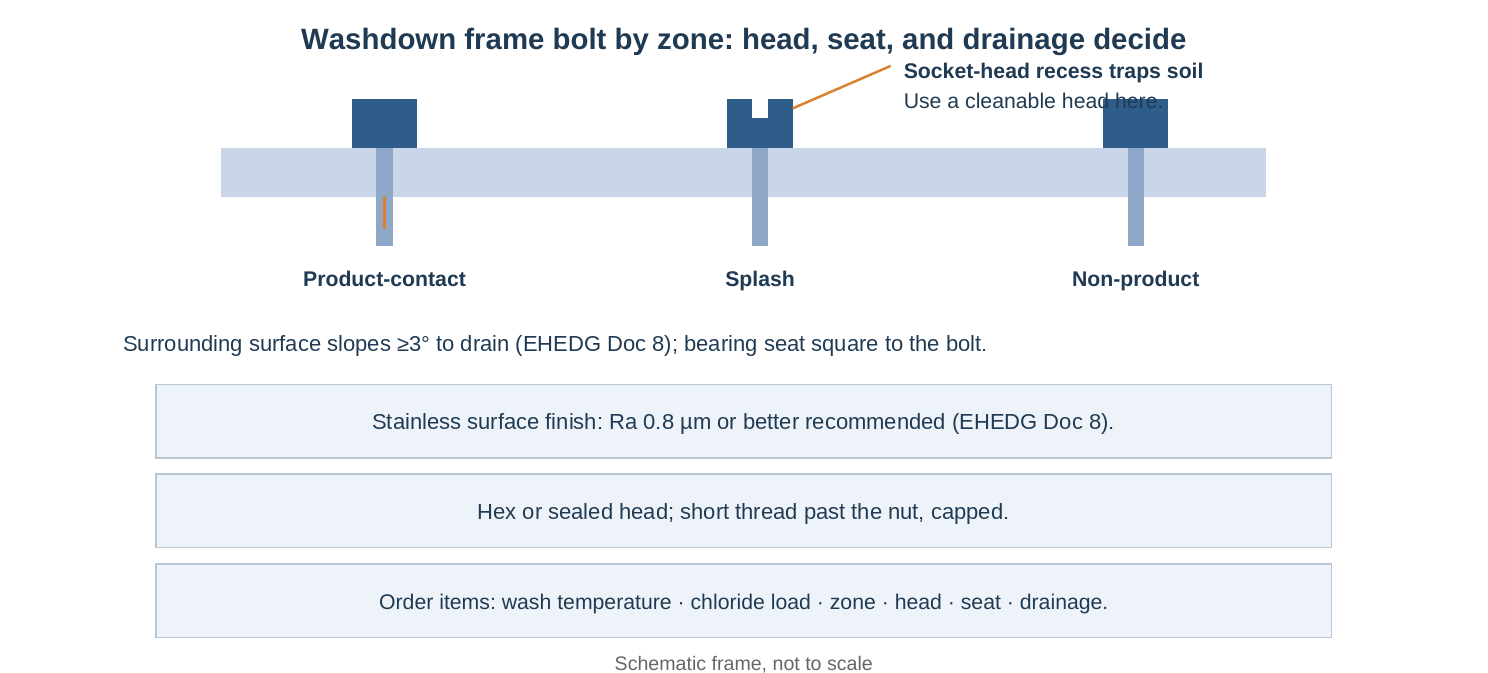
Hygiene zones decide the head
Mark each bolt's zone on the frame drawing before choosing heads: product-contact, splash or non-product.
EHEDG Document 8, Hygienic Design Principles, asks designers to eliminate exposed screw threads, metal-to-metal joints of fasteners, and pockets such as those in cap-head screws. In practice:
- A socket-head cap screw has a recess that fills with soil and wash water. In splash zones, a hex head cleans far better. A plain hex head or cap nut is not a hygienic seal by itself, though; where product can reach the fastener, use a sealed hygienic fastener.
- Thread showing past the nut is hard to clean. Keep the protrusion short (at least one full thread past the nut, so the nut is fully engaged) and cover it with a dome or cap nut in product and splash zones.
- In product-contact zones, a sealed fastener (a hygienic bolt with an integrated seal or a sealing washer) keeps soil out of the gap between head and surface.
State the head type for each zone, and whether it needs to be sealed or capped.
Drainage and seats
A bolt that stands in water corrodes and collects soil. EHEDG Doc 8 says horizontal surfaces should be avoided, and where they can't be, they should slope to one side at a minimum of 3°. Liquid on the outside of equipment should run away from the product area.
For bolting, that comes down to three details:
- Seat. A flat washer on a horizontal rail holds a ring of water. Mounting the bolt on a vertical face, or on a raised boss whose bearing face stays square to the bolt, keeps it out of standing water. Slope the surrounding surface to drain, not the face the head or nut bears on; a tilted bearing face bends the bolt unless it is compensated in the design.
- Gaps. Supports and brackets should be sealed or designed so there are no pockets where water and soil stay.
- Finish. For product-contact surfaces, EHEDG recommends Ra 0.8 µm or better, by mechanical polishing or machining, with higher values accepted where justified. Splash and non-product fasteners don't normally need polishing; if the frame drawing specifies a finish for fasteners, state it on the order.
Choosing the material
| Candidate | UNS and form | Where it fits a washdown frame | Limit to check |
|---|---|---|---|
| 316L | S31603, ISO 3506-1 A4-70 or A4-80 | Most splash and non-product positions; cool or warm washes | Pitting and cracking in hot chloride washes |
| Duplex 2205 | S32205, bar to ASTM A479 | Hot washes with chloride or chlorinated sanitizer; higher loads | Cost; check compatibility with frame material |
| Super duplex 2507 | S32750, bar to ASTM A479 | Brine, salted product or high-chloride washes | Cost; usually only for specific positions |
316L is the usual choice because it matches most stainless frames and resists caustic and acid CIP chemicals at normal cleaning conditions. Its weak points are chloride and heat together. Brine, salted product, chlorinated sanitizers and hot washes can pit 316L under deposits, and 316L is susceptible to chloride stress corrosion cracking as the temperature climbs past roughly 60°C, and at lower temperatures where wash water dries and concentrates on the bolt.
Duplex 2205 is the step up. It resists pitting and chloride cracking better, and in ASTM A479 bar it has a minimum of 655 MPa tensile and 450 MPa yield, in line with an A4-70 stainless bolt (450 MPa proof) and below an A4-80 (600 MPa). The reason to change is corrosion, not strength. For brine or very salty products, super duplex 2507 is the next option.
Galvanic effects are rarely a problem between stainless grades. A stainless bolt in an aluminium frame is different: the aluminium corrodes around the hole. If the frame or a bracket is aluminium, say so.
Tightening and inspection
Tighten frame joints to a written torque, in a cross pattern on multi-bolt plates, with a food-grade anti-seize on the threads. Without it, 316L nuts on 316L bolts can seize on the first tightening.
During hygiene inspections, check by position:
- soil or biofilm under washers and around heads
- standing water at seats
- rust staining or pitting on heads and exposed threads
- bolts that had to be cut to remove
Repeated soil at the same position usually means a head or seat problem, not a material one.
Requesting a quote
List bolts by zone, for example: "M12 × 40 316L hex bolts with sealing washers, product-contact zone, 24 pieces; M12 × 50 316L hex bolts with cap nuts, splash zone, 60 pieces; caustic wash at 70°C, nitric acid wash weekly, chlorinated sanitizer."
Send the frame drawing with the list and we will quote hex bolts in 316L, or 2205 hex bolts where the wash calls for them, after checking grade, dimensions and inspection requirements. Tank, pump and CIP fasteners are on our food and beverage equipment page.