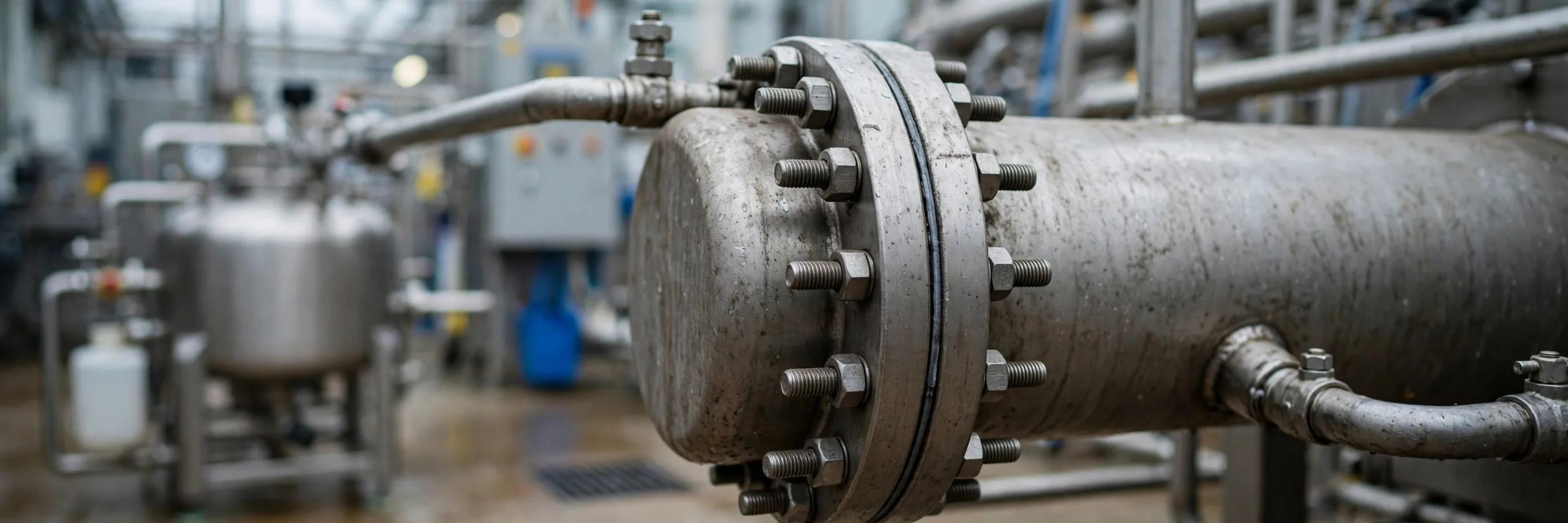
On a CIP skid, look for corroded fasteners in three places: below the dosing points, around the heater and on joints that never dry. Elsewhere, standard 316L can last as long as the skid.
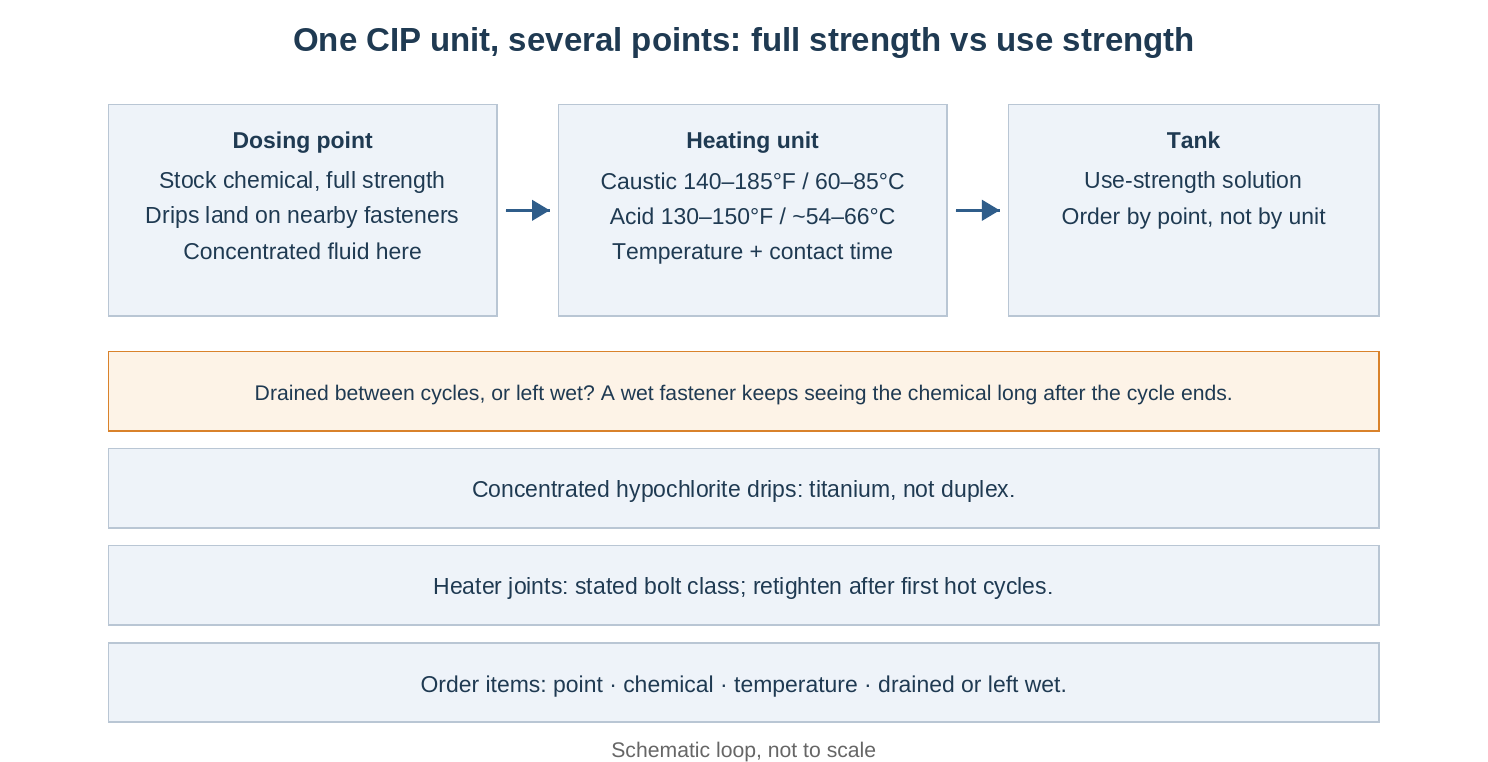
Full strength at the dosing point, use strength in the loop
A typical CIP cycle runs a pre-rinse, an alkaline wash, an intermediate rinse, an acid wash and a final rinse, often followed by a sanitizer. A guide to CIP chemicals from CSI gives sodium hydroxide at 0.5–2.0%, up to 4% for heavy soil, with the caustic stage at 140–185°F (60–85°C), and nitric acid at about 0.5%, at 130–150°F (about 54–66°C). Sanitizers such as hypochlorite, chlorine dioxide or peracetic acid are usually used at ambient temperature.
Those are use-strength concentrations in the circulating loop; the concentration, temperature and rinse state at any one fastener depend on the stage of the cycle and the plant's own procedure. At the dosing point, the chemical arrives from a day tank or drum at full strength, often 25–50% caustic or concentrated acid. A leaking dosing-pump head, injection quill or flange puts that concentrate onto nearby fasteners.
On the order, give for every point:
- the chemical and its concentration at that point
- whether the fastener is wetted in normal operation, or only by drips and leaks
- the temperature at that point
Heat, contact time and wet residue
The heater, usually a plate or shell-and-tube unit with steam or hot water on the other side, runs at the highest temperature in the loop and sees every hot stage. Its fasteners have two problems. Chemical attack is faster at temperature, and the joint cycles between hot and ambient several times a day.
Thermal cycling loosens joints as the gasket and bearing faces settle. Order stainless heater bolts in a stated property class, such as ISO 3506-1 A4-80 (600 MPa proof), check the joints again after the first hot cycles, and consider disc spring washers where a joint keeps losing preload.
Contact time is the other factor. A fastener drained and rinsed after every cycle sees chemical for minutes. One that stays wet, in a low spot, under a drip or inside a cabinet, sees it for hours or days, and as the residue dries, chloride and chemical concentrate. State for each point whether it drains.
Choosing the material by point
| Candidate | UNS and form | Where it fits a CIP unit | Limit to check |
|---|---|---|---|
| 316L | S31603, ISO 3506-1 A4-70 or A4-80 | Tanks, return lines, most pump and heater joints | Chlorinated residue that stays wet |
| Duplex 2205 | S32205, bar to ASTM A479 | Joints wetted by dilute in-loop sanitizer or chlorinated detergent | Concentrated hypochlorite |
| Titanium Grade 2 | R50400, bar to ASTM B348 | Fasteners near hypochlorite dosing points | Lower strength; galling; not for fluoride-bearing chemicals |
316L is the baseline. Caustic and nitric acid at normal CIP strengths cause it little trouble, and it matches the stainless equipment. Chlorine is the weak point: chlorinated chemicals can pit 316L, and chloride cracking becomes a real risk above about 60°C, or lower where residue dries and concentrates, according to the Alleima SAF 2205 datasheet.
Duplex 2205 handles dilute chlorinated residue much better than 316L. It is not a fix for concentrated hypochlorite, which attacks duplex and super duplex too. Around hypochlorite dosing equipment, titanium Grade 2 is the metal that holds up; it is weaker than stainless, so check the joint load. Nickel alloys such as 625 are seldom justified on CIP equipment.
Tightening, lubrication and inspection
Tighten heater and pump joints in a cross pattern in several passes to the procedure torque. Stainless and titanium threads can seize if assembled dry; use a lubricant compatible with the cleaning chemicals and any food-contact requirements.
At each inspection, check by point:
- pitting or rust staining on bolt heads and nuts below dosing points
- white or crystalline residue on threads
- weeping heater joints and bolts that turn easily
If the corrosion is only below one leaking dosing quill, fix the leak first.
Requesting a quote
List fasteners by point, for example: "M12 × 50 titanium Grade 2 hex bolts and nuts, 16 pieces, hypochlorite dosing pump and injection flanges, 12% stock solution drips; M16 × 90 316L studs, A4-80, with disc springs, 24 pieces, CIP heater; caustic at 2%, 80°C."
Point by point, we check the grade, dimensions and inspection plan and quote titanium Grade 2 hex bolts, 2205 hex bolts or stainless studs to suit. Related guides cover food tank and pump cover fasteners and washdown frame bolts; the food and beverage equipment page has the rest.