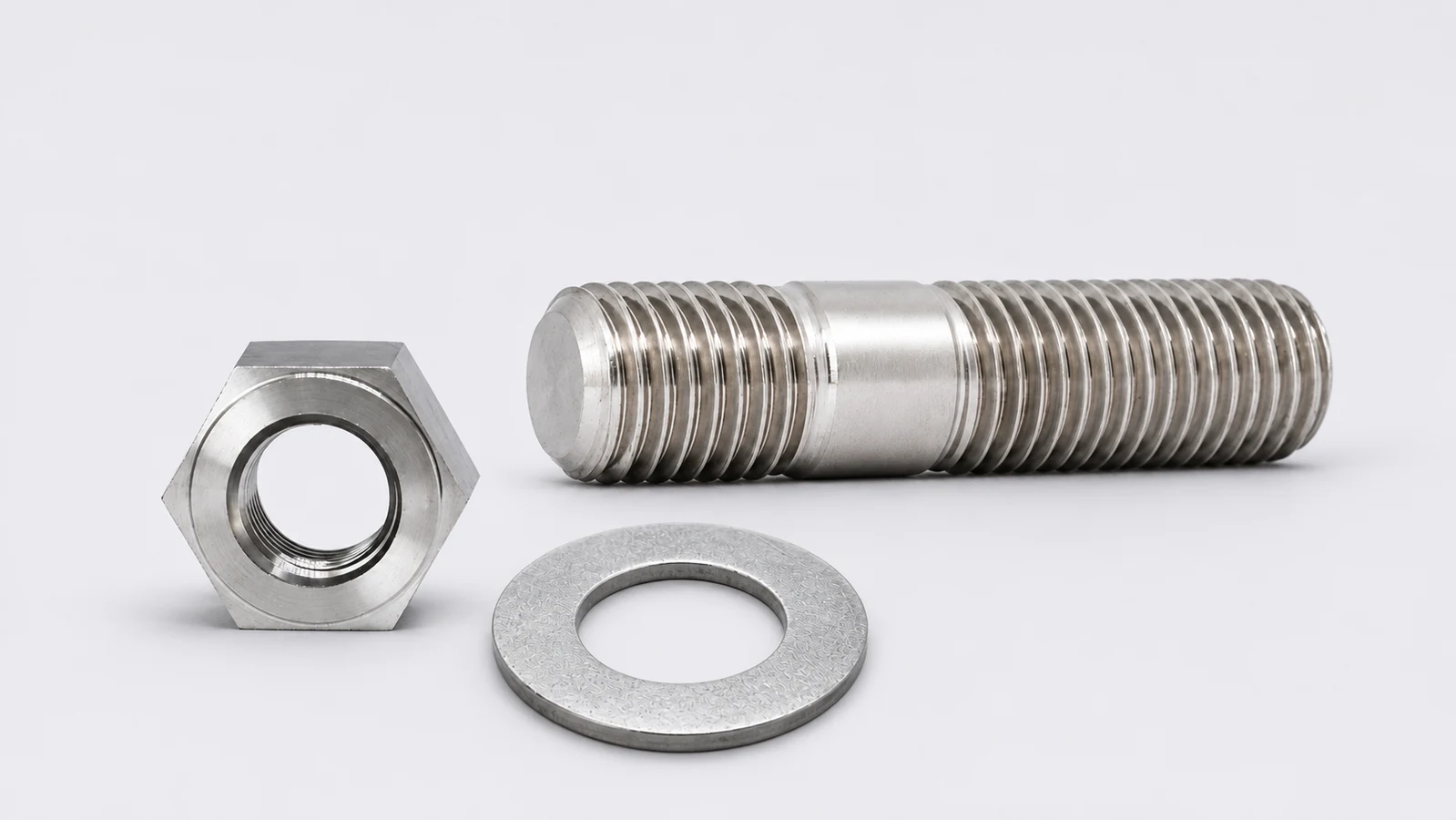
A lot of our exhaust stud enquiries start with a link. It is usually a 300-series stainless accessory stud kit, something like four M10 × 1.25 studs with 12-point flange nuts, and the question is either "Can you make this in A286?" or "What material would you use here?" Once we see what the studs go on (header flanges, turbo manifolds, downpipe flanges), our answer is almost always A286 exhaust studs. Below is why, compared with titanium, 300-series stainless and 17-4 PH, and what to send us for a quote.
What Goes Wrong on a Hot Exhaust Joint
If you build or sell exhaust parts, you have heard these from customers:
- The manifold starts ticking after a few weeks. The studs have lost clamp load and the gasket is leaking.
- The nuts need re-torquing after a few heat cycles. The studs are relaxing or stretching at temperature.
- A stud snaps, or a nut galls on removal. The stud yielded at some point, or the thread seized under heat and scale.
Behind all three are the same few things. Every drive is a full heat cycle: cold start, full load, heat soak, cool-down. The stud, the flange and the head grow at different rates as they heat. A stud held under stretch at temperature slowly creeps, so clamp load drifts down even if nothing visibly breaks. And hot threads gall.
None of this shows up in the tensile rating printed on the package.
"But the Stainless Kit Is Rated Higher"
That is a fair point. Popular stainless stud kits carry a room-temperature tensile rating above the specification minimum for A286, and on paper titanium and 17-4 PH look strong too:
| Material | Specification and condition | Min. tensile, ksi (MPa) | Min. yield, ksi (MPa) |
|---|---|---|---|
| A286 (UNS S66286) | ASTM A453 Grade 660, Class D, 2-1/2 in and under | 130 (896) | 105 (724) |
| Ti-6Al-4V (Grade 5) | ASTM B348, annealed bar | 130 (895) | 120 (828) |
| 17-4 PH (UNS S17400) | ASTM A1082 Type 630, H1150 | 135 (930) | 105 (725) |
| 304 stainless | ASTM F593 Group 1, cold worked (CW1), 1/4–5/8 in | 100 (690) | 65 (450) |
Specification minimums at room temperature. Ti-6Al-4V is shown at the bar specification it is made from. Branded 300-series kits are cold worked well beyond the F593 minimum shown here.
Every number in that table is measured at room temperature. A stud on a turbo manifold spends its working life hot. What decides the joint is how much strength the stud keeps when it is hot, whether it keeps it through hundreds of heat cycles, and whether it grows with the flange.
Titanium Exhaust Studs: Light, but Out of Their Range
- Heat. Producers typically rate Ti-6Al-4V for service up to about 400°C (750°F). Many header flanges, and most turbo manifold flanges, run hotter.
- Oxidation. Above that, titanium picks up oxygen and the surface turns hard and brittle. Threads that were fine on the bench crack or seize.
- Growth mismatch. Ti-6Al-4V expands at roughly half the rate of a stainless flange (about 8.6–9.5 versus about 17 µm/m·°C). As the joint heats, the flange stretches the stud past the preload you set. If the stud yields, the joint comes back loose when it cools. That repeats every drive.
- Galling. Titanium threads gall easily.
The weight saving is small: a full set of header studs weighs a few hundred grams at most. Titanium makes sense on cooler joints. On the hot side it trades a few grams for a joint that will not stay tight.
300-Series Stainless Studs: Fine Until the Heat Goes Up
304 and 316 cannot be hardened by heat treatment. Their strength comes from cold work, and that is where the high rating on a stainless kit comes from.
- Relaxation. Held under stretch at exhaust temperatures, cold-worked stainless studs creep. Clamp load drifts down over repeated heat cycles, which is where the re-torquing and the returning tick come from.
- Expansion. Stainless studs grow at the same rate as a stainless flange, which helps. It does not help if the stud cannot hold the load when hot.
- Galling. Stainless threads gall; the kits themselves call for anti-seize.
On a mild, naturally aspirated street header, 300-series studs often do the job. On turbo manifolds, diesel exhausts and engines that see sustained high load, they are usually the first thing to need attention.
Why We Ruled Out 17-4 PH
17-4 PH was the first alternative we looked at. It is precipitation hardened, strong at room temperature and costs less than A286.
The problem is heat. Producers rate its properties up to about 316°C (600°F). Held hotter for long periods, it loses toughness, so a stud that should stretch tends to crack instead. It also expands less than a stainless flange (about 10.8–11.2 µm/m·°C), which brings back the titanium mismatch problem.
17-4 PH is a good choice for the cool side of an exhaust system: hangers, brackets, mid-pipe clamps. It is not a manifold or turbo flange stud. For the full comparison, read A286 vs 17-4 PH.
Why A286 Fits Header and Turbo Flanges
A286 is an iron-nickel-chromium superalloy with about 25% nickel. Our A286 studs are made to ASTM A453 Grade 660: solution treated, then aged. Their strength comes from that heat treatment, which is designed to hold at temperature, not from cold work.
- Keeps its strength hot. A286 holds its strength in long-term service up to about 540°C (1,000°F), well past the point where titanium and 17-4 PH drop out. It is also an established exhaust-fastener alloy: Carpenter Technology lists it for automotive exhaust fasteners in the 1,000–1,300°F (537–700°C) range and notes it is often specified for diesel emissions hardware.
- Grows with a stainless flange. A286 expands at about 16.5 µm/m·°C (21–93°C), close to austenitic stainless. Stud and flange grow together, so preload stays steadier from cold start to full heat.
- Comes out at service time. A286 resists oxidation about as well as 310 stainless and corrosion about as well as 316, so the studs are not rusted or scaled solid when the manifold comes off.
- Non-magnetic, like 300-series stainless.
One thing stays the same as stainless: A286 nuts on A286 studs can gall on assembly. Use a nickel-based high-temperature anti-seize.
For strength figures at temperature, read A286 yield strength vs temperature. For grades, classes and the other forms we make, see A286 fasteners.
When to Go to Inconel 718
Inconel 718 covers the same temperature band with much higher strength: ASTM A1014 calls for 185 ksi (1275 MPa) minimum tensile and 150 ksi (1035 MPa) minimum yield. It is the step up for high-boost race builds, small studs carrying high clamp load, or flanges at the top of A286's range. See Inconel 718 fasteners and A286 vs 718.
Which Stud for Which Build
| Build | What the joint sees | Our pick |
|---|---|---|
| Naturally aspirated street header, mild use | Moderate heat | 300-series stainless is usually fine; A286 if the studs keep needing re-torque |
| Turbo manifold and turbo flange | High heat, large heat cycles | A286 |
| Diesel exhaust manifold | Long hours at temperature | A286; Inconel 718 for high-load joints |
| High-boost race build, hottest flanges | Top of A286's range, high clamp load | Inconel 718 |
| Hangers, brackets, mid-pipe clamps | Cool side of the system | 17-4 PH or stainless |
Exhaust Stud Materials at a Glance
| Material | Typical service range | Growth vs. stainless flange | What usually goes wrong hot |
|---|---|---|---|
| Ti-6Al-4V | Up to about 400°C (750°F) | About half | Stretched on heat-up, loose on cool-down; oxidizes; galls |
| 300-series, cold worked | No single figure; strength comes from cold work | Matched | Relaxes under sustained heat; galls |
| 17-4 PH | Up to about 316°C (600°F) | Lower | Loses toughness with long hot exposure |
| A286 | Long term to about 540°C (1,000°F); used for exhaust fasteners to 700°C (1,300°F) | Close | Galling on assembly without anti-seize |
| Inconel 718 | Same band as A286, higher strength | Lower | Cost |
Titanium and 17-4 PH ranges are taken from producer data sheets; see Sources.
What A286 Exhaust Studs Cost
A286 sounds like an aerospace price. For exhaust stud sets it is not. An A286 stud set from us usually costs less than the 300-series stainless kits sold under US brands.
The delivered price depends on quantity and on whether the order ships by air or by sea, so we quote each order on the terms you buy on: EXW, FOB Shanghai, CIF or DDP. Price also moves with nickel, stud size and nut style, which is why we quote rather than publish a list.
How to Order A286 Exhaust Stud Sets
The fastest route is the one most customers already take: send us the kit you use now (a link, a part number or the dimensions) and tell us what it goes on. We will confirm the details below and recommend the material.
- Stud size: diameter, overall length and the thread at each end (for example M8 × 1.25, M10 × 1.25, 3/8"-16 or 3/8"-24).
- Symmetric or not: the same thread length at both ends, or a different head-end and nut-end length to suit the head and flange thickness.
- Nose and drive: with or without a pilot nose on the nut end, and with or without a hex socket in the stud end for installing with an Allen key. If you want the socket, tell us the depth.
- Nut style: see below.
- Quantity: studs and nuts per set, and number of sets.
- Packing: loose by size, counted into sets (for example four studs and four nuts per pack), or packed under your own brand for resale.
You do not need to pick an ASTM class. Tell us the application and we set the A286 condition to suit (ASTM A453 Grade 660). Each order ships with an EN 10204 3.1 MTC; routine PMI by sampling, 100% PMI or third-party inspection on request. On request, lengths can be held to ±0.05 mm where the stud must sit at a set height.
Choosing the Nut: 12-Point Flange, Hex Flange or Hex
Pick the nut by wrench access and budget:
- 12-point flange nut. The best fit for header and turbo flanges. The compact 12-point drive takes a socket where primary tubes crowd the stud, and the flange spreads the load without a loose washer. The tooling makes it a larger batch: MOQ 500 pcs per size.
- Hex flange nut. The practical choice for smaller runs. Same built-in bearing face, standard hex wrenching, MOQ 50 pcs per size.
- Hex nut with washer. The lowest-cost set. It needs wrench clearance around the hex and a washer under each nut.
MOQ for studs is 100 pcs per size; nut MOQ as above. Lead time is 7–15 business days from stocked bar and 15–25 business days for hot-forged or special aged lots; expedite available.
Send us your current stud kit for an A286 quote → · Ask for a sample 3.1 MTC →
A286 Exhaust Studs – FAQ
| # | Question | Answer |
|---|---|---|
| 1 | Is A286 better than titanium for exhaust studs? | On hot flanges, yes. Titanium producers typically limit Ti-6Al-4V to about 400°C (750°F), and it expands about half as much as a stainless flange. Titanium makes sense on cooler joints where weight matters. |
| 2 | My stainless stud kit is rated higher than A286. Why switch? | That rating is measured at room temperature. On a turbo manifold, cold-worked stainless studs relax under heat and lose clamp load over repeated heat cycles. A286 is age hardened and holds its strength at those temperatures. |
| 3 | Do A286 studs need anti-seize? | Yes. A286 threads can gall on assembly like stainless. Use a nickel-based high-temperature anti-seize. |
| 4 | Can you make an A286 version of the stud kit I use now? | Yes. Send a link, part number or dimensions: overall length, thread at each end, symmetric or not, pilot nose and hex socket depth. We make the studs and nuts in A286 to match. |
| 5 | Can I get 12-point flange nuts in A286? | Yes, at MOQ 500 pcs per size because of the tooling. For smaller runs, hex flange nuts start at 50 pcs per size and give the same bearing face. |