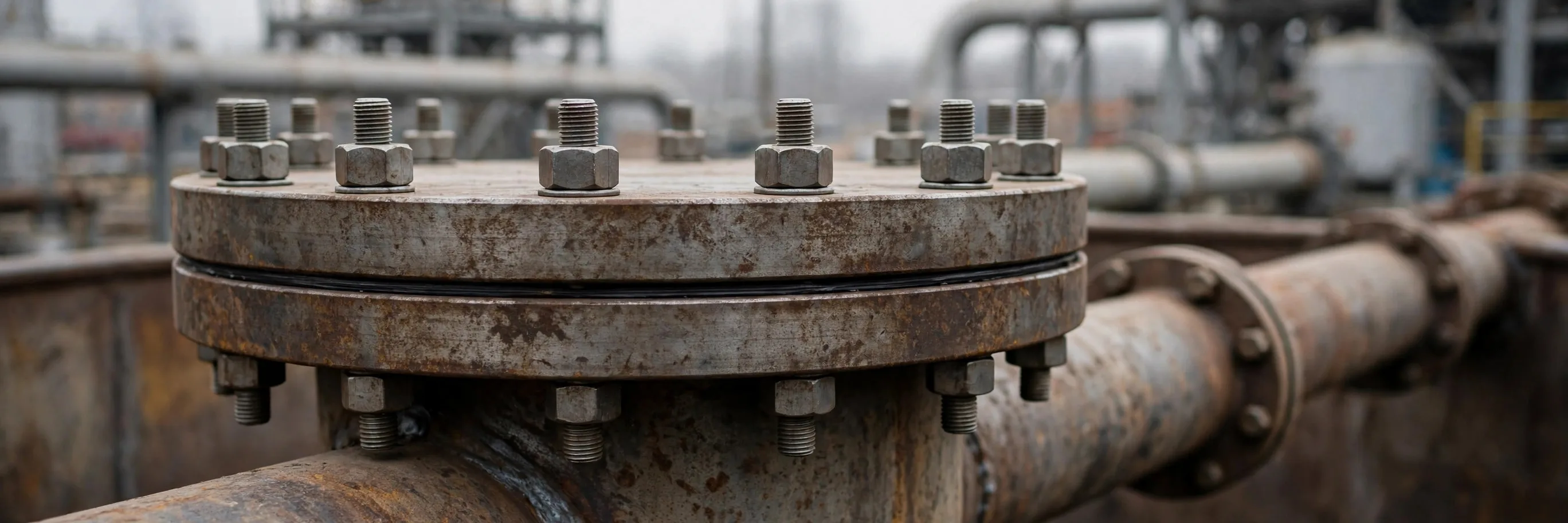
A leach vessel cover is bolted to a tank full of warm acid, and the studs sit just outside it. They are rarely immersed, yet they corrode faster than the shell, because the acid reaches them as condensate, mist and spills, and dries on the threads between washdowns.
See the related mining and mineral-processing applications.
Conditions by leach stage
Leach circuits vary. Atmospheric tank leaching of copper, nickel, zinc or uranium uses sulfuric acid at different strengths and temperatures, and the liquor picks up chloride from the ore, from saline process water, or from added reagents. Ferric iron and cupric copper in solution make the acid oxidizing; reducing conditions return where those ions are consumed. A stud that is fine in one stage can fail in the next.
For each vessel, state:
- the acid, its concentration and the pH range
- the operating temperature, and the temperature of the cover and vapour space
- chloride in the liquor, and its source
- dissolved oxidizing ions (ferric, cupric) and any oxidant added
- continuous or batch operation, and whether liquor stands in crevices between batches
How the acid reaches the cover studs
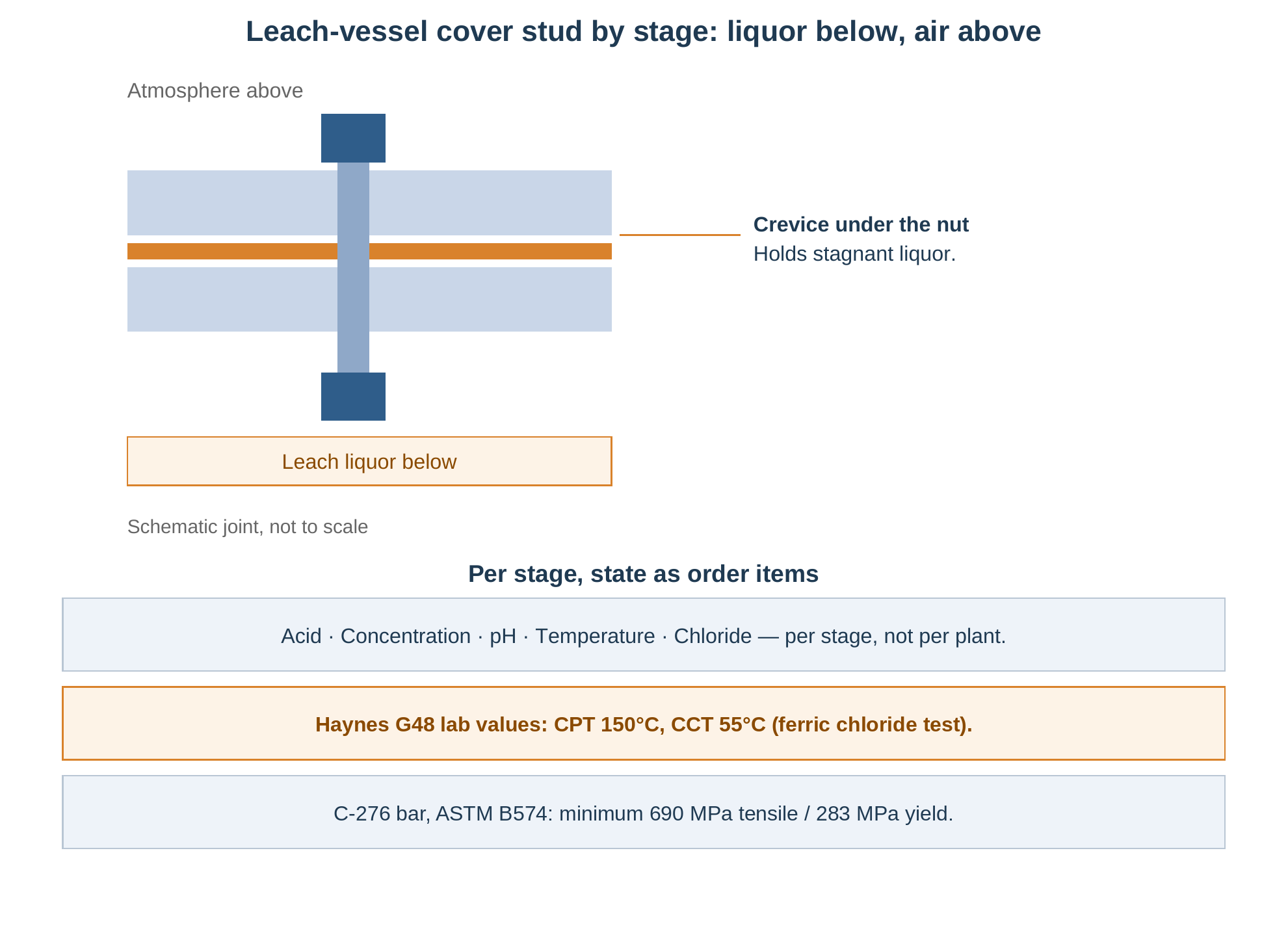
Warm acid liquor gives off mist and vapour that condense on the underside of the cover and run down to the flange. Agitator nozzles, sample ports and manways get splashed. Spills during sampling or maintenance dry on the nuts and leave concentrated acid salts in the threads, and those salts re-wet with every washdown or humid night.
The acid salts concentrate in the crevice under the nut. A cover can look clean while the thread under the nut has lost a millimetre of section. State whether the covers are washed down, with what, and how often the studs are inspected or replaced.
C-276, Alloy 20, 625 and duplex
Hastelloy C-276 is chosen for its tolerance of mixed conditions. Haynes International's alloy data gives a nominal 57% nickel, 16% chromium, 16% molybdenum and 4% tungsten, and ASTM G48 values of 150°C critical pitting temperature and 55°C critical crevice temperature in acidified ferric chloride. Those are laboratory rankings in one test solution, not service limits, but they show why C-276 is a common step up from stainless and duplex once chloride and hot acid meet.
| Candidate | UNS and specification | Where it fits a leach vessel cover | Limit to check |
|---|---|---|---|
| Hastelloy C-276 | N10276, ASTM B574 | Hot sulfuric acid with chloride and ferric or cupric ions | 283 MPa minimum yield; stud size |
| Alloy 20 | N08020, ASTM B473 | Sulfuric acid with little chloride | Pitting and crevice attack once chloride rises |
| Inconel 625 | N06625, ASTM B446 Grade 1 | Moderate acid with chloride, cooler stages | Less margin than C-276 in hot reducing acid |
| Duplex 2205 / super duplex 2507 | S32205 / S32750 | Sulfuric leach at pH 1–2 with low chloride; external fittings | Crevice attack once chloride and oxidizing ions rise |
| Hastelloy C-22 / titanium Grade 2 | N06022 / R50400 | Strongly oxidizing ferric or cupric chloride liquor | Titanium fails in reducing acid without oxidant |
Related references: Alloy 20 · Hastelloy C-22
Carpenter's 20Cb-3 data shows why Alloy 20 is the classic sulfuric acid alloy, and in a chloride-free stage it costs less than C-276. Once chloride is in the liquor at any real level, C-276 gives the wider margin. We compare the two in Alloy 20 vs Hastelloy.
ASTM B574 C-276 bar has minimums of 690 MPa tensile and 283 MPa yield. On a cover designed for higher-strength bolting, size the C-276 stud from that yield and check that the larger diameter fits the bolt holes and the nut clearance.
Washdown, spills and stud replacement
Order the nuts in C-276 as well. A nut of a lower alloy corrodes first in the acid crevice and locks onto the stud; C-276 heavy hex nuts matched to the studs avoid that corrosion lock, though deposits and galling still need lubrication and a cleaning routine. Assemble with an acid-tolerant anti-seize, because dry C-276 threads can gall on the first make-up.
On replacement, measure the remaining thread diameter of removed studs at the nut position, not just at the exposed end.
| Confirm before ordering | Why it matters | Document to ask for |
|---|---|---|
| Acid, strength, pH and temperature per stage | Stages in one circuit can need different grades | Process datasheet |
| Chloride and oxidizing ions | Decide between duplex, Alloy 20, C-276, C-22 and titanium | Liquor analysis |
| Batch or continuous; liquor standing in crevices | Acid left standing does the most damage | Operating procedure |
| Washdown and spill exposure | Dried acid salts re-wet on the threads | Maintenance practice |
| Stud size against bolt circle and gasket load | C-276 has a low yield | Cover drawing |
Requesting a quote
A stage-by-stage enquiry works best: "M24 stud and nut sets, C-276 at present, for atmospheric leach tank covers, stages 1–4, sulfuric acid at pH 1.0–1.8, 80°C, 2 g/L chloride, ferric iron present, continuous operation, manways opened monthly."
We'll come back with a grade for each stage and a price for C-276 stud and nut sets, or the alternative where it fits better, packed by vessel.