On a bleach line, the corrosion damage on a cover often looks out of proportion to the running conditions. The cause is usually one of two things: residual oxidant reaching an alloy that doesn't tolerate it, or the residue left in the threads when the line stops.
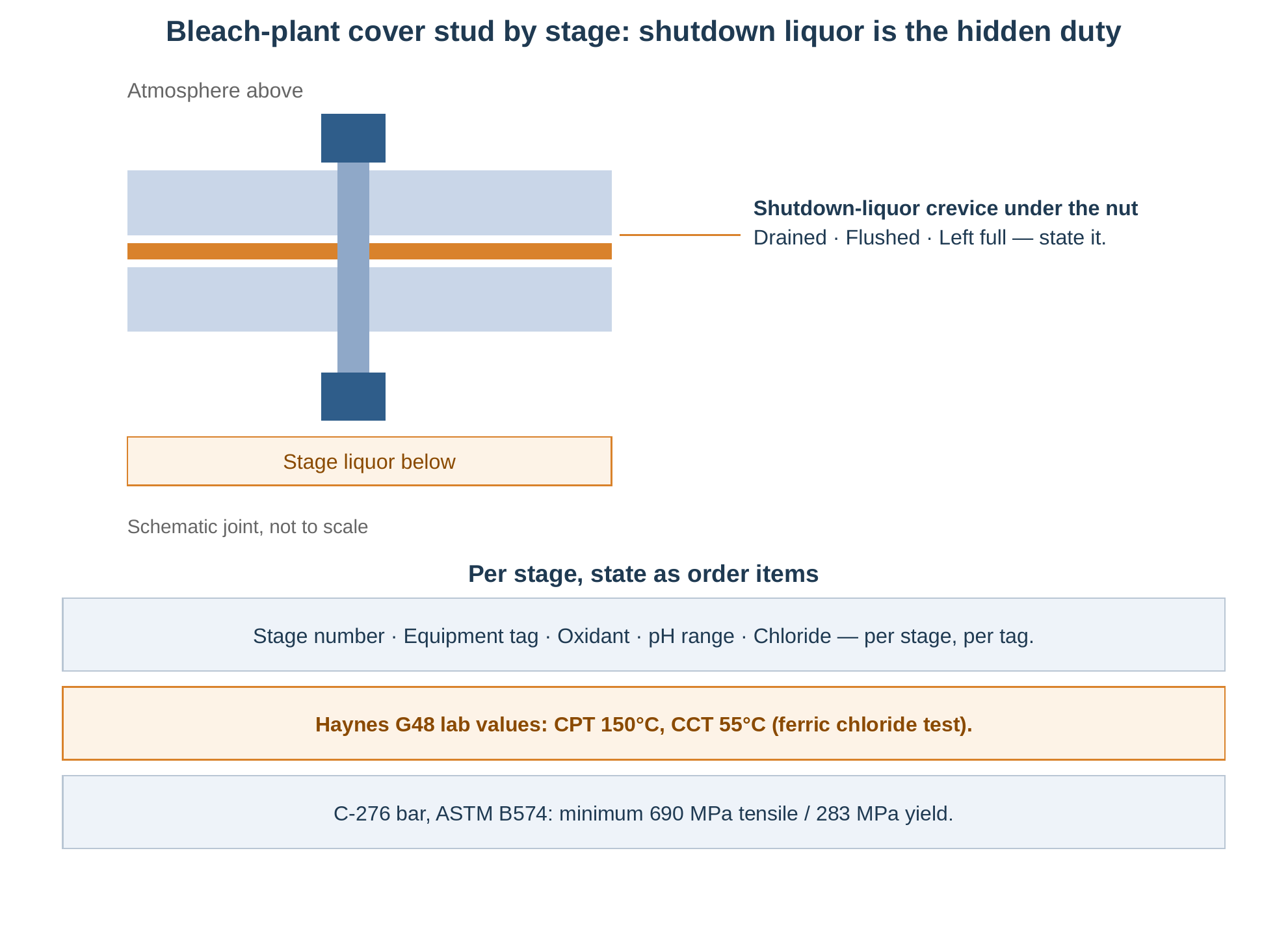
Stages and what reaches the studs
Bleaching runs in stages, each with its own chemical, washed between. An EPA background report on pulp bleaching lists the usual chemicals as chlorine, chlorine dioxide, hypochlorite, oxygen and peroxides, and notes that the alkaline extraction stage should end above pH 10.8. Sequences are written by stage letter: D(EOP)D, for example, is chlorine dioxide, then extraction reinforced with oxygen and peroxide, then chlorine dioxide again.
A D-stage cover and an E-stage cover are therefore different orders. For each cover, give:
- stage letter and equipment tag
- pH range and chloride
- whether residual chlorine dioxide or another oxidant reaches the studs, and at what concentration
- operating temperature, and the temperature after shutdown
- whether the equipment is a tower, washer hood, filtrate tank or mixer
Shutdown liquor
While the stage runs, liquor moves and is diluted with wash water. When it stops, liquor stays in the crevices under the nuts and in the threads of hood and manway bolting. As it dries, chloride and residual acid concentrate, and the bolts sit in that residue for the length of the outage.
State whether each cover is drained, flushed with fresh water, or left full at shutdown, and how long typical outages last. Acidic chloride residue from a D stage and alkaline residue from an E stage attack different grades. A cover flushed at every stop can often stay in a lower grade than one left full.
Choosing the grade by stage
Where the measured conditions support its use, see Titanium Grade 2 material information.
| Candidate | UNS | Where it fits bleach plant covers | Limit to check |
|---|---|---|---|
| Titanium Grade 2 | R50400 | D-stage hoods, mixers and towers with residual chlorine dioxide | Reducing acid, fluoride or alkaline peroxide; lower strength |
| Hastelloy C-22 | N06022 | Oxidizing acidic chloride where titanium doesn't suit, confirmed by plant data | Transpassive corrosion in chlorine dioxide above about pH 4; strength; stud size |
| Hastelloy C-276 | N10276, ASTM B574 | Acidic chloride residue with little oxidant; filtrate tanks and drains; covers left full | Residual chlorine dioxide; 283 MPa minimum yield |
| Duplex 2205 / 2507 | S32205 / S32750 | Alkaline E and P stages, dry external fixings | Crevice attack in acidic chloride |
Related references: Hastelloy C-22
Hastelloy C-276 carries 16% molybdenum, 16% chromium and 4% tungsten, according to Haynes International, which also lists ASTM G48 critical pitting and crevice temperatures of 150°C and 55°C. G48 is a ranking test in ferric chloride, not a bleach-plant limit, and it says nothing about chlorine dioxide. In acidic chloride residue without an active oxidant, C-276 is a strong choice; where chlorine dioxide is present, its high molybdenum and moderate chromium work against it.
Alloy 20 also appears in many acid plants, but bleach liquor is a chloride and oxidant problem more than a sulfuric acid one (Alloy 20 vs Hastelloy).
Outage records by stage
Pair C-276 studs with C-276 heavy hex nuts, and C-22 or titanium studs with nuts of the same alloy. Where hood or tower covers use studs screwed into a cast or welded boss, C-276 double-end studs give the tap end in the boss the same corrosion resistance as the exposed nut end, instead of a lower-grade stud screwed into the boss. Use an anti-seize suited to oxidizing service.
At each outage, record by stage and tag which studs lost thread under the nut and which nuts seized. Studs that fail only where chlorine dioxide reaches them need a different alloy; studs that fail on covers left full need a different shutdown practice as much as a different grade.
| Confirm before ordering | Why it matters | Document to ask for |
|---|---|---|
| Stage letter and equipment tag | D, E, P and H stages need different grades | Bleach sequence, equipment list |
| Residual chlorine dioxide at the studs (concentration or ORP) | Drives the assessment of titanium or C-22 versus C-276 | Stage datasheet |
| pH and chloride at the cover | Decides nickel alloy versus duplex | Stage datasheet |
| Shutdown procedure and outage length | Outage residue does the most damage | Shutdown procedure |
| Stud size against bolt circle and gasket load | C-276 has a low yield | Cover drawing |
Requesting a quote
List the covers by stage and tag, for example: "M20 stud and nut sets for D1 stage filtrate tank cover and washer hood, tags 41-T-102 and 41-W-103, pH 3–4, 70°C, residual chlorine dioxide at the hood only, tank left full during monthly outages."
Expect a grade per tag, which on that example would likely be different for the hood and the tank, and a price for C-276 stud and nut sets or the alternative. Bleach plant bolting sits alongside digester and evaporator bolting on our pulp and paper page.